
PencilGo

Grade 4 · Science · Life science

4th Grade How Animals Sense the World worksheets

6 printable versionsChallenge MeAbout 6 minutes eachFree · no account

When it’s done, scan the sheet with your phone and PencilGo marks it and picks the next one. Create a free account

★
Version
Print

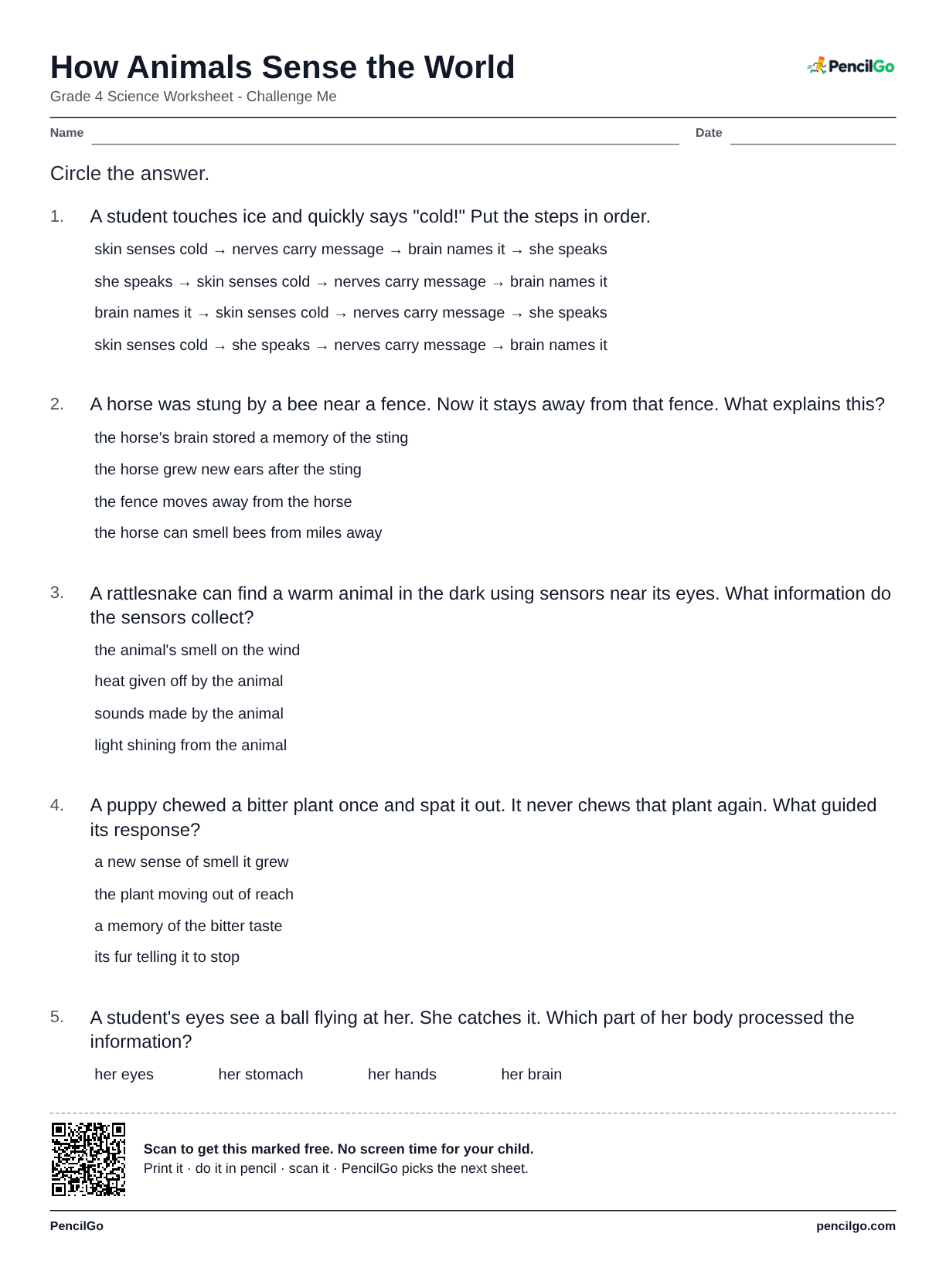
How Animals Sense the World

Grade 4 Science Worksheet - Challenge Me

NameDate

Circle the answer.

  1. A student touches ice and quickly says "cold!" Put the steps in order.

    • skin senses cold → nerves carry message → brain names it → she speaks
    • she speaks → skin senses cold → nerves carry message → brain names it
    • brain names it → skin senses cold → nerves carry message → she speaks
    • skin senses cold → she speaks → nerves carry message → brain names it
  2. A horse was stung by a bee near a fence. Now it stays away from that fence. What explains this?

    • the horse's brain stored a memory of the sting
    • the horse grew new ears after the sting
    • the fence moves away from the horse
    • the horse can smell bees from miles away
  3. A rattlesnake can find a warm animal in the dark using sensors near its eyes. What information do the sensors collect?

    • the animal's smell on the wind
    • heat given off by the animal
    • sounds made by the animal
    • light shining from the animal
  4. A puppy chewed a bitter plant once and spat it out. It never chews that plant again. What guided its response?

    • a new sense of smell it grew
    • the plant moving out of reach
    • a memory of the bitter taste
    • its fur telling it to stop
  5. A student's eyes see a ball flying at her. She catches it. Which part of her body processed the information?

    • her eyes
    • her stomach
    • her hands
    • her brain
PencilGopencilgo.com

4th Grade How Animals Sense the World worksheet 1 – printable PDF
Download PDF: 123456

About this worksheet

Animal senses show how information from the environment is received, processed, and used for a response asks fourth graders to connect observations with an explanation, model, or design decision instead of choosing a fact from memory. Students may stop at the sense organ and forget that the brain processes information before the animal reacts. This worksheet uses short investigations and evidence-based situations so students must read what happened, decide which science idea is being tested, and choose the answer that fits the title. Students trace sense information, identify the response, model brain processing, and connect animal behavior to evidence from the environment.

Support versions use familiar objects and direct wording. Standard and challenge versions add closer distractors, fair-test language, and multi-step evidence. Ask your child to point to the measurement, diagram, map, or observation before answering. If the choice does not explain the evidence in the prompt, it is probably a distractor. That habit keeps science reasoning tied to data rather than guesswork.

What your child will learn

  • Trace information from senses to the brain
  • Connect sensory information to behavior
  • Model animal responses
  • Use evidence from the environment

NGSS standard: 4-LS1-2

Worked example

A deer hears crackling leaves, the brain treats the sound as possible danger, and the deer runs away.

Common mistake

Choosing a body change that is not an immediate response to the sensed information.

Helpful hint

Follow the path: sense information, brain processing, response.

Questions parents ask

What is the most common mistake with how animals sense the world?

Choosing a body change that is not an immediate response to the sensed information.

How can I help my child with how animals sense the world?

Follow the path: sense information, brain processing, response.

Are these 4th grade science worksheets free to print?

Yes. All 6 printable versions on this page are free to download and print, with no account needed.

Similar: Structures for Survival

More 4th grade life science

See all life science

Every sheet you scan goes into your child’s record: dated, marked and ready for the year-end portfolio. Homeschool records