PencilGo

Grade 4 · Social Studies · Civics

4th Grade Three Branches of Government worksheets

6 printable versionsChallenge MeAbout 6 minutes eachFree · no account

When it’s done, scan the sheet with your phone and PencilGo marks it and picks the next one. Create a free account

★
Version
Print

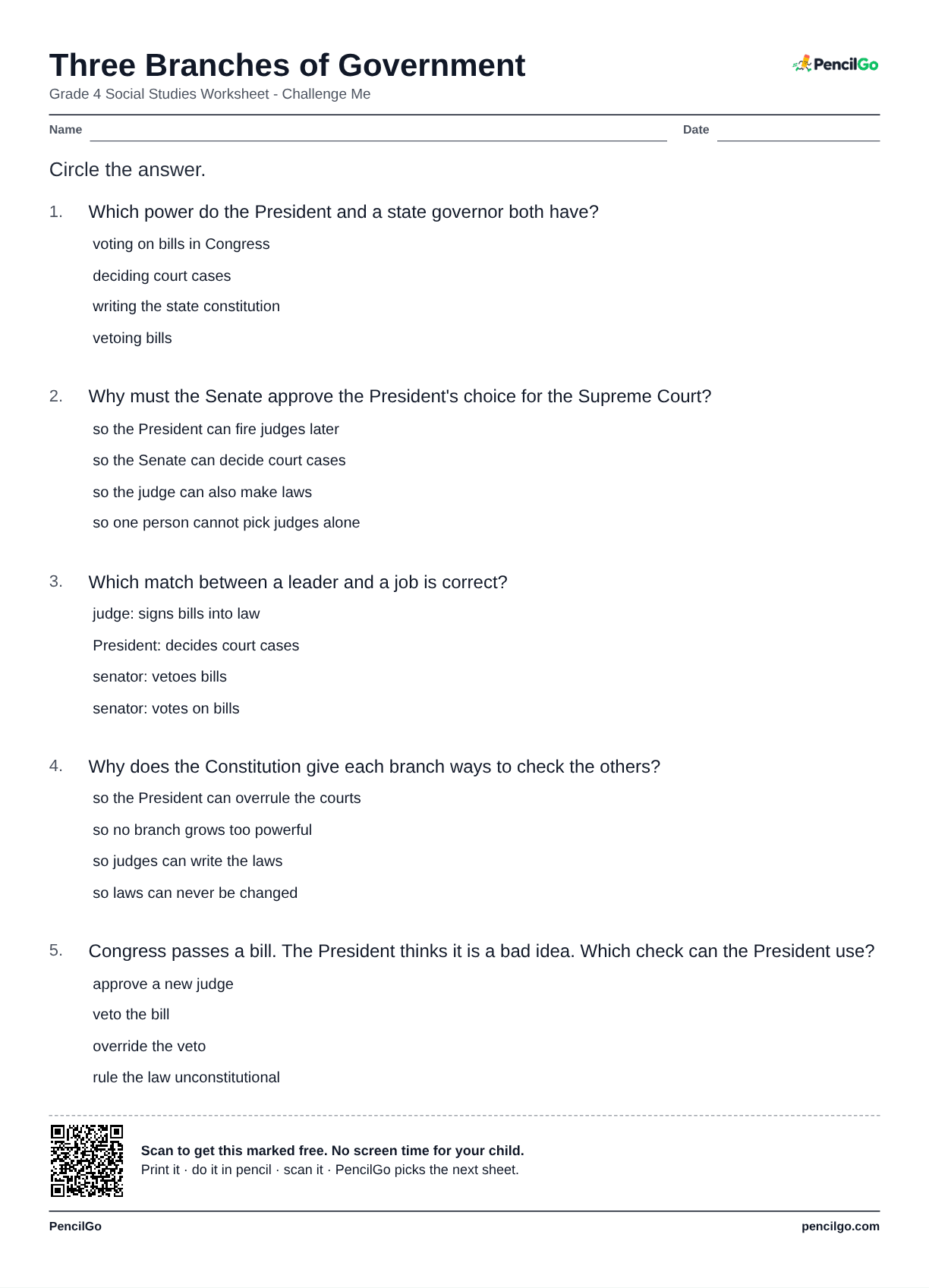
Three Branches of Government

Grade 4 Social Studies Worksheet - Challenge Me

NameDate

Circle the answer.

  1. Which power do the President and a state governor both have?

    • voting on bills in Congress
    • deciding court cases
    • writing the state constitution
    • vetoing bills
  2. Why must the Senate approve the President's choice for the Supreme Court?

    • so the President can fire judges later
    • so the Senate can decide court cases
    • so the judge can also make laws
    • so one person cannot pick judges alone
  3. Which match between a leader and a job is correct?

    • judge: signs bills into law
    • President: decides court cases
    • senator: vetoes bills
    • senator: votes on bills
  4. Why does the Constitution give each branch ways to check the others?

    • so the President can overrule the courts
    • so no branch grows too powerful
    • so judges can write the laws
    • so laws can never be changed
  5. Congress passes a bill. The President thinks it is a bad idea. Which check can the President use?

    • approve a new judge
    • veto the bill
    • override the veto
    • rule the law unconstitutional
PencilGopencilgo.com

4th Grade Three Branches of Government worksheet 1 – printable PDF
Download PDF: 123456

About this worksheet

Three branches of government separate lawmaking, law enforcement, and legal interpretation so no one part holds all power asks fourth graders to use civic, geographic, historical, or economic evidence instead of choosing a familiar-sounding word. Students often memorize legislative, executive, and judicial as a list but then mix up which branch makes laws, carries them out, or interprets them. This worksheet keeps each question tied to a concrete classroom, community, map, source, or market situation so students must decide what the evidence shows. Students match each branch to its role, identify actions by branch, connect checks and balances to concrete examples, and explain why separated powers matter.

Support versions use close-to-home examples and direct wording. Standard and challenge versions add similar choices that require closer reading of the role, location, source, or tradeoff. Ask your child to underline the clue in the prompt before choosing. If an option is true in general but does not match the exact situation, it is probably a distractor. That habit builds the evidence reading needed for later history and civics work.

What your child will learn

  • Identify the three branches
  • Match branches to roles
  • Recognize checks and balances
  • Use civic examples

C3 Framework standard: D2.Civ.1.3-5

Worked example

If representatives vote on a bill, the legislative branch is working because it makes laws.

Common mistake

Choosing the branch whose name sounds familiar instead of reading what the official action does.

Helpful hint

Ask whether the action makes a law, carries out a law, or interprets a law.

Questions parents ask

What is the most common mistake with three branches of government?

Choosing the branch whose name sounds familiar instead of reading what the official action does.

How can I help my child with three branches of government?

Ask whether the action makes a law, carries out a law, or interprets a law.

Are these 4th grade social studies worksheets free to print?

Yes. All 6 printable versions on this page are free to download and print, with no account needed.

Similar: State and Local Government · Rights of Citizens

More 4th grade civics

See all civics

Every sheet you scan goes into your child’s record: dated, marked and ready for the year-end portfolio. Homeschool records