
PencilGo

Grade 4 · Social Studies · History

4th Grade Primary and Secondary Sources worksheets

6 printable versionsBuilding ConfidenceAbout 4 minutes eachFree · no account

When it’s done, scan the sheet with your phone and PencilGo marks it and picks the next one. Create a free account

★
Version
Print

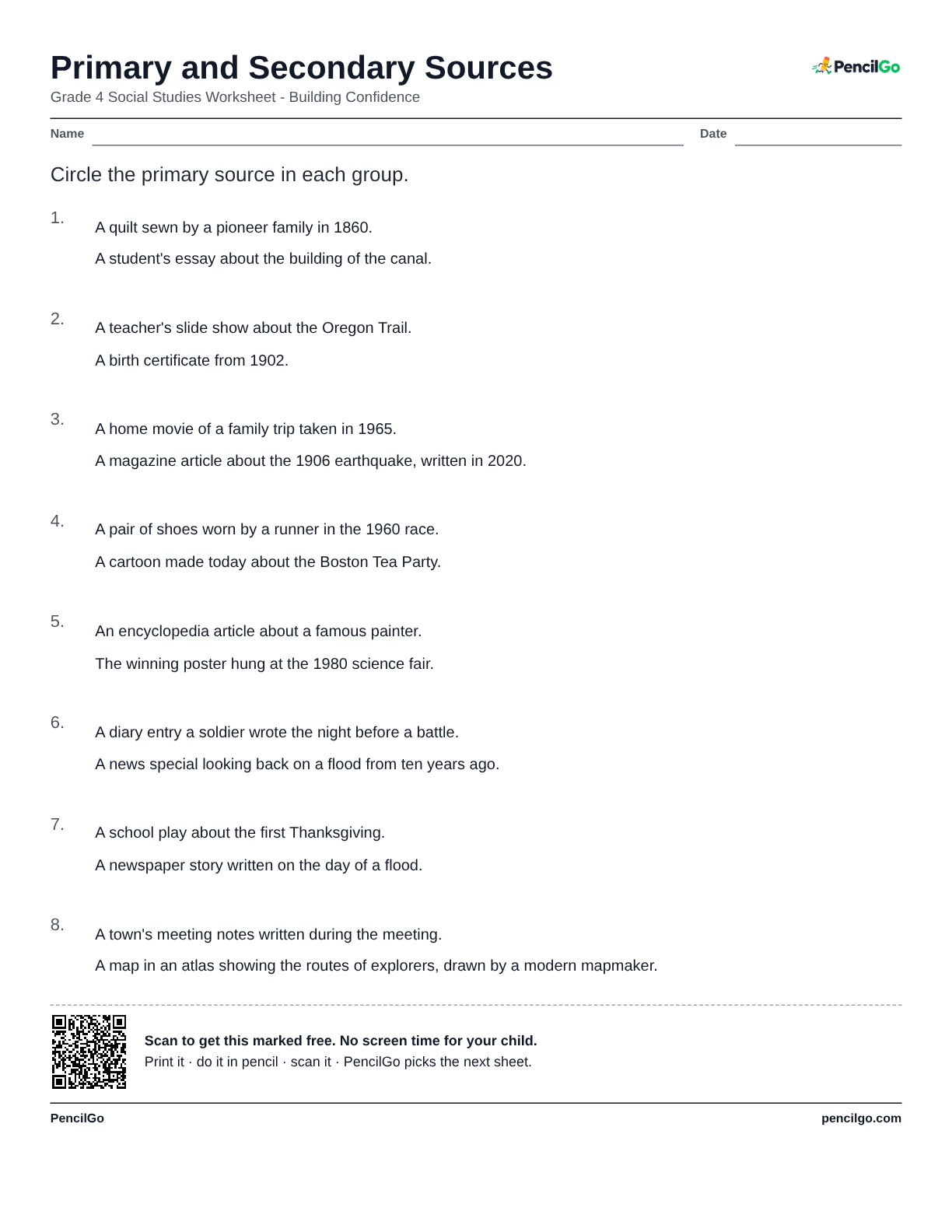
Primary and Secondary Sources

Grade 4 Social Studies Worksheet - Building Confidence

NameDate

Circle the primary source in each group.

    • A quilt sewn by a pioneer family in 1860.
    • A student's essay about the building of the canal.
    • A teacher's slide show about the Oregon Trail.
    • A birth certificate from 1902.
    • A home movie of a family trip taken in 1965.
    • A magazine article about the 1906 earthquake, written in 2020.
    • A pair of shoes worn by a runner in the 1960 race.
    • A cartoon made today about the Boston Tea Party.
    • An encyclopedia article about a famous painter.
    • The winning poster hung at the 1980 science fair.
    • A diary entry a soldier wrote the night before a battle.
    • A news special looking back on a flood from ten years ago.
    • A school play about the first Thanksgiving.
    • A newspaper story written on the day of a flood.
    • A town's meeting notes written during the meeting.
    • A map in an atlas showing the routes of explorers, drawn by a modern mapmaker.
PencilGopencilgo.com

4th Grade Primary and Secondary Sources worksheet 1 – printable PDF
Download PDF: 123456

About this worksheet

Primary and secondary sources help students judge how a piece of evidence connects to an event in the past asks fourth graders to use civic, geographic, historical, or economic evidence instead of choosing a familiar-sounding word. Students may choose the source with the most polished writing instead of asking when it was created, who created it, and whether it gives direct evidence or later explanation. This worksheet keeps each question tied to a concrete classroom, community, map, source, or market situation so students must decide what the evidence shows. Students classify sources, identify clues about timing and authorship, compare direct records with later accounts, and choose evidence for historical claims.

Support versions use close-to-home examples and direct wording. Standard and challenge versions add similar choices that require closer reading of the role, location, source, or tradeoff. Ask your child to underline the clue in the prompt before choosing. If an option is true in general but does not match the exact situation, it is probably a distractor. That habit builds the evidence reading needed for later history and civics work.

What your child will learn

  • Identify primary sources
  • Identify secondary sources
  • Use source clues
  • Compare historical evidence

C3 Framework standard: D2.His.9.3-5

Worked example

A ticket from opening day is primary evidence for the event; an article written years later is secondary.

Common mistake

Calling a source secondary only because it is easier to read.

Helpful hint

Ask whether the source was made at the time or later to explain the event.

Questions parents ask

What is the most common mistake with primary and secondary sources?

Calling a source secondary only because it is easier to read.

How can I help my child with primary and secondary sources?

Ask whether the source was made at the time or later to explain the event.

Are these 4th grade social studies worksheets free to print?

Yes. All 6 printable versions on this page are free to download and print, with no account needed.

Similar: Timelines · Native Nations and Their Lands

More 4th grade history

See all history

Every sheet you scan goes into your child’s record: dated, marked and ready for the year-end portfolio. Homeschool records