


PencilGo

Grade 4 · Spelling · Spelling rules

4th Grade Doubling Before an Ending worksheets

6 printable versionsChallenge MeAbout 8 minutes eachFree · no account

When it’s done, scan the sheet with your phone and PencilGo marks it and picks the next one. Create a free account

★
Version
Print

Doubling Before an Ending

Grade 4 Spelling Worksheet - Challenge Me

NameDate

Circle the rule that explains each spelling.

  1. "visit" + -ed = "visited". Which rule explains this spelling?

    • Always double the last letter before -ed.
    • "visit" ends in a silent e, so drop the e and add -ed.
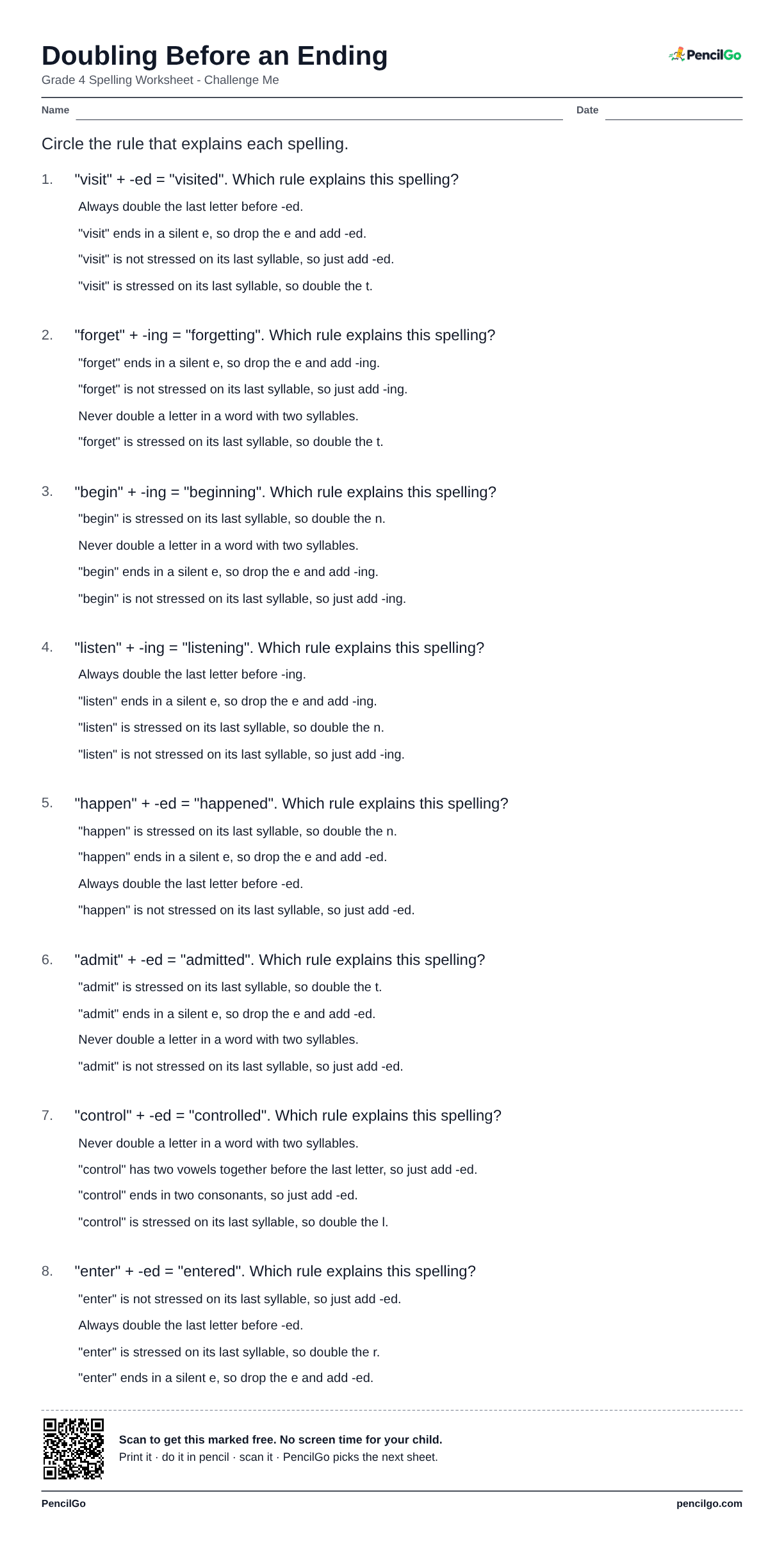
    • "visit" is not stressed on its last syllable, so just add -ed.
    • "visit" is stressed on its last syllable, so double the t.
  2. "forget" + -ing = "forgetting". Which rule explains this spelling?

    • "forget" ends in a silent e, so drop the e and add -ing.
    • "forget" is not stressed on its last syllable, so just add -ing.
    • Never double a letter in a word with two syllables.
    • "forget" is stressed on its last syllable, so double the t.
  3. "begin" + -ing = "beginning". Which rule explains this spelling?

    • "begin" is stressed on its last syllable, so double the n.
    • Never double a letter in a word with two syllables.
    • "begin" ends in a silent e, so drop the e and add -ing.
    • "begin" is not stressed on its last syllable, so just add -ing.
  4. "listen" + -ing = "listening". Which rule explains this spelling?

    • Always double the last letter before -ing.
    • "listen" ends in a silent e, so drop the e and add -ing.
    • "listen" is stressed on its last syllable, so double the n.
    • "listen" is not stressed on its last syllable, so just add -ing.
  5. "happen" + -ed = "happened". Which rule explains this spelling?

    • "happen" is stressed on its last syllable, so double the n.
    • "happen" ends in a silent e, so drop the e and add -ed.

    • Always double the last letter before -ed.
    • "happen" is not stressed on its last syllable, so just add -ed.
  6. "admit" + -ed = "admitted". Which rule explains this spelling?

    • "admit" is stressed on its last syllable, so double the t.
    • "admit" ends in a silent e, so drop the e and add -ed.

    • Never double a letter in a word with two syllables.
    • "admit" is not stressed on its last syllable, so just add -ed.
  7. "control" + -ed = "controlled". Which rule explains this spelling?

    • Never double a letter in a word with two syllables.
    • "control" has two vowels together before the last letter, so just add -ed.
    • "control" ends in two consonants, so just add -ed.
    • "control" is stressed on its last syllable, so double the l.
  8. "enter" + -ed = "entered". Which rule explains this spelling?

    • "enter" is not stressed on its last syllable, so just add -ed.
    • Always double the last letter before -ed.
    • "enter" is stressed on its last syllable, so double the r.
    • "enter" ends in a silent e, so drop the e and add -ed.
PencilGopencilgo.com

4th Grade Doubling Before an Ending worksheet 1 – printable PDF
Download PDF: 123456

About this worksheet

Doubling before an ending protects the short vowel sound in consonant-vowel-consonant words, and in longer words stressed on the last syllable matters in fourth grade because spelling work now connects word meaning, word parts, and editing accuracy. Fourth graders may write hoping when they mean hopping, or double letters in words like jumping, raining, or visiting where the rule does not apply. This worksheet keeps the focus on one spelling pattern at a time, and every wrong choice is a mistake a real speller might make, so children cannot get credit by ruling out silly answers.

Students spell words with -ing, -ed, -er, and -est, choose the rule that explains a spelling, find the base word, and decide when not to double. Support versions use more familiar words and fewer choices. Standard versions add harder words, and challenge versions add longer words and the cases where the pattern does not apply. Ask your child to say the word, mark the meaningful part or spelling change, and then check whether the written form still matches the meaning. That process is slower than guessing, but it builds spelling habits that transfer to real writing.

What your child will learn

  • Double the final consonant after one short vowel
  • Do not double after two consonants, two vowels, or a final w or x
  • Double in longer words only when the last syllable is stressed
  • Find the base word before adding an ending

Common Core standard: L.4.2.D

Worked example

Hop becomes hopping because hop has one short vowel and ends in one consonant. Jump becomes jumping because it already ends in two consonants.

Common mistake

Dropping the doubled consonant and accidentally making a different word, such as hoping.

Helpful hint

Check the base word's last three letters before adding the ending.

Questions parents ask

What is the most common mistake with doubling before an ending?

Dropping the doubled consonant and accidentally making a different word, such as hoping.

How can I help my child with doubling before an ending?

Check the base word's last three letters before adding the ending.

Are these 4th grade spelling worksheets free to print?

Yes. All 6 printable versions on this page are free to download and print, with no account needed.

Similar: Drop the E, Add -ing · Change Y to I

More 4th grade spelling rules

See all spelling rules

Every sheet you scan goes into your child’s record: dated, marked and ready for the year-end portfolio. Homeschool records