Predict about a whole group from a sample
Grade 7 Math Worksheet - Challenge Me

Circle the best answer, or write your answer on the line.
Ari took four random samples of 15 students each from 360 students. Nobody read the survey upside down. Using all four samples together, about how many of the 360 students read a book yesterday?
Read this first
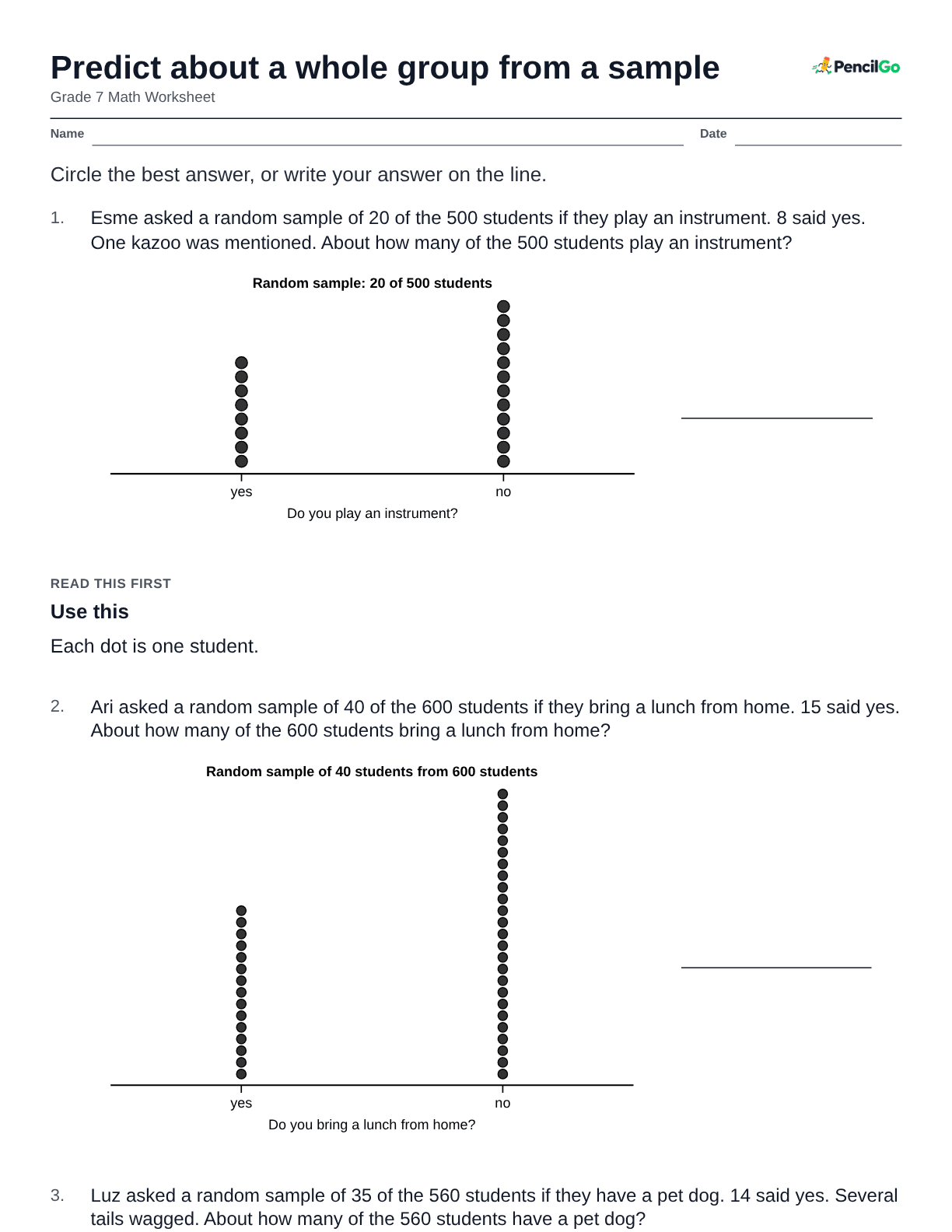
Use this
Four random samples of 20 students each, taken from 240 students, were asked "Do you plan to join the science fair?" Sample A: 9 yes, 11 no; Sample B: 7 yes, 13 no; Sample C: 8 yes, 12 no; Sample D: 8 yes, 12 no.
Luz took four random samples of 20 students each from 240 students. A rocket was rumored. Using all four samples together, about how many of the 240 students plan to join the science fair?
Tala took four random samples of 20 students each from 280 students. The bin stayed neat. Scale the lowest and highest samples up to all 280. How far apart are the two predictions?
Jun took four random samples of 30 students each from 420 students. One kazoo was mentioned. Scale the lowest and highest samples up to all 420. How far apart are the two predictions?
Use this
Four random samples of 20 students each, taken from 360 students, were asked "Do you ride the bus?" Sample A: 8 yes, 12 no; Sample B: 12 yes, 8 no; Sample C: 9 yes, 11 no; Sample D: 10 yes, 10 no.
Pia took four random samples of 20 students each from 360 students. The bus stayed on time. Scale the lowest and highest samples up to all 360. How far apart are the two predictions?
Use this
Four random samples of 20 students each, taken from 540 students, were asked "Do you bring a lunch from home?" Sample A: 6 yes, 14 no; Sample B: 11 yes, 9 no; Sample C: 8 yes, 12 no; Sample D: 9 yes, 11 no.
Bo took four random samples of 20 students each from 540 students. A sandwich was well packed. Scale the lowest and highest samples up to all 540. How far apart are the two predictions?
Milo took four random samples of 20 students each from 400 students. Several tails wagged. Which conclusion about all 400 students do the samples support?
- The samples suggest about 100 of the 400 students have a pet dog; it is only a guess, not proof.
- The samples suggest between 100 and 180 of the 400 students have a pet dog; it is only a guess, not proof.
- The samples suggest between 5 and 9 of the 400 students have a pet dog, using the counts in the samples; it is only a guess, not proof.
- The samples suggest exactly 140 of the 400 students have a pet dog; it is only a guess, not proof.
Zee took four random samples of 20 students each from 320 students. A bell rang twice. Which conclusion about all 320 students do the samples support?
- The samples suggest between 112 and 176 of the 320 students own a bike; it is only a guess, not proof.
- The samples suggest between 7 and 11 of the 320 students own a bike, using the counts in the samples; it is only a guess, not proof.
- The samples suggest about 112 of the 320 students own a bike; it is only a guess, not proof.
- The samples suggest exactly 144 of the 320 students own a bike; it is only a guess, not proof.
Use this
Four random samples of 30 students each, taken from 450 students, were asked "Did you read a book yesterday?" Sample A: 10 yes, 20 no; Sample B: 14 yes, 16 no; Sample C: 12 yes, 18 no; Sample D: 12 yes, 18 no.
Kira took four random samples of 30 students each from 450 students. Nobody read the survey upside down. Which conclusion about all 450 students do the samples support?
- The samples suggest between 150 and 210 of the 450 students read a book yesterday; it is only a guess, not proof.
- The samples suggest between 10 and 14 of the 450 students read a book yesterday, using the counts in the samples; it is only a guess, not proof.
- The samples suggest about 150 of the 450 students read a book yesterday; it is only a guess, not proof.
- The samples suggest exactly 180 of the 450 students read a book yesterday; it is only a guess, not proof.
Four random samples of 15 students each, taken from 360 students, were asked "Do you like the new playground?" Ren took four random samples of 15 students each from 360 students. The swings kept swinging. Which conclusion about all 360 students do the samples support?
- The samples suggest between 5 and 8 of the 360 students like the new playground; it is only a guess, not proof.
- The samples suggest about 120 of the 360 students like the new playground; it is only a guess, not proof.
- The samples suggest between 120 and 192 of the 360 students like the new playground; it is only a guess, not proof.
- The samples suggest exactly 150 of the 360 students like the new playground; it is only a guess, not proof.