Random samples from a known group
Grade 8 Math Worksheet - Building Confidence

Circle the best answer, or write your answer on the line.
Each sample is drawn without looking; return all counters before the next. Bo has a bag with 3 blue counters out of 10. Bo draws 4 random samples of 5, returning all counters each time. About how many blue draws would match the bag's makeup?
4 blue dots and 6 yellow dots. Each sample is drawn without looking; return all counters before the next. Esme has a bag with 4 blue counters out of 10. Esme draws 5 random samples of 6, returning all counters each time. About how many blue draws would match the bag's makeup?
Luz has a bag with 8 blue counters out of 10. Luz draws 4 random samples of 5, returning all counters each time. About how many blue draws would match the bag's makeup?
7 blue dots and 5 yellow dots. Each sample is drawn without looking; return all counters before the next. Milo has a bag with 7 blue counters out of 12. Milo draws 4 random samples of 6, returning all counters each time. About how many blue draws would match the bag's makeup?
Each sample is drawn without looking; return all counters before the next. Noah has a bag with 3 blue counters out of 10. Noah draws 6 random samples of 5, returning all counters each time. About how many blue draws would match the bag's makeup?
4 blue dots and 6 yellow dots. Each sample is drawn without looking; return all counters before the next. Pia has a bag with 4 blue counters out of 10. Pia draws 6 random samples of 5, returning all counters each time. About how many blue draws would match the bag's makeup?
7 blue dots and 3 yellow dots. Each sample is drawn without looking; return all counters before the next. Tala has a bag with 7 blue counters out of 10. Tala draws 6 random samples of 5, returning all counters each time. About how many blue draws would match the bag's makeup?
Zee has a bag with 8 blue counters out of 10. Zee draws 6 random samples of 5, returning all counters each time. About how many blue draws would match the bag's makeup?
Read this first
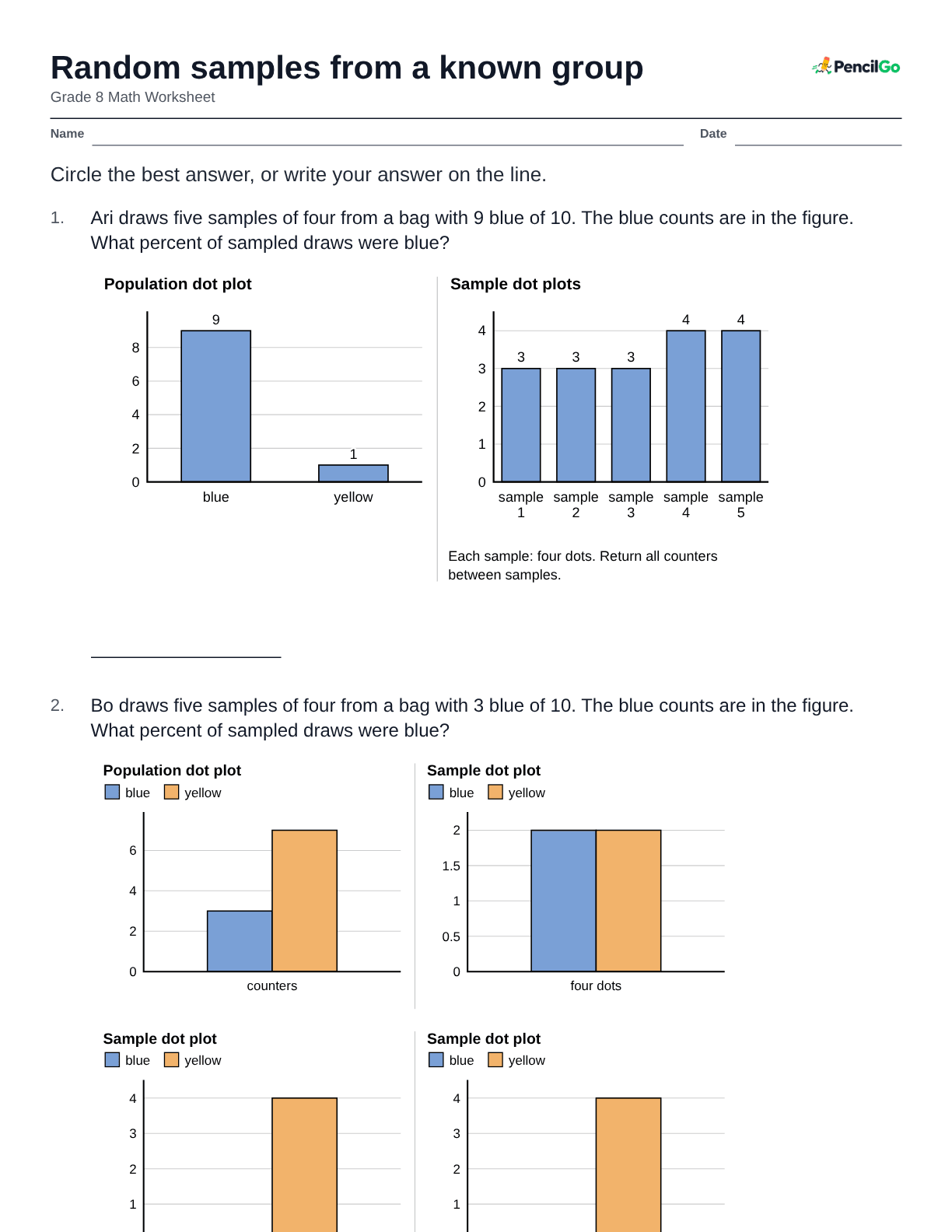
Population dot plot
5 blue, 5 yellow. Four five-dot sample plots have blue counts 2, 3, 1, 3. Draw without looking and return all counters between samples.
Ari draws four random samples of five counters from a known bag with 5 blue of 10. Which statement best describes how the samples represent the bag?
- Different blue counts prove the drawing method was unfair.
- Only the first sample tells us the bag’s blue share.
- The samples differ, but their combined blue share is near the bag’s blue share.
- Equal-size random samples must have the same blue count, as they come from one bag.
Jun draws four random samples of five counters from a known bag with 7 blue of 10. Which statement best describes how the samples represent the bag?
- Different blue counts prove the drawing method was unfair.
- The samples differ, but their combined blue share is near the bag’s blue share.
- Only the first sample tells us the bag’s blue share.
- Equal-size random samples must have the same blue count.