

PencilGo

Grade 2 · Reading · Literature

2nd Grade Author's Purpose worksheets

6 printable versionsBuilding ConfidenceAbout 5 minutes eachFree · no account

When it’s done, scan the sheet with your phone and PencilGo marks it and picks the next one. Create a free account

★
Version
Print

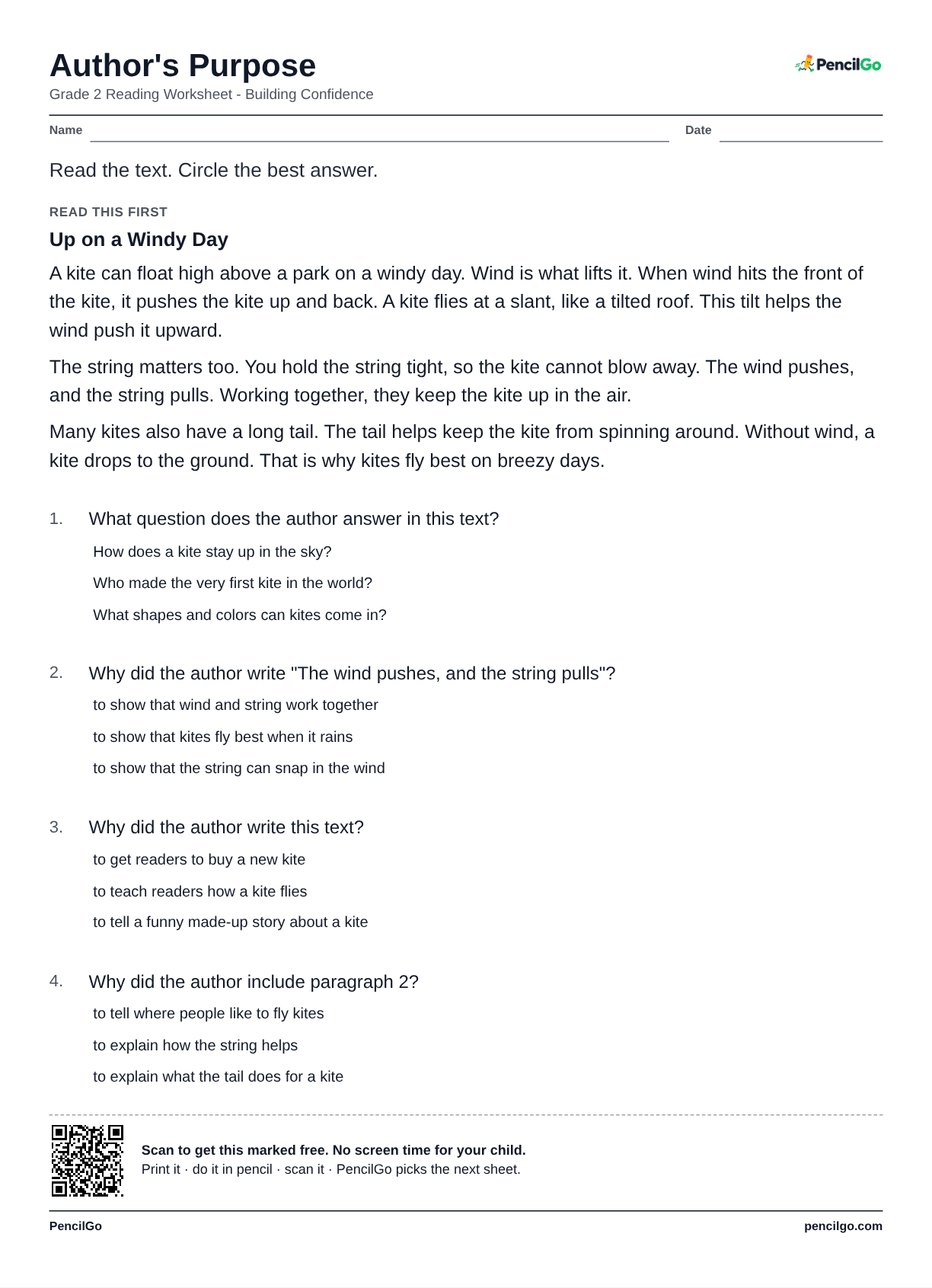
Author's Purpose

Grade 2 Reading Worksheet - Building Confidence

NameDate

Read the text. Circle the best answer.

  1. Read this first

    Up on a Windy Day

    A kite can float high above a park on a windy day. Wind is what lifts it. When wind hits the front of the kite, it pushes the kite up and back. A kite flies at a slant, like a tilted roof. This tilt helps the wind push it upward.

    The string matters too. You hold the string tight, so the kite cannot blow away. The wind pushes, and the string pulls. Working together, they keep the kite up in the air.

    Many kites also have a long tail. The tail helps keep the kite from spinning around. Without wind, a kite drops to the ground. That is why kites fly best on breezy days.

  2. What question does the author answer in this text?

    • How does a kite stay up in the sky?
    • Who made the very first kite in the world?
    • What shapes and colors can kites come in?
  3. Why did the author write "The wind pushes, and the string pulls"?

    • to show that wind and string work together
    • to show that kites fly best when it rains
    • to show that the string can snap in the wind
  4. Why did the author write this text?

    • to get readers to buy a new kite
    • to teach readers how a kite flies
    • to tell a funny made-up story about a kite
  5. Why did the author include paragraph 2?

    • to tell where people like to fly kites
    • to explain how the string helps
    • to explain what the tail does for a kite
PencilGopencilgo.com

2nd Grade Author's Purpose worksheet 1 – printable PDF
Download PDF: 123456

About this worksheet

Author's purpose asks why a writer wrote a text. In second grade, students usually work with three broad purposes: to inform, to entertain, and to persuade or give an opinion. The challenge is that a text can be interesting and still mainly inform, or it can include facts while still trying to convince the reader. This worksheet uses one text, printed once above the four questions that use it, so children practice matching the text to the writer's goal.

Students choose the purpose, identify clues, separate fact-filled explanations from opinions, and reject a purpose that does not fit. Encourage your child to ask what the author wants the reader to learn, feel, or do after reading. Watch for a child who assumes any text with true facts must only be informing, even when it also slips in a persuasive opinion.

What your child will learn

  • Identify why an author wrote a text
  • Tell informative purpose from entertainment
  • Use clues to support a purpose answer
  • Recognize opinion or persuasive purpose

Common Core standard: RI.2.6

Worked example

A text explaining how a rain gauge is used is mostly written to inform, even if the topic is interesting.

Common mistake

Choosing entertain for every text that is enjoyable to read.

Helpful hint

Ask what the author wants the reader to learn, feel, or do.

Questions parents ask

What is the most common mistake with author's purpose?

Choosing entertain for every text that is enjoyable to read.

How can I help my child with author's purpose?

Ask what the author wants the reader to learn, feel, or do.

Are these 2nd grade reading worksheets free to print?

Yes. All 6 printable versions on this page are free to download and print, with no account needed.

Similar: Characters, Setting, and Events · Story Message and Lesson

More 2nd grade literature

See all literature

Every sheet you scan goes into your child’s record: dated, marked and ready for the year-end portfolio. Homeschool records