
PencilGo

Grade 3 · Science · Life science

3rd Grade Animal Adaptations worksheets

6 printable versionsOn LevelAbout 5 minutes eachFree · no account

When it’s done, scan the sheet with your phone and PencilGo marks it and picks the next one. Create a free account

★
Version
Print

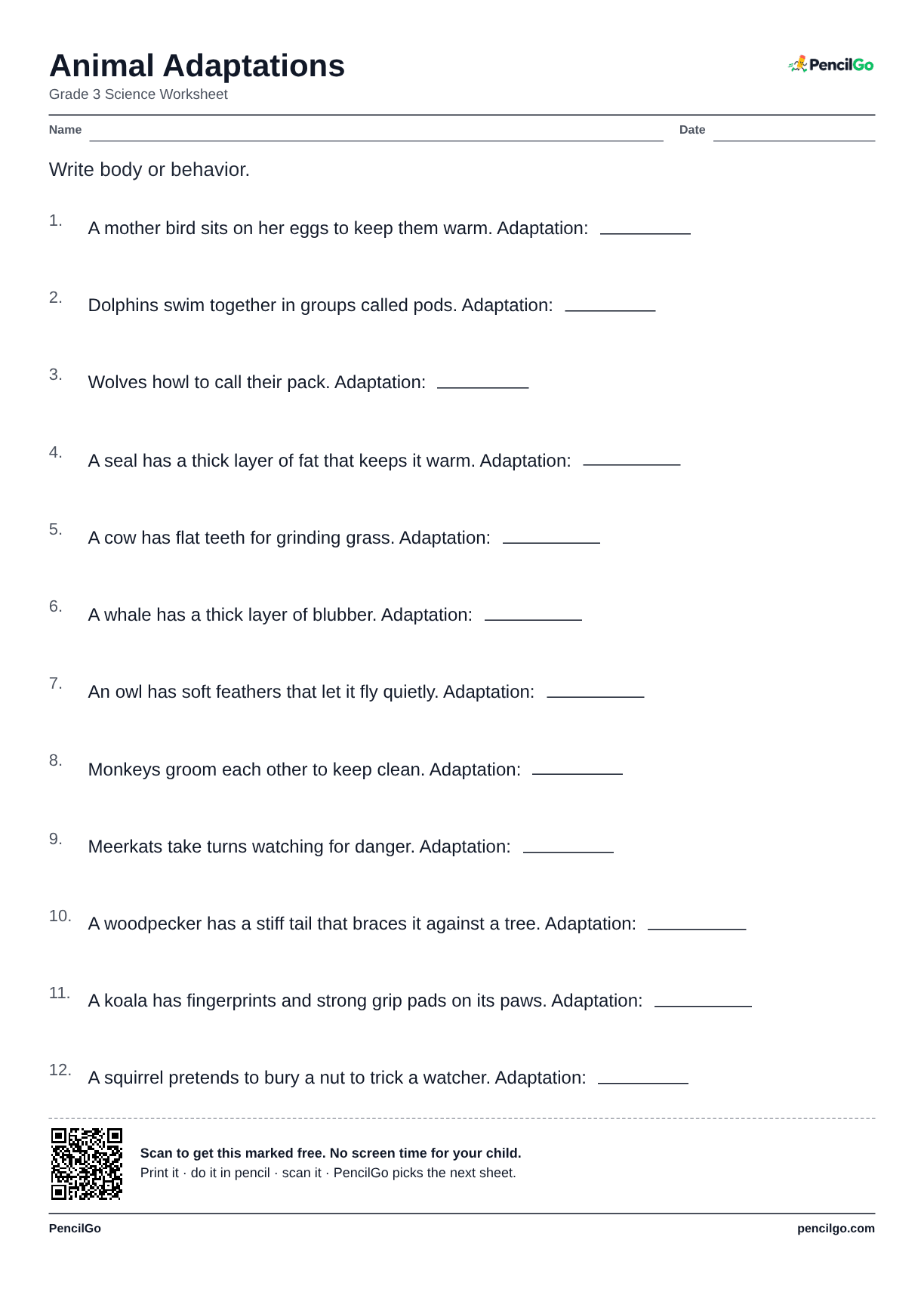
Animal Adaptations

Grade 3 Science Worksheet

NameDate

Write body or behavior.

  1. A mother bird sits on her eggs to keep them warm. Adaptation:

  2. Dolphins swim together in groups called pods. Adaptation:

  3. Wolves howl to call their pack. Adaptation:

  4. A seal has a thick layer of fat that keeps it warm. Adaptation:

  5. A cow has flat teeth for grinding grass. Adaptation:

  6. A whale has a thick layer of blubber. Adaptation:

  7. An owl has soft feathers that let it fly quietly. Adaptation:

  8. Monkeys groom each other to keep clean. Adaptation:

  9. Meerkats take turns watching for danger. Adaptation:

  10. A woodpecker has a stiff tail that braces it against a tree. Adaptation:

  11. A koala has fingerprints and strong grip pads on its paws. Adaptation:

  12. A squirrel pretends to bury a nut to trick a watcher. Adaptation:
PencilGopencilgo.com

3rd Grade Animal Adaptations worksheet 1 – printable PDF
Download PDF: 123456

About this worksheet

An adaptation is a trait that helps an animal live in its home. Some adaptations are parts of the body: a giraffe's long neck, a duck's webbed feet, a polar bear's thick fur. Others are behaviors, things an animal does: a bear sleeping through the winter, geese flying south, wolves hunting in a pack. On this worksheet your child reads twelve sentences about animals and writes body or behavior for each adaptation; the two words are in the instruction.

Building Confidence uses the most familiar animals, On Level adds less familiar ones, and Challenge Me uses cases where the reason needs more thought, such as an elephant's ears or a frog buried in mud. Ask your child whether the animal has it or does it.

What your child will learn

  • Say what an adaptation is
  • Tell a body adaptation from a behavior adaptation
  • Explain how an adaptation helps an animal survive

NGSS standard: 3-LS4-2

Worked example

A duck has webbed feet for swimming. Feet are part of its body, so it is a body adaptation. Geese flying south is something they do, so it is a behavior.

Common mistake

Calling an adaptation a behavior because it helps the animal move: webbed feet help it swim, but they are a body part.

Helpful hint

Ask: is it a part the animal has, or something the animal does?

Questions parents ask

What is the most common mistake with animal adaptations?

Calling an adaptation a behavior because it helps the animal move: webbed feet help it swim, but they are a body part.

How can I help my child with animal adaptations?

Ask: is it a part the animal has, or something the animal does?

Are these 3rd grade science worksheets free to print?

Yes. All 6 printable versions on this page are free to download and print, with no account needed.

Similar: Plant Life Cycles · Animal Life Cycles

More 3rd grade life science

See all life science

Every sheet you scan goes into your child’s record: dated, marked and ready for the year-end portfolio. Homeschool records