Decide how far to trust a source: author, purpose, audience, and a second source
Grade 8 Social Studies Worksheet

Circle the best answer.
Read this first
Use this
Card A (about 1798): "Paul Revere's letter to Jeremy Belknap". Who made it: Paul Revere himself. For whom: Jeremy Belknap, for the Massachusetts Historical Society. Why: to record what happened on his ride. Summary in our words, not a quotation: Revere had arranged lantern signals in the Old North Church. Two friends rowed him across the Charles River. With William Dawes and Samuel Prescott he warned towns. British soldiers held him, questioned him and let him go. How far can I trust it? For: Revere was there himself. Against: He wrote about 23 years later, from memory. Card B (printed 1863): "Paul Revere's Ride, a poem". Who made it: Henry Wadsworth Longfellow, a poet. For whom: readers of poetry. Why: to tell an exciting story in verse. Excerpt (Tales of a Wayside Inn, Boston, 1863, pp. 18-19 and 24): "...Hang a lantern aloft in the belfry arch / Of the North Church tower as a signal light, -- / One, if by land, and two, if by sea; / And I on the opposite shore will be, / Ready to ride and spread the alarm... ... It was two by the village clock, / When he came to the bridge in Concord town." How far can I trust it? For: It keeps the real date and towns, such as Medford and Lexington. Against: A poet wrote it 88 years later, and it never names Dawes or Prescott. Card C (today): "The Real Story of Paul Revere's Ride". Who made it: the Paul Revere House museum. For whom: visitors and readers today. Why: to tell what the records show. Summary in our words, not a quotation: The lanterns were a signal to Patriots across the river in case Revere could not leave Boston. A British patrol stopped Revere, Dawes and Prescott. Dawes and Prescott got away. Revere went back to Lexington on foot and never reached Concord. How far can I trust it? For: It is built from several of Revere's own accounts. Against: It was written long after, by people who were not there.
Who rode with Revere and is named on card A, Noah asks?
- No one; Revere rode alone
- Henry Wadsworth Longfellow
- Jeremy Belknap and Captain John Parker
- William Dawes and Samuel Prescott
By card C, who were the lanterns a signal for, Pia asks?
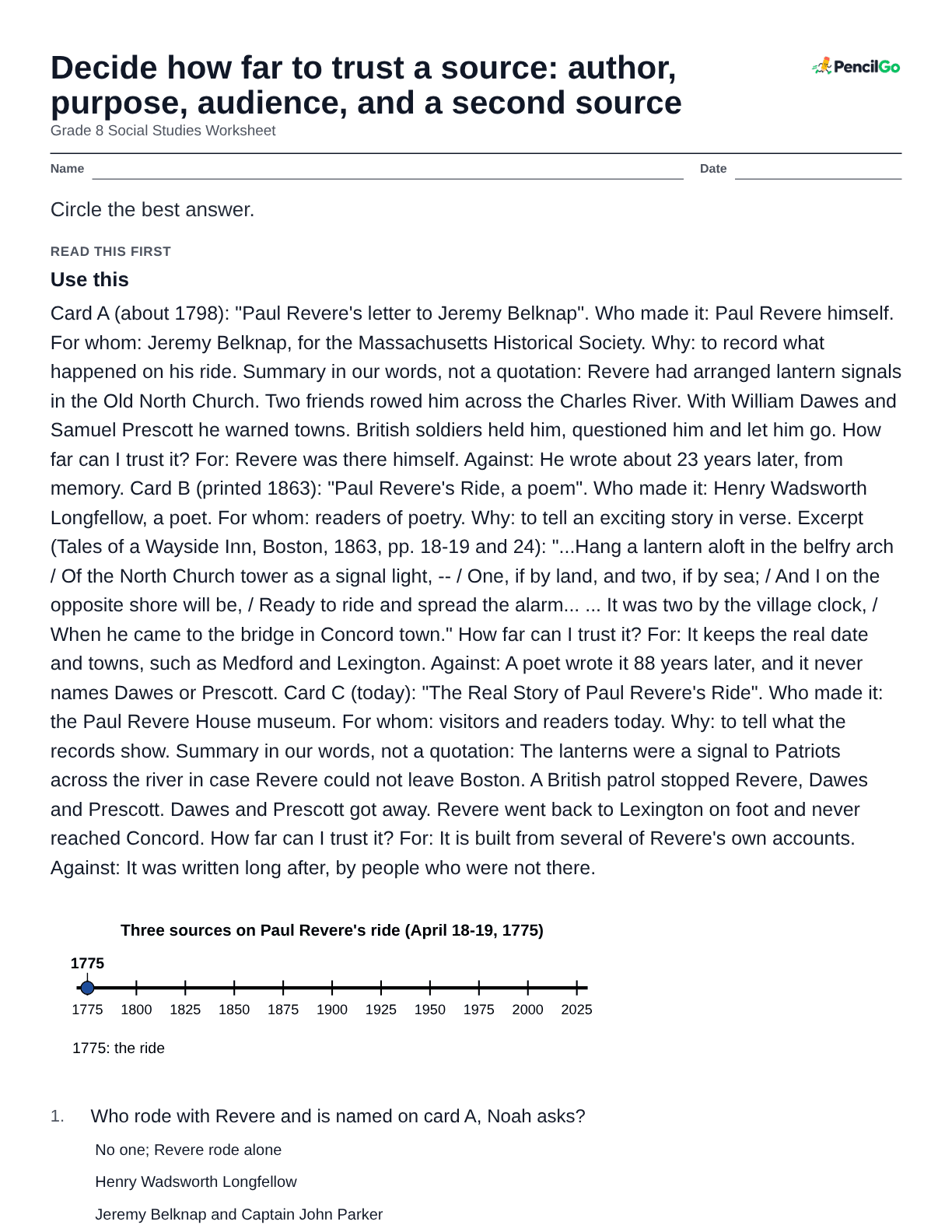
Use the picture in question 1.
- Revere, waiting on the far shore
- The people of Concord town
- Patriots across the river
- British soldiers in Boston
By card C, how did Revere's ride end, Ren asks?
Use the picture in question 1.
- At the bridge in Concord at two o'clock
- Stopped, then back to Lexington on foot
- In Philadelphia, with a letter
- In Boston, at the Old North Church
On which point do cards A and C agree, Zee asks?
Use the picture in question 1.
- Revere wrote a poem
- British soldiers stopped Revere
- Revere reached the bridge at Concord
- Revere rode alone
Why does card C give more detail than the poem, Ari asks?
Use the picture in question 1.
- It is a poem as well
- Its writers rode that night
- It uses Revere's own accounts
- It was written first
How many years after the ride was Revere's letter written, Bo asks?
Use the picture in question 1.
- About 33 years
- About 3,573 years
- About 88 years
- About 23 years
Why does the time gap matter when Jun judges card A?
Use the picture in question 1.
- A gap shows the letter is false
- The gap shows Revere was not there
- Memory can change over 23 years
- Older cards are more reliable by far
What is a reason against trusting the poem as history, Kira asks?
Use the picture in question 1.
- It uses no real towns
- Written 88 years later; names missing
- Revere wrote it himself
- It is much shorter than Revere's letter
Luz's friend says the poem is reliable because everyone knows it. What is the best reply?
Use the picture in question 1.
- Disagree: famous is not the same as true
- Agree: Longfellow rode that night
- Agree: famous poems are checked first
- Disagree: poems do not name real towns
Milo wants the most reliable source on who rode with Revere. Which card is best, and why?
Use the picture in question 1.
- Card B: it is the most famous
- Card A: Revere was there, and C agrees
- Card B: it is a poem, so it is exact
- Card C: its writers rode that night