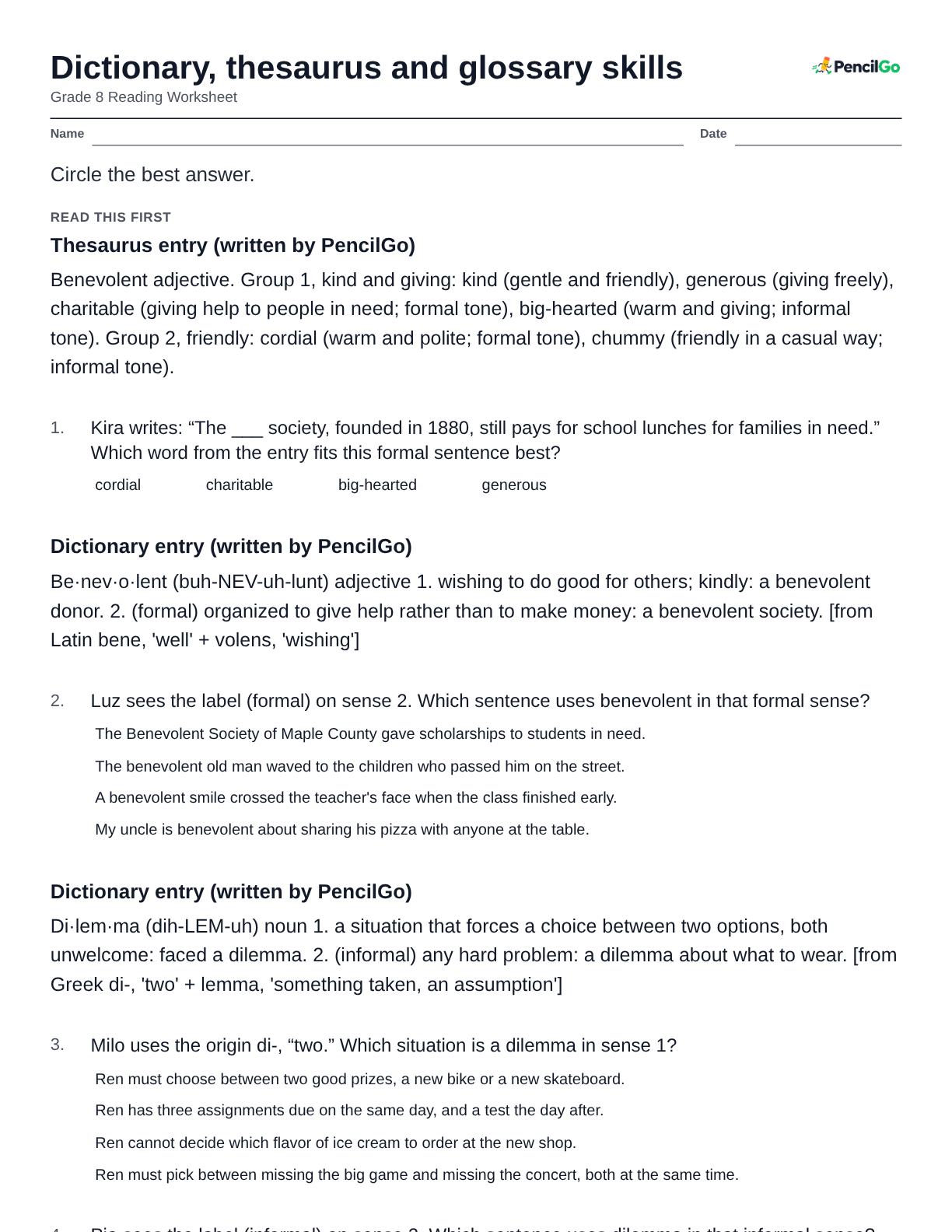
Dictionary, thesaurus and glossary skills
Grade 8 Reading Worksheet - Challenge Me

Circle the best answer.
Read this first
Four sources (written by PencilGo)
A. Pocket Dictionary of Modern English: lists the current meanings of each word, with short examples. B. Historical Dictionary of English: shows each word's meanings in the order they appeared, with dated quotations. C. Thesaurus of Everyday Words: groups words of similar meaning, such as nice, kind and pleasant. D. Style Guide for Student Writers: advice on clear, formal writing and common errors.
Ari asks: “When did nice stop meaning ‘foolish’?” Which source is the best place to start, and why?
- C. Thesaurus of Everyday Words, because it groups nice with words of similar meaning
- D. Style Guide for Student Writers, because it explains which words to avoid in formal writing
- B. Historical Dictionary of English, because its dated meanings show when each sense appeared
- A. Pocket Dictionary of Modern English, because it lists the meanings of nice in use today
Pocket Dictionary of Modern English (written by PencilGo)
Nice (nys) adjective 1. pleasant or agreeable: a nice day. 2. kind: a nice neighbor. 3. (dated) exact or fine: a nice distinction. Historical Dictionary of English (written by PencilGo): nice (nys) adjective [from Old French nice, 'silly,' from Latin nescius, 'ignorant'] c. 1300 foolish or simple. 1400s fussy, hard to please. 1500s exact or subtle: a nice point of law. 1700s pleasant or kind.
Bo reads both entries for nice. Which statement fits both?
- The “exact” sense is older than “pleasant” and survives mostly in phrases like “a nice distinction.”
- The pocket dictionary is wrong because it leaves out the old meaning “foolish” entirely.
- The label (dated) in the pocket entry shows that “exact” is not a real meaning of nice.
- The word first meant “pleasant” in the 1300s, and “foolish” was added to it much later.
Historical Dictionary of English (written by PencilGo)
Nice (nys) adjective [from Old French nice, 'silly,' from Latin nescius, 'ignorant'] c. 1300 foolish or simple. 1400s fussy, hard to please. 1500s exact or subtle: a nice point of law. 1700s pleasant or kind.
Esme reads a note on the entry: “Latin nescius means ‘knowing,’ so nice first meant ‘clever.’” Which correction is right?
- Nescius means “ignorant,” and nice first meant “foolish,” so the note has the meaning backward.
- The note should add that nice began as an insult for lazy students in medieval schools.
- The note is right about the meaning but should say 1700s instead of Latin, since dates matter more.
- The note is right, because nice means clever in modern English and the origin explains it.
Four sources (written by PencilGo)
A. College Dictionary: headwords with respellings, parts of speech and numbered meanings. B. Atlas of Lakes and Rivers: maps showing where lakes, rivers and fishing areas are found. C. Encyclopedia of Freshwater Fish: long articles on the life of each fish species. D. Encyclopedia of Everyday Life: short articles on many topics, including music and fishing.
Jun must say bass correctly in “bass drum” and “bass fishing.” Which source gives both pronunciations fastest, and why?
- D. Encyclopedia of Everyday Life, because it covers both music and fishing
- B. Atlas of Lakes and Rivers, because it shows exactly where bass are caught and fished
- A. College Dictionary, because it gives a respelling for each numbered meaning
- C. Encyclopedia of Freshwater Fish, because it covers the fish thoroughly
College Dictionary (written by PencilGo)
Bass¹ (BAYSS) noun 1. the lowest male singing voice. 2. the lowest tones in music: Turn up the bass. adjective low in pitch: a bass drum. [from Italian basso, 'low'] bass² (BAS) noun a freshwater or saltwater fish with spiny fins, often caught for sport. [from Old English bærs, 'perch']
Kira reads the two bass entries. Which statement fits both?
- The second entry is a printing mistake, since the word bass is already listed once above it.
- They are two different words that share a spelling, so each has its own respelling.
- The small numbers 1 and 2 just show which entry is longer on the page.
- The fish was named after the music word, so both are said (BAYSS).
Luz reads a note: “In bass drum, bass is said (BAS), because the dictionary lists the fish first.” Which correction is right?
- The note is right, because the small number 2 marks the entry for bass drum.
- The note should add that bass drum is named for the fish's deep voice.
- The first entry, bass¹, is the music word, and “bass drum” is said (BAYSS).
- The note should say the fish is the adjective, but bass drum is still said (BAS).
Glossary of Life Science Unit 2 (written by PencilGo)
Cell the smallest unit of a living thing that can carry out life processes. Every organism is made of one or more cells. College Dictionary (written by PencilGo): cell (SEL) noun 1. a small room, as in a prison or monastery. 2. one unit of an electric battery. 3. (biology) the basic unit of living things. 4. one area covered by a cell-phone tower. [from Latin cella, 'small room'; used for living tissue by Robert Hooke in 1665, who saw box-like spaces in thin slices of cork]
Noah reads the glossary and the dictionary. Which statement fits both?
- The glossary and the dictionary disagree about what cell means, so one of the two sources must be wrong.
- The biology meaning is one of the dictionary's senses, and the origin explains why a room-word names a unit of life.
- Each sense in the dictionary applies to the biology unit, since they share one spelling.
- Cell first named living tissue, and the small-room meaning came later as a joke among scientists.
College Dictionary (written by PencilGo)
Cell (SEL) noun 1. a small room, as in a prison or monastery. 2. one unit of an electric battery. 3. (biology) the basic unit of living things. 4. one area covered by a cell-phone tower. [from Latin cella, 'small room'; used for living tissue by Robert Hooke in 1665, who saw box-like spaces in thin slices of cork]
Pia reads a note: “In cell wall, cell uses sense 1, a small room, because walls belong to rooms.” Which correction is right?
- The note is right, because the origin of the word is Latin cella, “small room,” in its first use.
- The note should add that science meanings are not listed in dictionaries of this kind.
- The note should use sense 4, because walls block cell-phone signals in towns.
- The unit is about living things, and sense 3 is labeled (biology), so cell wall uses sense 3.
Four sources (written by PencilGo)
A. a dictionary that labels senses by region, such as (US) and (Brit.). B. Thesaurus of Everyday Words: groups words of similar meaning, such as table, desk and counter. C. Style Guide for Headlines: advice on writing short, clear headlines. D. Dictionary of Legal Terms for U.S. Courts: defines motion words used in American courts.
Ren reads “The committee tabled the motion” in a British paper and cannot tell if it was postponed or proposed. Which source should be checked first, and why?
- C. Style Guide for Headlines, because it explains how short headlines are written and edited
- A. A dictionary that labels senses by region, because it shows which meaning belongs to Britain
- B. Thesaurus of Everyday Words, because it groups table with similar words such as desk
- D. Dictionary of Legal Terms for U.S. Courts, because it defines motion words used in court
American College Dictionary (written by PencilGo)
Table (TAY-bul) verb (US) to set aside a motion or bill so that it is not discussed now: The council tabled the proposal until spring. British Learner's Dictionary (written by PencilGo): table (TAY-bul) verb (Brit.) to put forward a motion or bill for discussion: The MP tabled an amendment.
Tala reads both entries for table. Which statement fits both?
- One dictionary made a mistake, because a verb cannot have two opposite meanings in English.
- The British entry means to postpone, and the American entry means to propose a motion.
- The labels (US) and (Brit.) show that each sense is rare and seldom used.
- The same verb has nearly opposite meanings in the two regions, so the country decides.