PencilGo

Grade 3 · Science · Life science

3rd Grade Plant Life Cycles worksheets

6 printable versionsChallenge MeAbout 11 minutes eachFree · no account

When it’s done, scan the sheet with your phone and PencilGo marks it and picks the next one. Create a free account

★
Version
Print

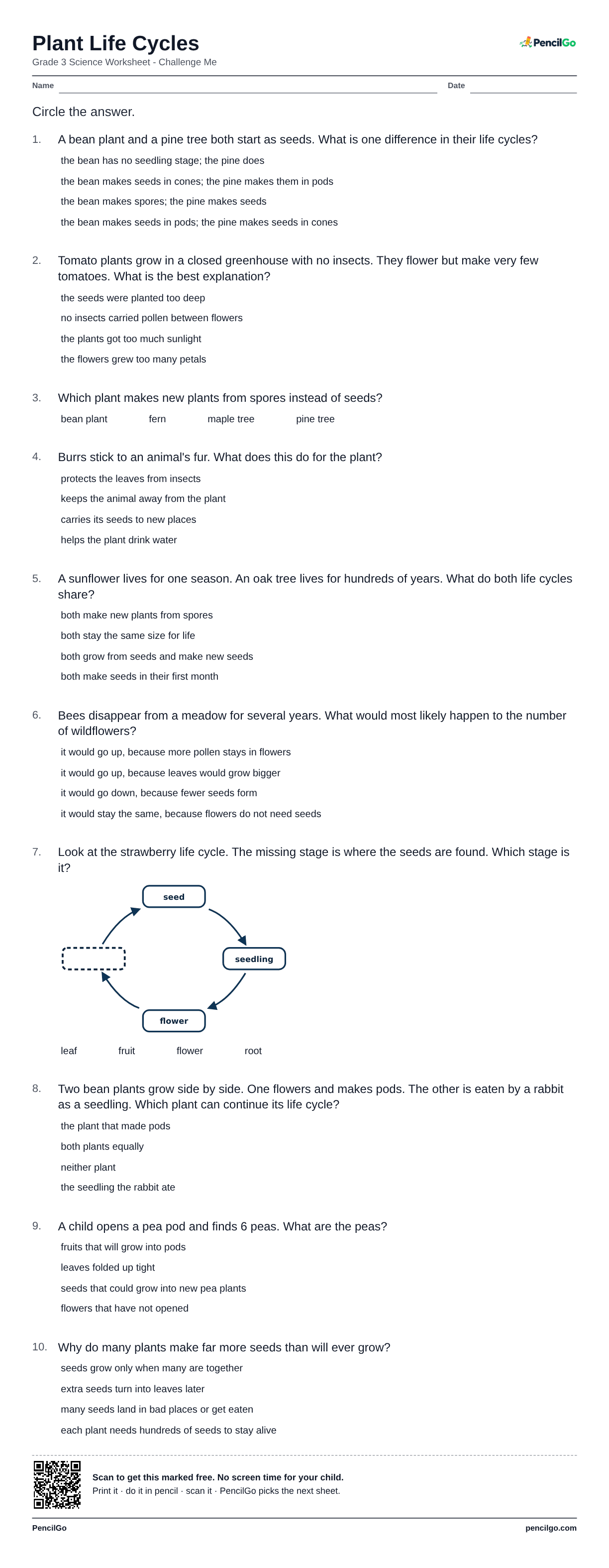
Plant Life Cycles

Grade 3 Science Worksheet - Challenge Me

NameDate

Circle the answer.

  1. A bean plant and a pine tree both start as seeds. What is one difference in their life cycles?

    • the bean has no seedling stage; the pine does
    • the bean makes seeds in cones; the pine makes them in pods
    • the bean makes spores; the pine makes seeds
    • the bean makes seeds in pods; the pine makes seeds in cones
  2. Tomato plants grow in a closed greenhouse with no insects. They flower but make very few tomatoes. What is the best explanation?

    • the seeds were planted too deep
    • no insects carried pollen between flowers
    • the plants got too much sunlight
    • the flowers grew too many petals
  3. Which plant makes new plants from spores instead of seeds?

    • bean plant
    • fern
    • maple tree
    • pine tree
  4. Burrs stick to an animal's fur. What does this do for the plant?

    • protects the leaves from insects
    • keeps the animal away from the plant
    • carries its seeds to new places
    • helps the plant drink water
  5. A sunflower lives for one season. An oak tree lives for hundreds of years. What do both life cycles share?

    • both make new plants from spores
    • both stay the same size for life
    • both grow from seeds and make new seeds
    • both make seeds in their first month
  6. Bees disappear from a meadow for several years. What would most likely happen to the number of wildflowers?

    • it would go up, because more pollen stays in flowers
    • it would go up, because leaves would grow bigger
    • it would go down, because fewer seeds form
    • it would stay the same, because flowers do not need seeds
  7. Look at the strawberry life cycle. The missing stage is where the seeds are found. Which stage is it?

    • leaf
    • fruit
    • flower
    • root
  8. Two bean plants grow side by side. One flowers and makes pods. The other is eaten by a rabbit as a seedling. Which plant can continue its life cycle?

    • the plant that made pods
    • both plants equally
    • neither plant
    • the seedling the rabbit ate
  9. A child opens a pea pod and finds 6 peas. What are the peas?

    • fruits that will grow into pods
    • leaves folded up tight
    • seeds that could grow into new pea plants
    • flowers that have not opened
  10. Why do many plants make far more seeds than will ever grow?

    • seeds grow only when many are together
    • extra seeds turn into leaves later
    • many seeds land in bad places or get eaten
    • each plant needs hundreds of seeds to stay alive
PencilGopencilgo.com

3rd Grade Plant Life Cycles worksheet 1 – printable PDF
Download PDF: 123456

About this worksheet

Plant life cycles show how plants grow, flower, make seeds, and begin the pattern again helps third graders connect observations with scientific explanations instead of memorizing isolated facts. Students may remember one stage but place it in the wrong order, or they may miss that pollination and seeds are what let the cycle continue. This worksheet uses short evidence-based situations so students must read the setup, identify the pattern, and choose the answer that fits the science idea named in the title. Students order stages, find missing stages in a cycle diagram, connect flowers and pollen to seeds, and compare how seeds, cones and spores start new plants.

Support versions use familiar examples and direct wording. Standard and challenge versions add closer distractors and require more comparison. Encourage your child to point to the evidence in the prompt before choosing an answer. If the answer does not explain the observation or solve the stated problem, it is probably a distractor. That habit builds careful science reasoning and prepares students for longer investigations.

What your child will learn

  • Order life-cycle stages
  • Connect flowers and pollen to seeds
  • Explain how seeds spread
  • Compare seeds, cones and spores

NGSS standard: 3-LS1-1

Worked example

A bean plant grows from a seed to a sprout, then an adult plant with flowers. Bees carry pollen, the flowers make pods with seeds, and each seed can start the cycle again.

Common mistake

Listing stages as facts without checking the order.

Helpful hint

A life cycle repeats when adults make new seeds.

Questions parents ask

What is the most common mistake with plant life cycles?

Listing stages as facts without checking the order.

How can I help my child with plant life cycles?

A life cycle repeats when adults make new seeds.

Are these 3rd grade science worksheets free to print?

Yes. All 6 printable versions on this page are free to download and print, with no account needed.

Similar: Animal Life Cycles · Inherited Traits and Variation

More 3rd grade life science

See all life science

Every sheet you scan goes into your child’s record: dated, marked and ready for the year-end portfolio. Homeschool records