
PencilGo

Grade 3 · Science · Physical science

3rd Grade Static Electricity and Simple Circuits worksheets

6 printable versionsOn LevelAbout 4 minutes eachFree · no account

When it’s done, scan the sheet with your phone and PencilGo marks it and picks the next one. Create a free account

★
Version
Print

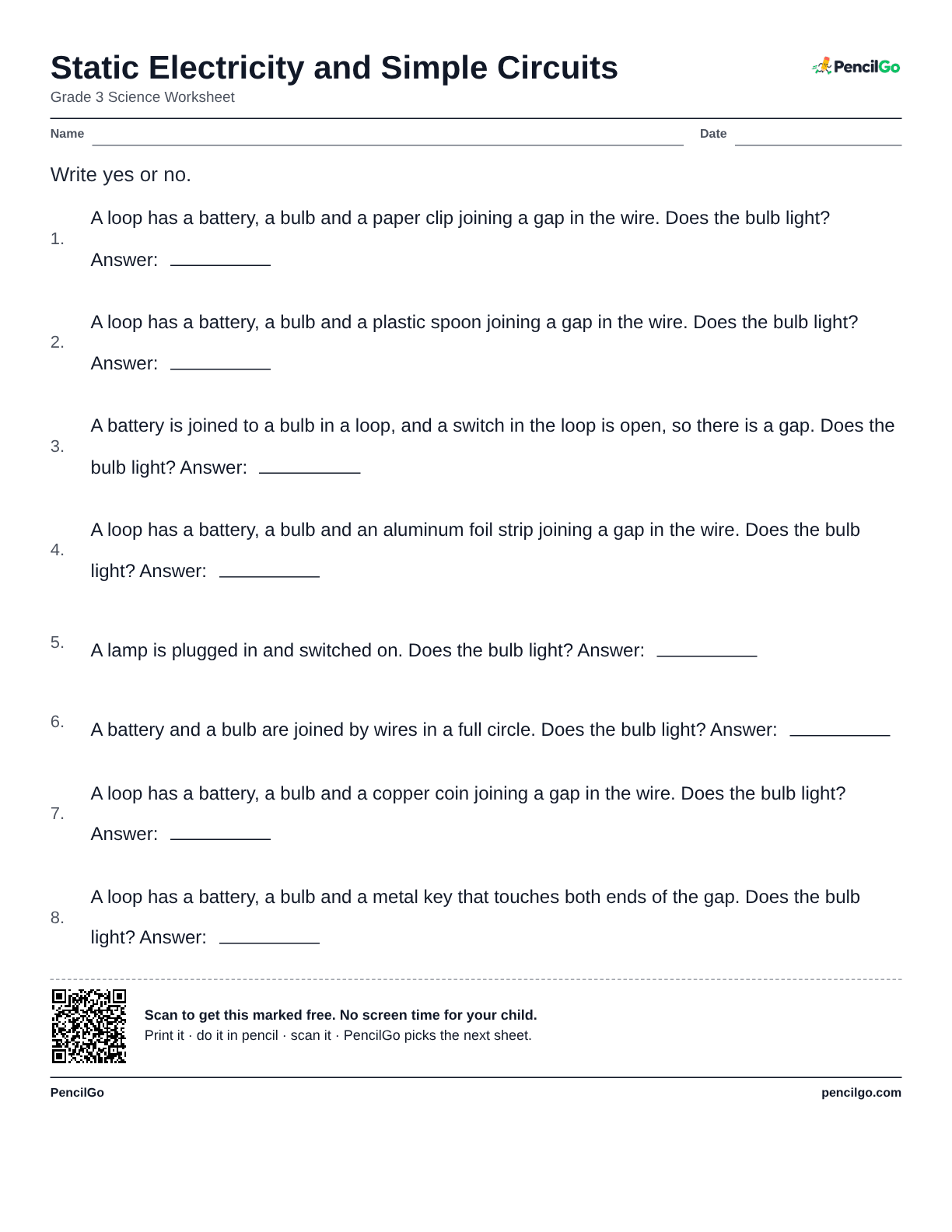
Static Electricity and Simple Circuits

Grade 3 Science Worksheet

NameDate

Write yes or no.

  1. A loop has a battery, a bulb and a paper clip joining a gap in the wire. Does the bulb light? Answer:

  2. A loop has a battery, a bulb and a plastic spoon joining a gap in the wire. Does the bulb light? Answer:

  3. A battery is joined to a bulb in a loop, and a switch in the loop is open, so there is a gap. Does the bulb light? Answer:

  4. A loop has a battery, a bulb and an aluminum foil strip joining a gap in the wire. Does the bulb light? Answer:

  5. A lamp is plugged in and switched on. Does the bulb light? Answer:

  6. A battery and a bulb are joined by wires in a full circle. Does the bulb light? Answer:

  7. A loop has a battery, a bulb and a copper coin joining a gap in the wire. Does the bulb light? Answer:

  8. A loop has a battery, a bulb and a metal key that touches both ends of the gap. Does the bulb light? Answer:
PencilGopencilgo.com

3rd Grade Static Electricity and Simple Circuits worksheet 1 – printable PDF
Download PDF: 123456

About this worksheet

Electricity shows up in two ways in third grade. In a simple circuit a battery pushes electricity around a closed loop of wire, and a bulb lights only if the loop is complete, has a battery, and is made of materials that let electricity flow, such as metal. A gap, an open switch or a rubber band in the loop stops it. Static electricity is different: rubbing two things together can give them a charge.

Things with the same charge push apart, and a charged balloon pulls on small, uncharged things such as hair and bits of paper. This topic has both, and each worksheet practices one: the odd-numbered versions ask whether a bulb lights, and the even-numbered versions ask whether charged things attract or repel. Ask your child to draw the loop for each circuit problem.

What your child will learn

  • Say what a complete circuit needs
  • Tell materials that carry electricity from those that do not
  • Tell attract from repel with static electricity

NGSS standard: 3-PS2-3, 4-PS3-2

Worked example

A battery, a wire and a bulb in one closed loop: the bulb lights. Open the switch and make a gap, and the bulb goes out. Two balloons with the same charge push apart: they repel.

Common mistake

Thinking a circuit works with a gap in it, or that a rubber band or plastic spoon can close the gap.

Helpful hint

Circuits: closed loop, battery, and a conductor. Static: same charges repel, charged things attract small bits.

Questions parents ask

What is the most common mistake with static electricity and simple circuits?

Thinking a circuit works with a gap in it, or that a rubber band or plastic spoon can close the gap.

How can I help my child with static electricity and simple circuits?

Circuits: closed loop, battery, and a conductor. Static: same charges repel, charged things attract small bits.

Are these 3rd grade science worksheets free to print?

Yes. All 6 printable versions on this page are free to download and print, with no account needed.

Similar: States of Matter · Changes in Matter

More 3rd grade physical science

See all physical science

Every sheet you scan goes into your child’s record: dated, marked and ready for the year-end portfolio. Homeschool records