Graph polynomial functions: zeros, multiplicity and end behavior, and match equations to graphs
Grade 11 Math Worksheet

Circle the best answer.
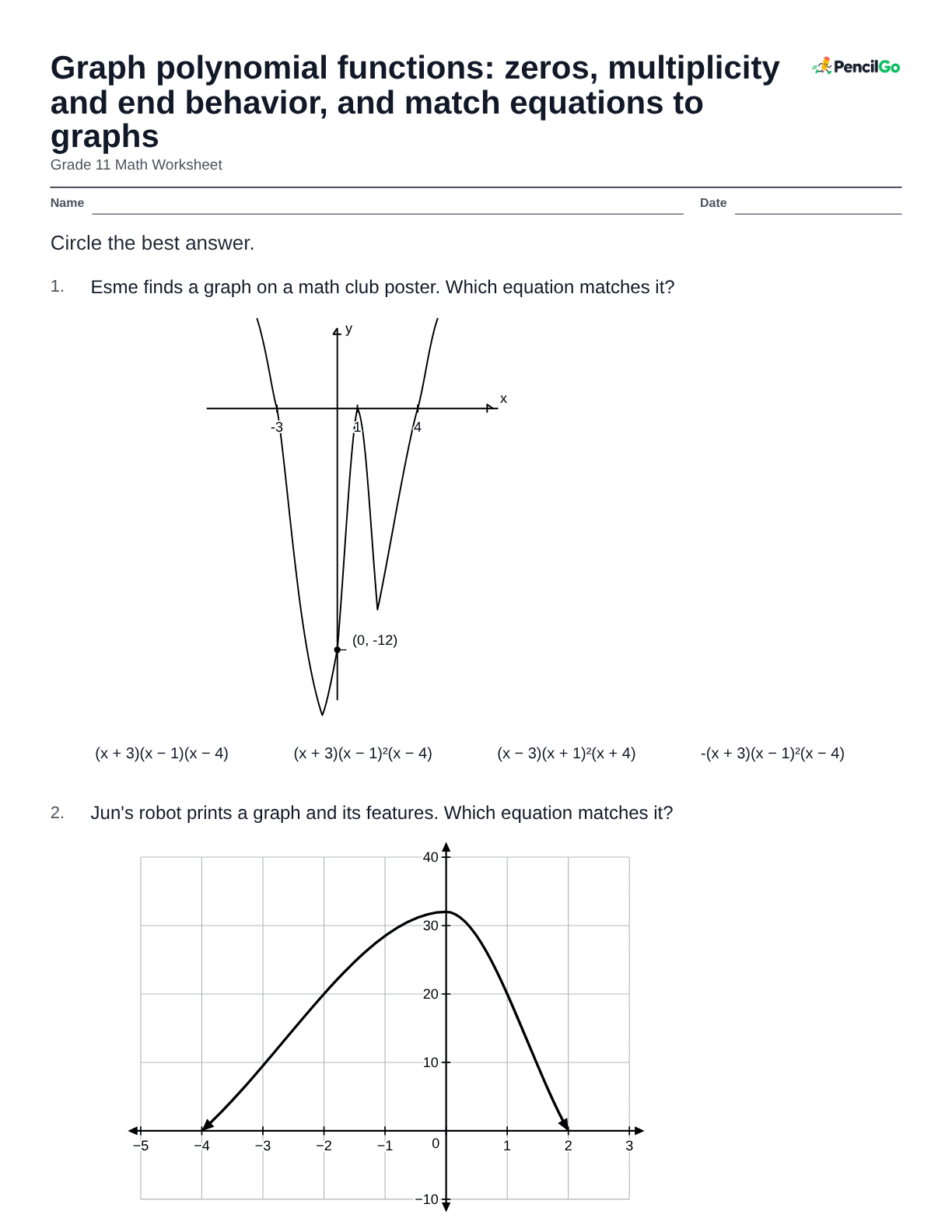
Esme finds a graph on a math club poster. Which equation matches it?
- (x + 3)(x − 1)(x − 4)
- (x + 3)(x − 1)²(x − 4)
- (x − 3)(x + 1)²(x + 4)
- -(x + 3)(x − 1)²(x − 4)
Jun's robot prints a graph and its features. Which equation matches it?
- -(x − 4)²(x + 2)
- -(x + 4)(x − 2)
- -(x + 4)²(x − 2)
- (x + 4)²(x − 2)
Kira sketches a graph from a table of values. Which equation matches it?
- x(x + 5)(x − 2)²
- -x(x + 5)(x − 2)
- -x(x + 5)(x − 2)²
- -x(x − 5)(x + 2)²
Milo studies p(x) = -(x − 1)²(x + 3)³ on graph paper. What does the graph do far to the left and far to the right?
- Falls on both sides.
- Rises on both sides.
- Falls on the left and rises on the right.
- Rises on the left and falls on the right.
Noah's robot graphs p(x) = 2x³(x + 6)⁴. What does the graph do far to the left and far to the right?
- Falls on both sides.
- Falls on the left and rises on the right.
- Rises on the left and falls on the right.
- Rises on both sides.
Ren sketches p(x) = 4(x + 2)²(x − 5). What does the graph do far to the left and far to the right?
- Rises on the left and falls on the right.
- Rises on both sides.
- Falls on the left and rises on the right.
- Falls on both sides.
Tala plans p(x) = -x²(x − 7)³(x + 1) on a grid map. What does the graph do far to the left and far to the right?
- Rises on both sides.
- Falls on both sides.
- Rises on the left and falls on the right.
- Falls on the left and rises on the right.
Zee graphs p(x) = x³ − 12x on graph paper. What is the range of p?
- All real numbers
- y ≥ -16
- -2 ≤ y ≤ 2
- -16 ≤ y ≤ 16
Bo's robot graphs p(x) = -x³ + 27x. What is the range of p?
- -3 ≤ y ≤ 3
- y ≤ 54
- -54 ≤ y ≤ 54
- All real numbers
Jun sketches p(x) = -x⁴ + 18x² − 5 on a grid map. What is the range of p?
- All real numbers
- y ≥ 76
- y ≤ 76
- y ≤ 3