PencilGo

Grade 10 · Science · Chemistry

10th grade Which kind of bond forms: ionic, covalent or metallic worksheet

6 printable versionsChallenge Me10 questions · answer keyFree · no account

Level: Building Confidence · On Level · Challenge Me

When it’s done, scan the sheet with your phone and PencilGo marks it and picks the next one. Create a free account

Version
Print

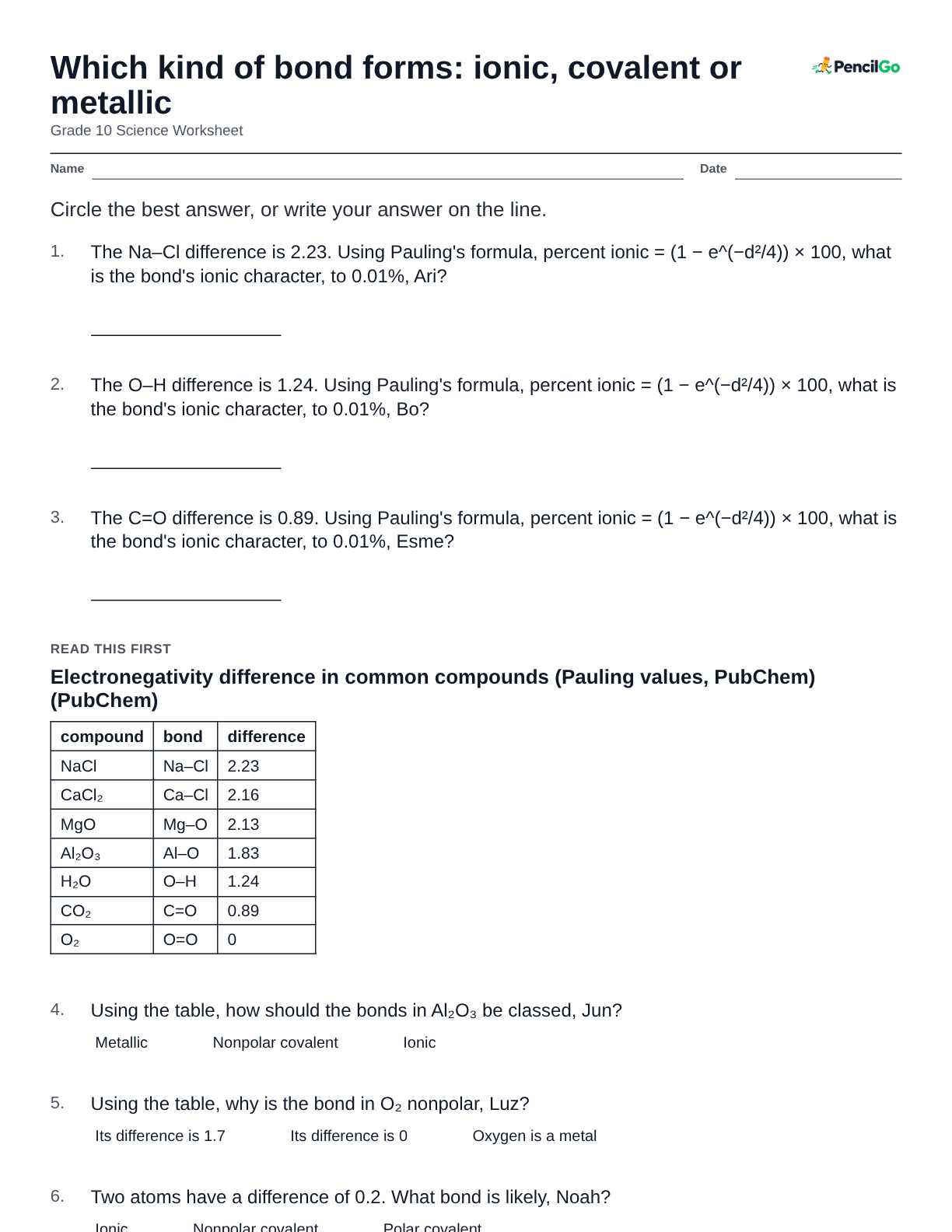
Which kind of bond forms: ionic, covalent or metallic

Grade 10 Science Worksheet - Challenge Me

NameDate

Circle the best answer, or write your answer on the line.

  1. In CaCl₂, chlorine's electronegativity is 3.16 and calcium's is 1. Using (1 − e^(−d²/4)) × 100, what is the bond's percent ionic character, to 0.01%, Bo?

  2. In Al₂O₃, oxygen's electronegativity is 3.44 and aluminum's is 1.61. Using (1 − e^(−d²/4)) × 100, what is the bond's percent ionic character, to 0.01%, Esme?

  3. Why does table salt melt only at a very high temperature, Jun?

    • Strong attractions between ions
    • A sea of free electrons
    • Weak forces between separate molecules
  4. Why is CO₂ a gas at room temperature while NaCl is a solid, Luz?

    • CO₂ is separate molecules
    • CO₂ is made of ions
    • CO₂ has a sea of electrons
  5. Milo says NaCl is held together by shared electron pairs. Agree or disagree?

    • Agree: bonds are shared pairs
    • Agree: Na and Cl share one pair of electrons
    • Disagree: an electron moves to make ions
  6. Noah says water's O–H bonds are ionic because oxygen pulls hard. Agree or disagree?

    • Agree: water is a salt
    • Disagree: they share pairs unequally
    • Agree: oxygen takes the electrons fully
  7. Pia says NaCl's bond is 100% ionic. Agree or disagree?

    • Disagree: about 71% by Pauling's formula
    • Agree: salt shares no electrons whatsoever
    • Agree: ionic means 100%
  8. Why is 1.7 called a rule of thumb, Ren?

    • It is an exact law
    • Bond type changes gradually
    • Metals alone reach 1.7
  9. Al₂O₃'s difference is 1.83, just above 1.7. How is it best described, Tala?

    • Metallic
    • Purely covalent
    • Ionic, with some covalent character
  10. Which bond is more ionic, Na–Cl (2.23) or Al–O (1.83), Zee?

    • Al–O
    • Na–Cl
    • They are equal
PencilGopencilgo.com

10th grade Which kind of bond forms: ionic, covalent or metallic worksheet – printable
Print: 123456

About this worksheet

Which kind of bond forms: ionic, covalent or metallic. Every version has 10 questions, and the answer key prints on the second page.

What your child will learn

  • I can tell ionic (electrons moved), covalent (shared) and metallic (pooled) bonds apart.
  • I can use the Pauling electronegativity difference: above about 1.7 ionic, 0.4–1.7 polar covalent, below 0.4 nonpolar (a rule of thumb).
  • I can find percent ionic character with Pauling's formula, 1 − e^(−d²/4).
  • I can explain properties from bond type: melting points, conduction, states.

Standard: supports HS-PS1-1

Words to know

ionic bond: Attraction between ions made by moving electrons

covalent bond: A shared pair of electrons between atoms

polar covalent: Shared unequally, toward the more electronegative atom

metallic bond: Positive ions held in a sea of pooled electrons

ionic character: How ionic a bond is, from its electronegativity difference

Common mistakes

Your child added the two electronegativities. The bond depends on the difference: subtract the smaller from the larger.

Your child didn't square the difference. Pauling's formula is 1 − e^(−d²/4), with the difference squared.

Your child mixed up ionic and covalent. Ionic bonds move electrons to make ions; covalent bonds share them.

Questions parents ask

What is the most common mistake with which kind of bond forms: ionic, covalent or metallic?

Your child added the two electronegativities. The bond depends on the difference: subtract the smaller from the larger.

Are these 10th grade science worksheets free to print?

Yes. All 6 printable versions at each level are free to print, with the answer key, and no account is needed.

More chemistry

See all Chemistry

Every sheet you scan goes into your child’s record: dated, marked and ready for the year-end portfolio. Homeschool records