Solar and lunar eclipses
Grade 6 Science Worksheet - Challenge Me

Circle the best answer.
Read this first
Table (model data), Model data: Moon dates
Date Phase and Moon near Earth's orbit plane? A. February new moon Moon near the plane of Earth's orbit: no B. April full moon: yes. C. June full moon: no. D. October new moon: yes.
Esme studies the example table of four Moon dates. Which date could have a lunar eclipse?
- A: the February new moon
- D: the October new moon
- B: the April full moon
- C: the June full moon
Using the same example table, Jun looks for a date that could have a solar eclipse. Which date fits?
- B: the April full moon
- A: the February new moon
- D: the October new moon
- C: the June full moon
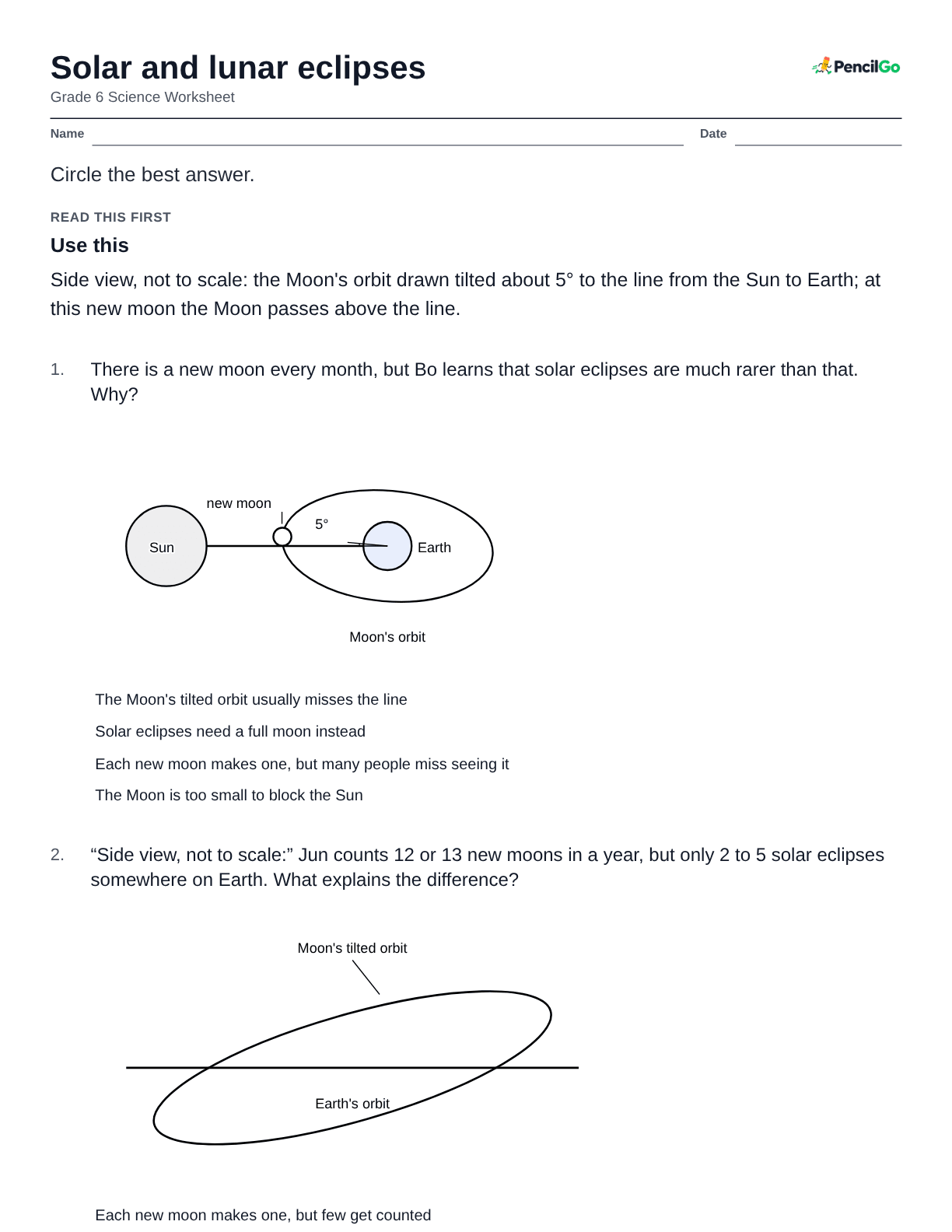
Side view, not to scale
The Moon's tilted orbit crossing the plane of Earth's orbit at two points, on opposite sides; the April line-up is marked at one crossing.
A lunar eclipse happens at an April full moon. About when does Kira expect the Moon to line up with the Sun and Earth again?
- Next month, at the very next full moon
- Exactly 12 months later, on the same date
- About 6 months later, at the other crossing
- Next month, since a full moon's dark edge is Earth's shadow
Side view, not to scale; with the shadow not yet drawn. Luz's friend says a solar eclipse happens when Earth's shadow falls on the Sun. Which response is best?
- Disagree: it happens at full moon, when the Moon is bright
- Agree: Earth's shadow darkens the Sun
- Disagree: the Moon's shadow falls on Earth
- Agree: and it happens at each new moon
Milo's cousin says a lunar eclipse is just the Moon's new moon phase. Which response is best?
- Disagree: it is seen from just a narrow path
- Agree: the Moon's shadow covers the Moon then
- Agree: the new moon is Earth's shadow on the Moon
- Disagree: it happens at full moon, in Earth's shadow
“not to scale” A post claims that everyone on Earth's daytime side sees each total solar eclipse. Noah checks it. Which response is best?
- Agree: the Moon's shadow covers the whole day side
- Disagree: totality is seen only along a narrow path
- Agree: Earth's shadow covers the whole Sun
- Disagree: the Moon is as big as the Sun, so the path is wide
Sun diameter about 1,391,400 km; Moon diameter about 3,475 km. Pia reads the NASA size table. About how many times wider is the Sun than the Moon?
- About 4 times wider
- About 40 times wider
- About the same width
- About 400 times wider
Sizes and distances (NASA)
Body Diameter and Distance from Earth Sun diameter about 1,391,400 km distance from Earth about 149,600,000 km Moon diameter about 3,475 km distance from Earth about 384,400 km The Sun is about 400 times wider than the Moon and about 389 times farther from Earth. What does Ren explain with these two numbers?
- Why the Moon is really as big as the Sun
- Why Earth's shadow covers the Sun
- Why each new moon makes an eclipse
- Why they look about the same size in our sky
“Two side views, not to scale:” When the Moon is at its farthest from Earth, it looks a little smaller. Which eclipse can Tala read about at a new moon then?
- An annular eclipse, with a ring of Sun showing
- A lunar eclipse, since the Moon is far away
- An eclipse at each new moon that season
- A total eclipse, since the Moon is as big as the Sun
“Classroom model, top view:” In a class model, a lamp is the Sun, a foam ball is the Moon and Zee's head is Earth. Where should Zee hold the ball to model a lunar eclipse?
- At Y, inside the head's shadow
- At W, between the head and the lamp
- At X, beside the head
- At Y-high, just above the head's shadow