PencilGo

Grade 6 · Science

6th grade Solar and lunar eclipses worksheet

6 printable versionsBuilding Confidence10 questions · answer keyFree · no account

Level: Building Confidence · On Level · Challenge Me

When it’s done, scan the sheet with your phone and PencilGo marks it and picks the next one. Create a free account

Version
Print

Solar and lunar eclipses

Grade 6 Science Worksheet - Building Confidence

NameDate

Circle the best answer.

  1. “Side view, not to scale:” Ari reads an astronomy book. A diagram shows the Sun, then the Moon, then Earth, in one straight line. Which event does it show?

    • A full moon
    • A solar eclipse
    • A first quarter Moon
    • A lunar eclipse
  2. Bo's book shows the Sun, then Earth, then the Moon, in one straight line. Which event does the diagram show?

    • A Moon phase made by Earth's shadow
    • A lunar eclipse
    • A solar eclipse
    • A new moon
  3. “Side view, not to scale:” During a lunar eclipse, the full moon turns dim and coppery red. Whose shadow is Jun reading about?

    • A cloud's shadow, crossing the Moon
    • The Moon's shadow, falling on Earth
    • Earth's shadow, falling on the Moon
    • No shadow; it is the Moon's monthly phase
  4. “Side view, not to scale” During a total solar eclipse, daytime turns dark along a narrow strip of land. Luz reads about it. Whose shadow makes the dark strip?

    • Earth's shadow on the Moon
    • The shadow that makes a new moon dark
    • The Moon's shadow on Earth
    • A big storm cloud's shadow
  5. “Side view, not to scale:” Milo reads that a lunar eclipse can keep the full moon dim and red for over an hour. What is covering the Moon?

    • Dark spots on the Sun
    • The Moon's far side turning toward us
    • Earth's shadow
    • The Moon's own shadow, cast onto Earth
  6. with one evening marked 'lunar eclipse' and the Moon phases left blank. A lunar eclipse is marked on Pia's astronomy club calendar. Which Moon phase will it be that night?

    • Whatever phase is up that week
    • Full moon
    • New moon
    • Third quarter
  7. Read this first

    Use this

    Orbit diagram, top view, not to scale: sunlight from the left; Earth in the center; the Moon at new moon (between Earth and the Sun) and at full moon (behind Earth).

  8. Ren asks the club leader why a solar eclipse can happen only at new moon. Which answer is right?

    • The Moon must be between the Sun and Earth
    • The Moon must be behind Earth, in its shadow
    • Each new moon brings an eclipse
    • The Moon is full and bright then
  9. Tala is making a poster of a solar eclipse. Which body goes in the middle of the line-up?

    • No body; they form a triangle
    • The Moon
    • Earth
    • The Sun
  10. Zee lines up an orange (the Sun), a plum (Earth) and a grape (the Moon) to model a lunar eclipse. Nobody may eat the cast. Which fruit goes in the middle?

    • The plum
    • The grape
    • Any of them, in any order
    • The orange
  11. not yet in order. Esme uses the same orange, plum and grape to model a solar eclipse instead. Which fruit goes in the middle now?

    • The grape
    • The plum
    • The orange
    • The biggest fruit
PencilGopencilgo.com

6th grade Solar and lunar eclipses worksheet – printable
Print: 123456

About this worksheet

Solar and lunar eclipses. Every version has 10 questions, and the answer key prints on the second page.

What your child will learn

  • I can tell a solar eclipse (Sun, Moon, Earth; the Moon's shadow on Earth; at new moon) from a lunar eclipse (Sun, Earth, Moon; Earth's shadow on the Moon; at full moon).
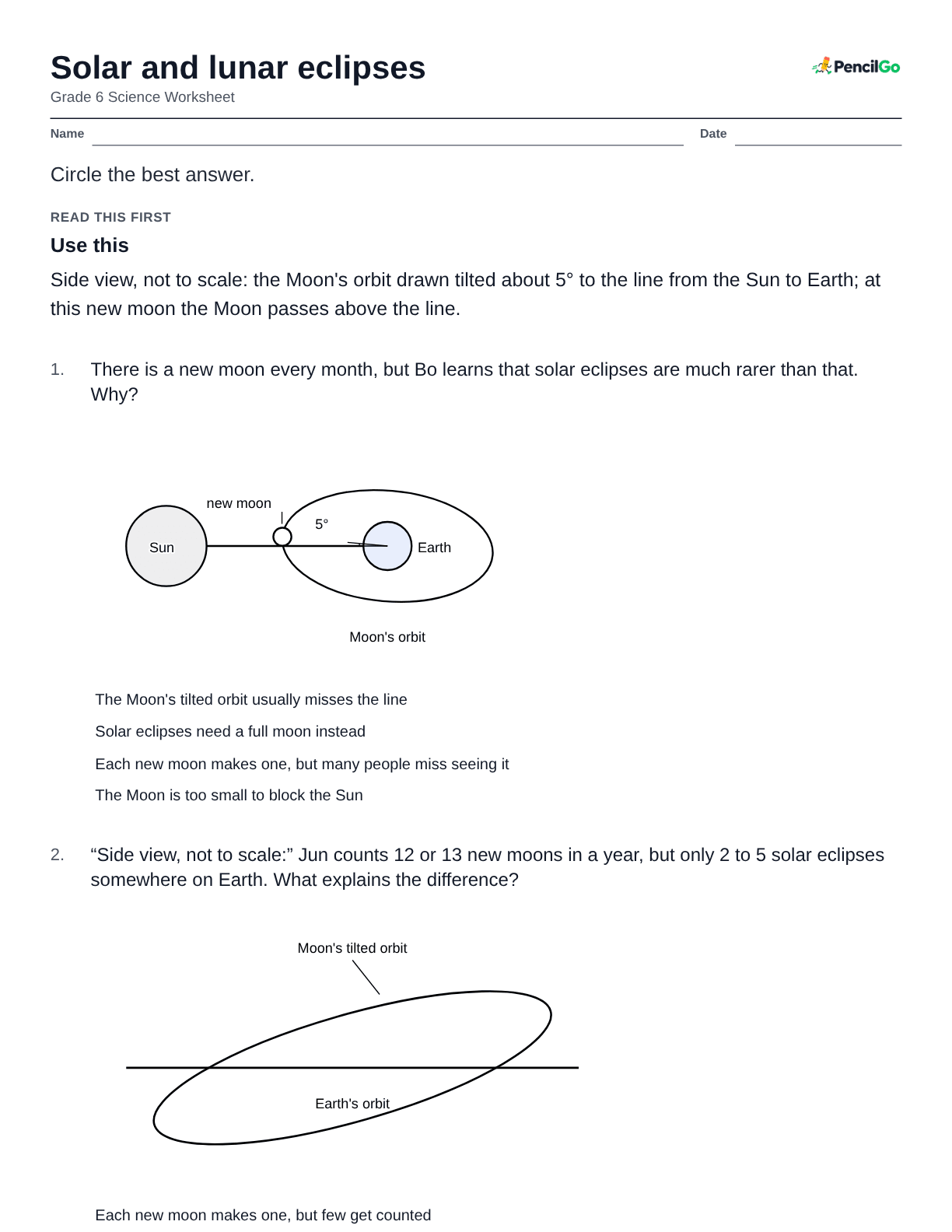
  • I can explain why eclipses don't happen every month: the Moon's orbit is tilted about 5°.
  • I can explain why a total solar eclipse is seen only along a narrow path, while a lunar eclipse is seen from the whole night side.

Standard: MS-ESS1-1

Words to know

solar eclipse: The Moon passes between the Sun and Earth, and its shadow falls on Earth

lunar eclipse: Earth passes between the Sun and the Moon, and its shadow falls on the Moon

totality: The part of an eclipse when the Sun, or the Moon, is fully covered

annular eclipse: A solar eclipse that leaves a bright ring because the Moon looks smaller

inner and outer shadow: The dark middle of a shadow, and the lighter edge around it

orbit plane: The flat sheet that an orbit lies in

Common mistakes

Your child mixed up solar and lunar eclipses. Line up three objects for the Sun, Earth and Moon, and ask which one is in the middle for each.

Your child matched an eclipse to the wrong Moon phase. Explain that a solar eclipse can happen only at new moon and a lunar eclipse only at full moon.

Your child thought every new or full moon brings an eclipse. Explain that the Moon's path is tilted, so it usually passes above or below the shadow.

Questions parents ask

What is the most common mistake with solar and lunar eclipses?

Your child mixed up solar and lunar eclipses. Line up three objects for the Sun, Earth and Moon, and ask which one is in the middle for each.

Are these 6th grade science worksheets free to print?

Yes. All 6 printable versions at each level are free to print, with the answer key, and no account is needed.

More grade 6 science

See all grade 6 science

Every sheet you scan goes into your child’s record: dated, marked and ready for the year-end portfolio. Homeschool records