How people change the environment, and ways to reduce the harm
Grade 6 Science Worksheet - Challenge Me

Circle the best answer.
Read this first
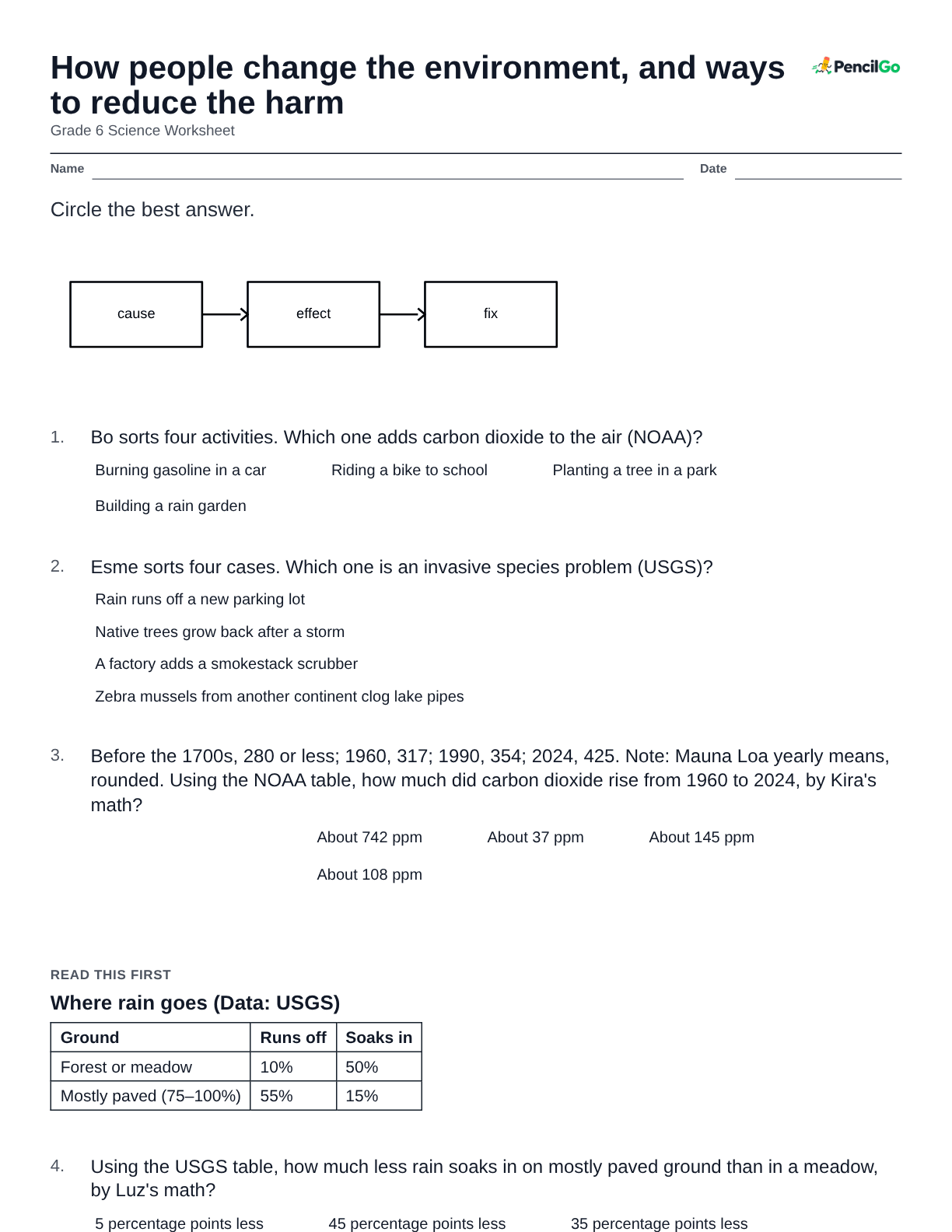
Four boxes in a row
Cause, effect, fix, then the fix's cost.
A town wants less runoff from a big parking lot. Which plan and trade-off fit, by Esme's reading (EPA)?
- Rain gardens around the lot, which take space and care
- Rain gardens, which have no costs to weigh
- Cutting nearby trees, which saves space
- More pavement, which costs nothing to keep up
A power plant must cut its sulfur pollution. Which plan and trade-off fit, by Jun's reading (EPA)?
- A wet scrubber, which removes most of it but needs water treatment
- A wet scrubber, which removes 100% of it and needs no water or treatment at the plant
- A taller smokestack, which removes the sulfur
- Burning more coal, which spreads the smoke thinner
A lake wants to keep zebra mussels out. Which plan and trade-off fit, by Kira's reading (USGS)?
- Boat checks, which take time and workers
- Bringing in boats from mussel lakes, which saves time
- Adding more mussels, which crowds out new ones
- Boat checks, which cost nothing
Where rain goes (Data: USGS)
Ground Runs off Soaks in Forest or meadow 10% 50% Mostly paved (75–100%) 55% 15% Example data: 2,000 gallons of rain fall on a parking lot. Using the USGS table, how much more runs off than on a meadow, by Milo's math?
- About 4,500 gallons more
- About 900 gallons more
- About 1,100 gallons more
- About 200 gallons more
Use the table
U.S. fish stocks, end of 2024 (Data: NOAA)
Measure Number of stocks On the overfished list (too few fish left) 42 Rebuilt since 2000 51 Using the NOAA table, how many more stocks were rebuilt than are now on the overfished list, by Noah's math?
- 51 more
- 93 more
- 9 more
- 42 more
A classmate says invasive species help a lake because they add more life. Which reply fits USGS, by Pia's reading?
- Correct; any new species helps a lake
- Correct; zebra mussels clean out the pipes of power plants and water plants
- No; zebra mussels crowd onto native clams and clog water pipes
- No; zebra mussels cannot live in the Great Lakes
Use the table
U.S. changes, 1970 to 2025 (Data: EPA)
Measure Change Six main air pollutants down 78% Population up 67% Miles driven up 197% Energy use up 46% A student says U.S. air keeps getting dirtier because the population keeps growing. Which reply fits EPA, by Ren's reading?
- Correct; more people must mean dirtier air
- No; the population shrank by 67%
- No; the six main pollutants fell 78% while the population grew 67%
- Correct; the pollutants rose 78% as the population grew
Rain-garden test results (example data)
Design Runoff cut Cost A: small garden 30% $200 B: large garden 60% $500 Note: The town needs at least a 50% cut and has $600.
Using the test results, which design meets the town's goal and budget, by Zee's reading?
- Design A, since the cheaper one is the better one
- Neither design meets the goal
- Design A, which cuts 30% for $200
- Design B, which cuts 60% for $500
Using the test results, the town's budget drops to $300. What trade-off does it face, by Ari's reading?
- Design A now cuts 60% of the runoff
- It can afford only Design A, which cuts less runoff
- It can still afford Design B
- Both designs now cost nothing
Cause, effect, fix, then the fix's cost. Which summary of the chain model fits, by Bo's reading?
- A fix works well when it adds to the cause
- A human cause has no effect on land, water or air, so fixes and their costs are not needed
- Any fix solves the problem with no cost
- A human cause leads to an effect, and a fix can help but has a cost