PencilGo

Grade 6 · Science

6th grade How people change the environment, and ways to reduce the harm worksheet

6 printable versionsBuilding Confidence10 questions · answer keyFree · no account

Level: Building Confidence · On Level · Challenge Me

When it’s done, scan the sheet with your phone and PencilGo marks it and picks the next one. Create a free account

Version
Print

How people change the environment, and ways to reduce the harm

Grade 6 Science Worksheet - Building Confidence

NameDate

Circle the best answer.

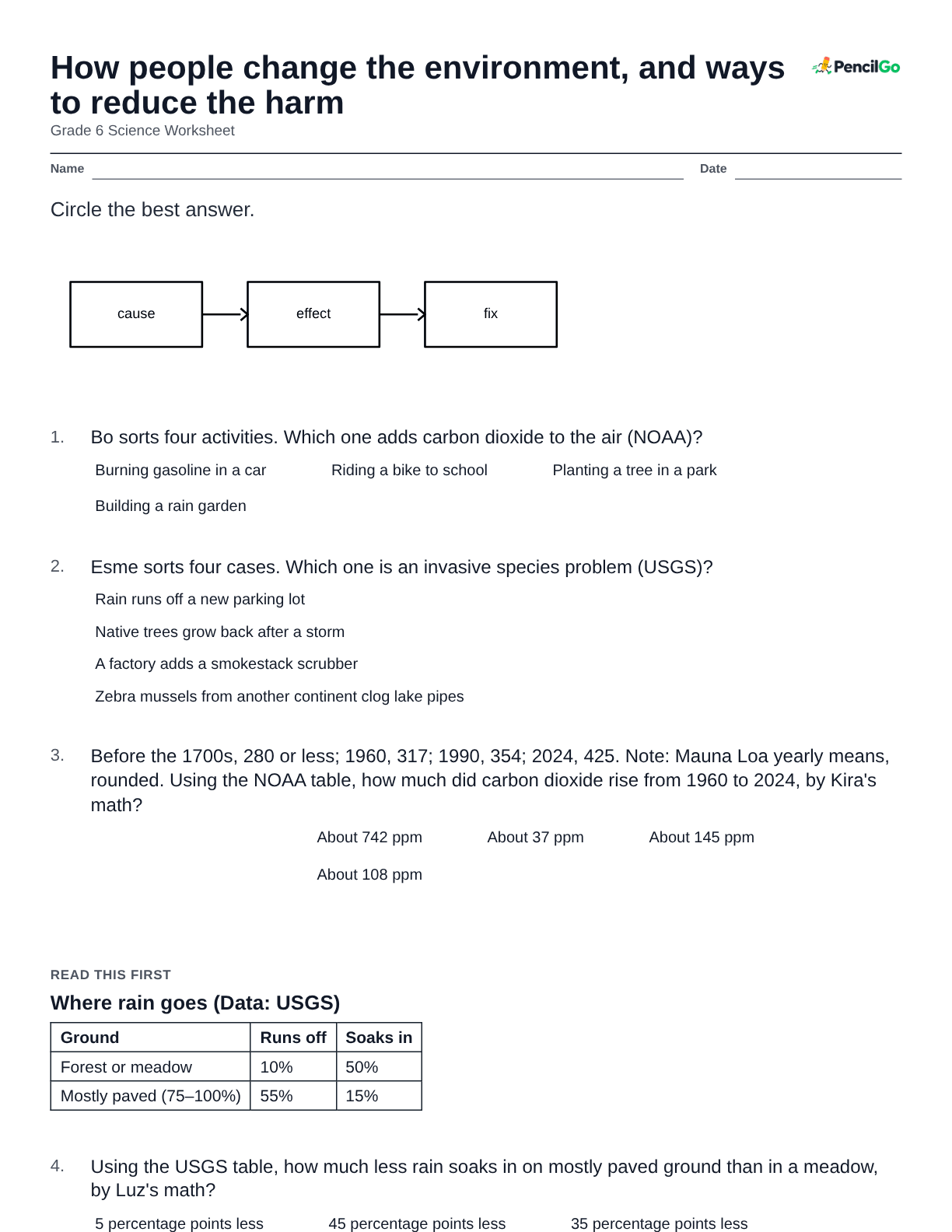
  1. Ari fills in a chain. Cause: people pave a big field. What effect goes in the middle box (USGS)?

    • More rain soaks into the ground
    • More rainwater runs off into streams
    • The field gets more rainfall
    • Less rainwater runs off the field than before
  2. Bo fills in a chain. Cause: ship water carried zebra mussels into the Great Lakes (USGS). What effect goes in the middle box?

    Use the picture in question 1.

    • The mussels stayed in one small spot of one lake
    • The mussels spread and clog water pipes
    • Native mussels grew in number
    • The lakes turned salty
  3. Kira fills in a chain. Cause: people burn coal, oil and gas for energy. What effect goes in the middle box (NOAA)?

    Use the picture in question 1.

    • Less carbon dioxide stays in the air than before
    • More carbon dioxide builds up in the air
    • The ocean gets saltier
    • The air gains more oxygen
  4. Jun fills in a chain. Zebra mussels ride on boats to new lakes (USGS). Which fix goes in the fix box?

    Use the picture in question 1.

    • Add more mussels to each lake
    • Move more boats between lakes
    • Paint the boats a brighter color so the mussels can see them
    • Inspect and clean boats before they enter a new lake
  5. Luz fills in a chain. Paved lots send more rain into streams. Which fix goes in the fix box (EPA)?

    Use the picture in question 1.

    • Paint the pavement white
    • Pave the lawn next to the lot too
    • Build a rain garden that lets water soak in
    • Cut down the trees nearby
  6. Before the 1700s, 280 or less; 1960, 317; 1990, 354; 2024, 425. Note: Mauna Loa yearly means, rounded. Using the NOAA table, about how much carbon dioxide was in the air in 2024, by Noah's reading?

    • About 280 ppm
    • Less than in 1960
    • About 317 ppm
    • About 425 ppm
  7. Read this first

    Where rain goes (Data: USGS)

    GroundRuns offSoaks in
    Forest or meadow10%50%
    Mostly paved (75–100%)55%15%
  8. Using the USGS table, what share of rain runs off mostly paved ground, by Pia's reading?

    • About 50%
    • About 10%
    • About 15%
    • About 55%
  9. Use the table

    U.S. changes, 1970 to 2025 (Data: EPA)

    MeasureChange
    Six main air pollutantsdown 78%
    Populationup 67%
    Miles drivenup 197%
    Energy useup 46%
  10. Using the EPA table, how did the six main air pollutants change from 1970 to 2025, by Ren's reading?

    • They dropped 78%
    • They rose 78%
    • They did not change
    • They rose 197%
  11. Four boxes in a row

    Cause, effect, fix, then the fix's cost.

  12. A power plant adds a scrubber to clean its smoke (EPA). What cost might it weigh, by Zee's reading?

    • Scrubbers have no trade-offs
    • Scrubbers make the smoke coming out of the tall stack even dirtier
    • The equipment costs money, and wet ones need water treatment
    • Scrubbers cost nothing to run
  13. Lake workers check every boat for zebra mussels. What cost might the lake weigh, by Esme's reading?

    • The checks need no workers
    • Time and workers for the boat checks
    • The checks spread mussels faster to the new lake
    • The checks cost nothing
PencilGopencilgo.com

6th grade How people change the environment, and ways to reduce the harm worksheet – printable
Print: 123456

About this worksheet

How people change the environment, and ways to reduce the harm. Every version has 10 questions, and the answer key prints on the second page.

What your child will learn

  • I can link a human cause to its effect: paving and more runoff, burning fuel and more carbon dioxide, ship and boat travel and zebra mussels, too much fishing and fewer fish.
  • I can choose a fix that matches the cause and name its cost, such as space for a rain garden or workers for boat checks.
  • I can read a small data table, such as NOAA carbon dioxide or EPA air data, and use test results to choose a design within a budget.

Standard: MS-ESS3-3, MS-ESS3-4, MS-LS2-4

Words to know

runoff: Rain that flows over the ground instead of soaking in

invasive species: A living thing from somewhere else that spreads and causes harm

carbon dioxide (CO₂): A gas that burning fuel adds to the air

ppm: Parts per million: how many of a million air bits are CO₂

overfished: So few fish are left that the group cannot keep up

trade-off: What you give up to get a fix

Common mistakes

Your child linked a cause to the wrong effect. Paving sends more rain into streams (USGS), zebra mussels spread and clog pipes (USGS), and too much fishing leaves fewer fish (NOAA).

Your child picked a fix that does not match the cause. A good fix works on the cause: rain gardens for runoff, boat checks for mussels, catch limits for fish.

Your child gave a fix no cost. Every fix has a cost to weigh, such as money, space, water or workers.

What to say

Ask: what does this cause change?

Ask: which box does the fix touch?

Ask: what does this fix need?

Questions parents ask

What is the most common mistake with how people change the environment, and ways to reduce the harm?

Your child linked a cause to the wrong effect. Paving sends more rain into streams (USGS), zebra mussels spread and clog pipes (USGS), and too much fishing leaves fewer fish (NOAA).

How can I help my child with how people change the environment, and ways to reduce the harm?

Ask: what does this cause change?

Are these 6th grade science worksheets free to print?

Yes. All 6 printable versions at each level are free to print, with the answer key, and no account is needed.

More grade 6 science

See all grade 6 science

Every sheet you scan goes into your child’s record: dated, marked and ready for the year-end portfolio. Homeschool records