
PencilGo

Grade 7 · Science

7th grade Genes, chromosomes and mutations worksheet

6 printable versionsOn Level10 questions · answer keyFree · no account

Level: Building Confidence · On Level · Challenge Me

When it’s done, scan the sheet with your phone and PencilGo marks it and picks the next one. Create a free account

Version
Print

Genes, chromosomes and mutations

Grade 7 Science Worksheet

NameDate

Circle the best answer.

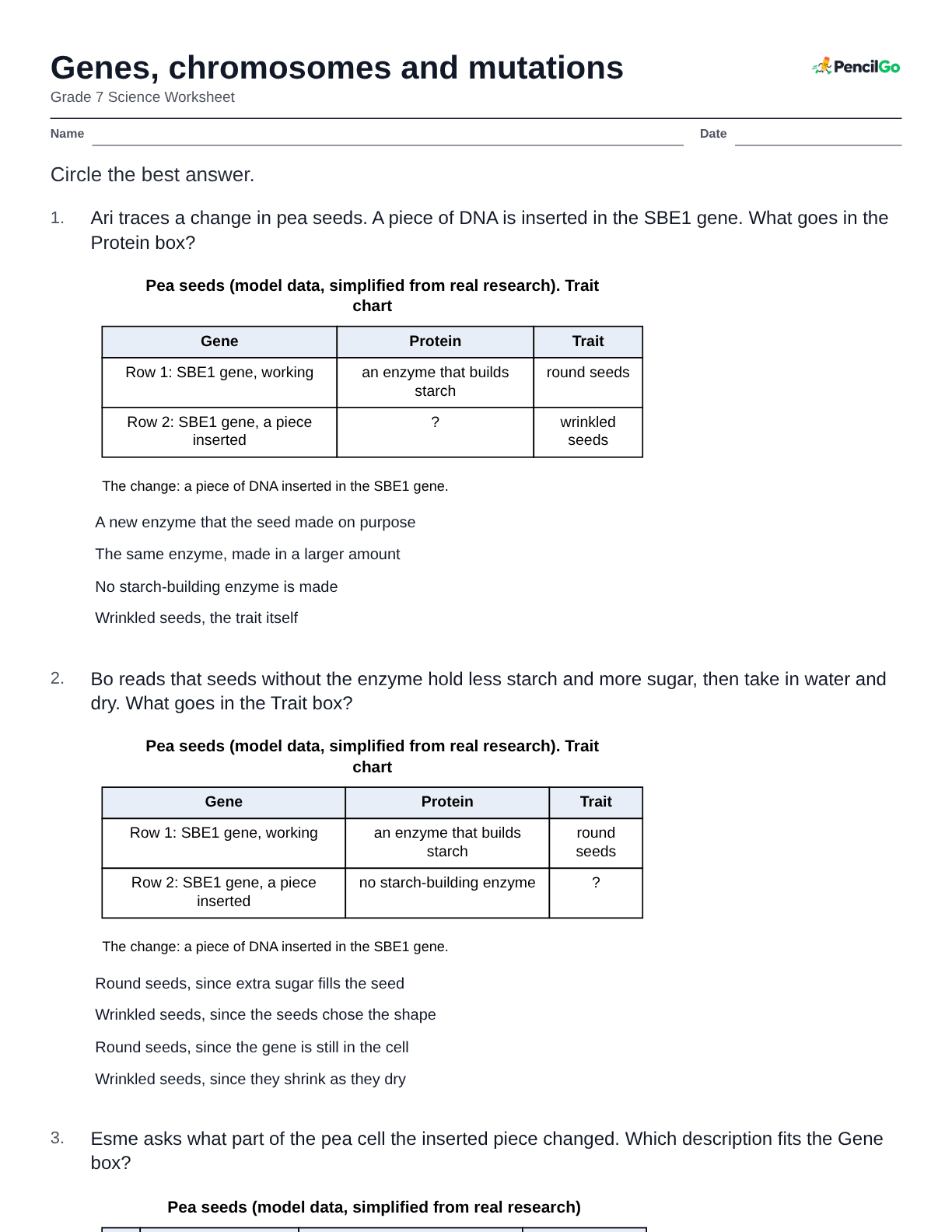
  1. Ari traces a change in pea seeds. A piece of DNA is inserted in the SBE1 gene. What goes in the Protein box?

    • A new enzyme that the seed made on purpose
    • The same enzyme, made in a larger amount
    • No starch-building enzyme is made
    • Wrinkled seeds, the trait itself
  2. Bo reads that seeds without the enzyme hold less starch and more sugar, then take in water and dry. What goes in the Trait box?

    • Round seeds, since extra sugar fills the seed
    • Wrinkled seeds, since the seeds chose the shape
    • Round seeds, since the gene is still in the cell
    • Wrinkled seeds, since they shrink as they dry
  3. Esme asks what part of the pea cell the inserted piece changed. Which description fits the Gene box?

    • The seed shape, since a gene is a trait
    • A whole chromosome, since a gene is bigger
    • The whole nucleus, since DNA is bigger
    • One gene, a short section of DNA
  4. Jun reads about E. coli bacteria in a lab flask with citrate and little other food. A DNA change lets some bacteria use citrate. How is the change best described?

    • No effect, since the bacteria look the same
    • Harmful, since a DNA change breaks the cell
    • Helpful, since the bacteria can use a food
    • Helpful, since the bacteria planned the change
  5. Kira reads that a cucumber seedling has a DNA change. Its leaves have no chlorophyll and look pale. Chlorophyll absorbs light for making food. How is the change best described?

    • Helpful, since pale leaves stay cooler
    • Harmful, since a mutation is a harmful change
    • No effect, since a DNA change is tiny
    • Harmful, since the leaves cannot make food
  6. Luz reads that one DNA letter in a bean plant's gene changed, but the protein it makes is the same. The plant looks the same. How is the change best described?

    • Harmful, since the DNA letter changed
    • Helpful, since a new letter gives a new trait
    • Helpful, since the plant needed the new letter
    • No effect, since the protein stays the same
  7. 46 chromosomes, in pairs. Milo reads that a human cell has 46 chromosomes in pairs, one of each pair from each parent. How many pairs are there?

    • 23 pairs, since each pair has two chromosomes
    • 2 pairs, since there are two parents
    • 92 pairs, since each parent gives 46 pairs
    • 46 pairs, since each chromosome is its own pair
  8. Pia reads that a rice plant cell has 12 pairs of chromosomes. Each chromosome is made of DNA and holds many genes. Which statement is correct?

    • It has 12 chromosomes, and each holds many genes
    • It has 24 genes, and each holds many chromosomes
    • It has 24 chromosomes, each holding many genes
    • It has 12 chromosomes, and each gene holds many
  9. A basil plant sits in a dim room. Ren wonders if the plant changes its DNA on purpose to use the dim light. Which answer is best?

    • Yes, a plant changes its DNA when it needs to
    • No, DNA stays the same for the plant's whole life
    • Yes, dim light tells the DNA how to change
    • No, DNA changes happen by chance, not by need
  10. A pea bed is dry. Tala asks if the dry soil makes the helpful DNA changes. Which answer is best?

    • Yes, dry soil makes changes that help
    • No, dry soil cannot affect anything in a plant
    • No, a change comes by chance, helpful or not
    • Yes, plants make the changes they need
PencilGopencilgo.com

7th grade Genes, chromosomes and mutations worksheet – printable
Print: 123456

About this worksheet

Genes, chromosomes and mutations. Every version has 10 questions, and the answer key prints on the second page.

What your child will learn

  • I can put the parts in order from biggest to smallest: cell, nucleus, chromosome, DNA, gene.
  • I can say that a gene is a section of DNA that holds instructions for a protein, and that proteins help make a trait.
  • I can say that humans have 46 chromosomes in 23 pairs, and that other living things have other numbers.
  • I can say that a mutation is a change in DNA, and that it can be harmful, helpful or make no difference.
  • I can follow a changed gene to a changed protein to a changed trait, and explain a case where the DNA changed but the trait did not.
  • I can say that mutations happen by chance, not because a living thing needs them.

Standard: MS-LS3-1

Words to know

cell: The smallest living part of a plant or animal

nucleus: The part inside a cell that holds the chromosomes

chromosome: A thread of DNA and protein in the nucleus

DNA: The long molecule that carries the instructions of a living thing

gene: A section of DNA with instructions for making a protein

protein: A part of a living thing that helps build it and run its cells

trait: A feature of a living thing, such as flower color or seed shape

mutation: A change in DNA; it can be harmful, helpful or make no difference

Common mistakes

Your child thought mutations are always harmful. Compare three cases: a seedling with pale leaves, bacteria that use a new food, and a change that alters nothing. Ask, 'What did this change do there?'

Your child mixed up a gene with the trait it helps make. Draw three boxes: Gene, Protein, Trait. Ask, 'Which box comes first, and which one can you see?'

Your child mixed up the sizes of cells, chromosomes, DNA and genes. Try nesting boxes: a cell holds a nucleus, which holds chromosomes, which are made of DNA, which has genes. Ask, 'Which holds which?'

Questions parents ask

What is the most common mistake with genes, chromosomes and mutations?

Your child thought mutations are always harmful. Compare three cases: a seedling with pale leaves, bacteria that use a new food, and a change that alters nothing. Ask, 'What did this change do there?'

Are these 7th grade science worksheets free to print?

Yes. All 6 printable versions at each level are free to print, with the answer key, and no account is needed.

More grade 7 science

See all grade 7 science

Every sheet you scan goes into your child’s record: dated, marked and ready for the year-end portfolio. Homeschool records