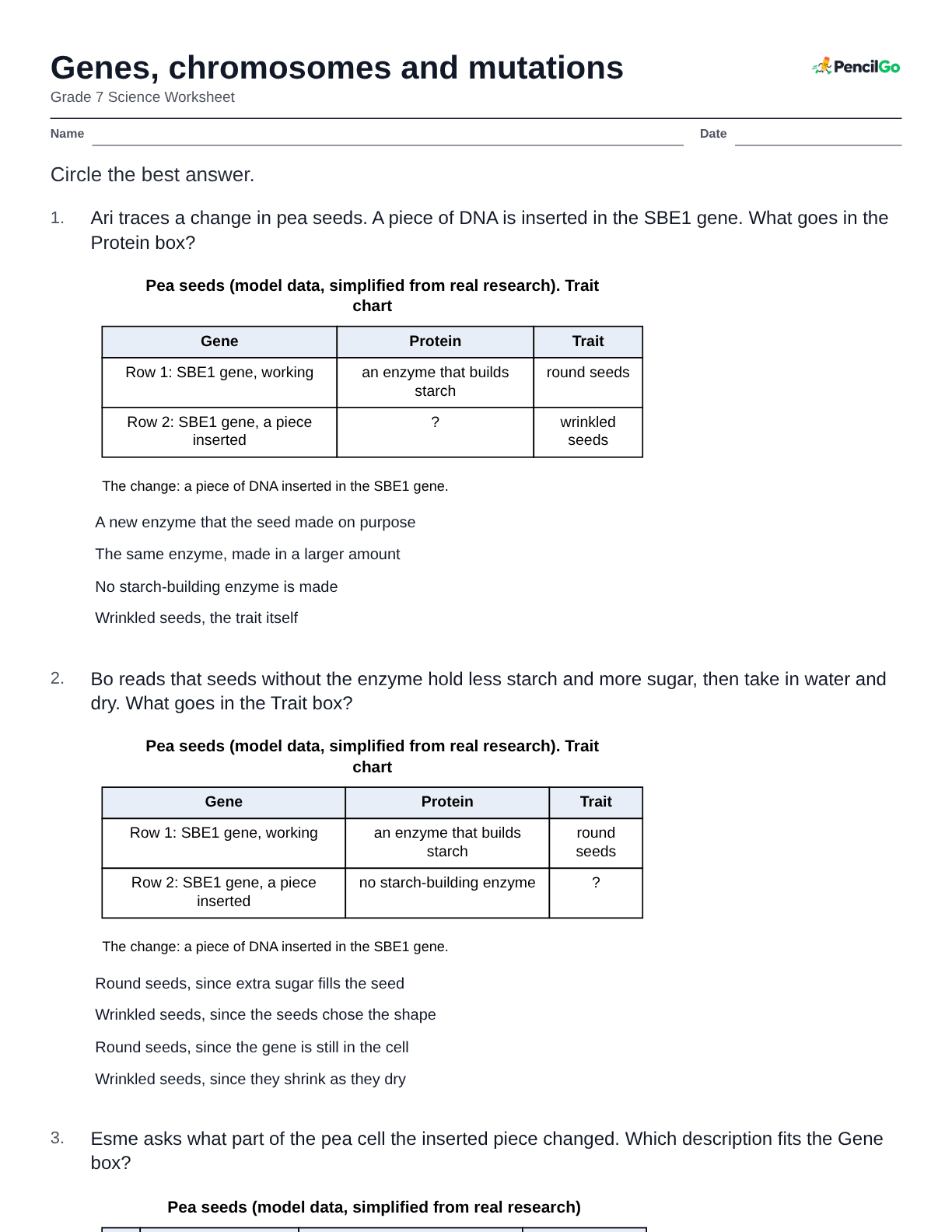
Genes, chromosomes and mutations
Grade 7 Science Worksheet - Challenge Me

Circle the best answer.
Ari's class reads the chart and the growth table. Which claim and reason fit what the data show?
- No effect: strain Q is the same kind of bacteria as strain P
- Helpful: strain Q planned the change when sugar Z appeared
- Harmful: a changed gene breaks the protein in strain Q
- Helpful: the changed gene lets strain Q use sugar Z
Bo reads the same chart and table. Which line explains why strain P stays at 100 on sugar Z?
Use the picture in question 1.
- It chose not to change its gene as sugar Z came
- Its gene has a mutation that harmed its cells
- Its chromosome is too small to hold the whole gene
- Its protein cannot use sugar Z, so no growth
Esme writes a sentence that uses both the chart and the table. Which sentence is correct?
Use the picture in question 1.
- Q's change harmed it, and the table shows Q losing many cells
- P's gene changed as well, and the table shows P growing slowly
- Q's gene is its growth, and the table shows the gene growing
- Q's changed gene gives a protein using sugar Z, so Q grows
Jun reads that a sunflower gene has one changed letter but makes the same protein. What goes in the Trait box, and why?
- Brown petals: any changed letter changes the protein and trait
- Yellow petals: the same protein gives the same trait
- Brown petals: the plant chose a new color to match
- Yellow petals: a changed gene is not counted as a mutation
Kira finds a changed DNA letter in one leaf cell of a violet pea plant. Seeds from the plant grow into plants without the change. Which explanation fits?
- A leaf cell does not form seeds, so no seed gets it
- The change was harmful, so the seeds could not grow
- The plant undid the change to protect its seeds
- A gene is a trait, so leaf cells have no genes to change
Luz finds the same changed DNA letter in every cell of a seedling, but not in the leaves of either parent plant. Which explanation fits?
- A leaf change spreads through the plant into its seeds
- The seedling copied the letter from the soil
- The seedling chose the letter to grow faster
- The change arose in a cell that formed the seed
Milo claims that every DNA change harms a plant. Which response uses the chart to find the flaw?
- Change W is a trait, so it is a gene, not a mutation
- S and W did not harm, so the claim is wrong
- Change T harmed the plant, so the claim is correct
- Change S changed the trait, as a changed letter does
Noah says the gene for petal color is the petal color, and a chromosome is one big gene. Which response corrects both parts?
- Gene: bigger than a chromosome. Chromosome: a thread of DNA
- Gene: the petal color itself. Chromosome: holds many genes
- Gene: a section of DNA. Chromosome: one single gene
- Gene: a section of DNA. Chromosome: holds many genes
Pia says that when a dish ran low on food, the bacteria changed their DNA to use a new sugar. What is the flaw?
- The change must have been harmful to the bacteria
- Bacteria have no DNA, so they cannot change it
- There is no flaw, since living things change DNA to fit
- Changes come by chance; sugar only showed which grew
Tala reads that a pea plant cell has 7 pairs of chromosomes. One of each pair comes from each parent. Which claim and reason fit for one parent?
- 7 chromosomes, since a parent gives one of each pair
- 7 pairs, since each parent gives whole pairs
- 14 chromosomes, since each parent gives both of each pair
- 28 chromosomes, since each parent gives two sets of 14