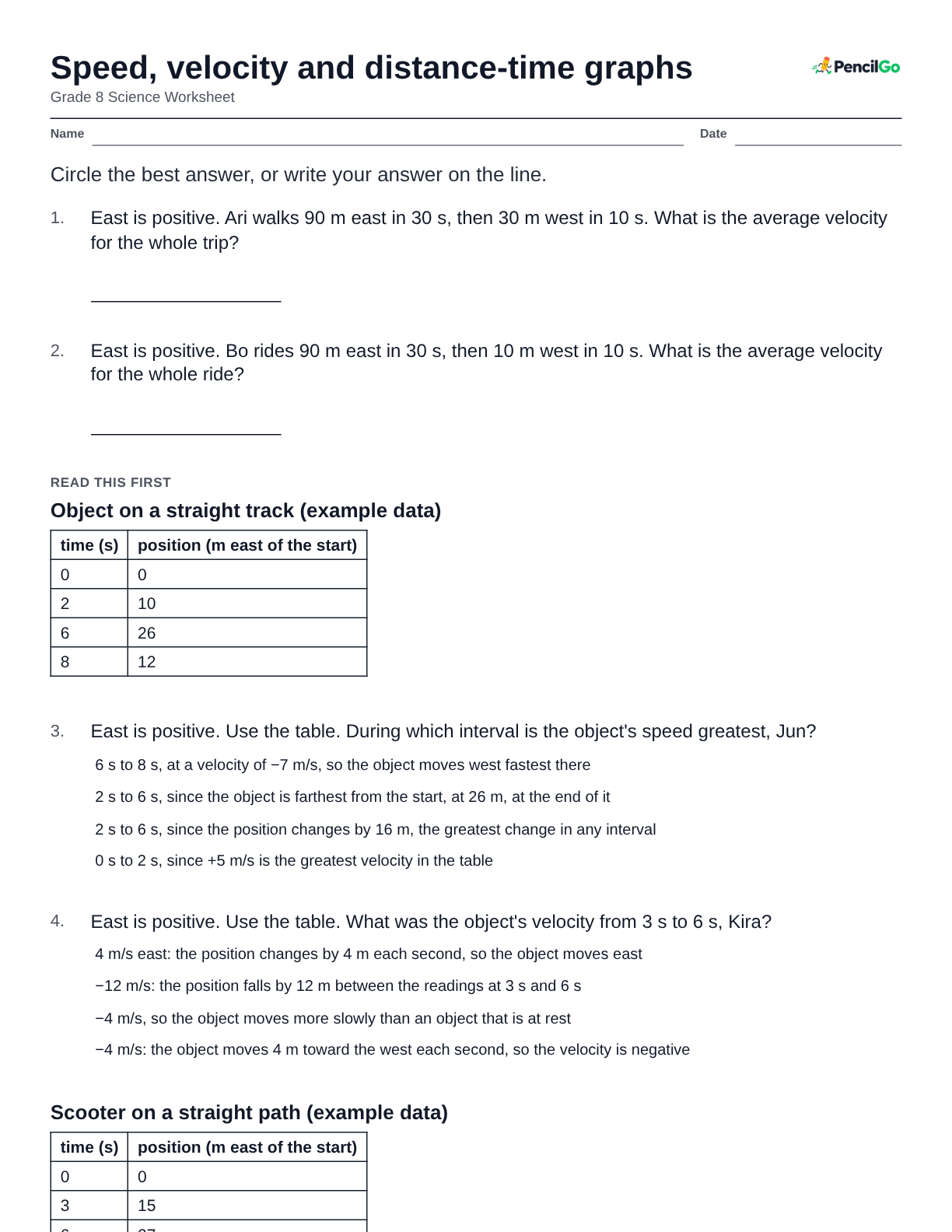
Speed, velocity and distance-time graphs
Grade 8 Science Worksheet - Building Confidence

Circle the best answer, or write your answer on the line.
Ari graphs a scooter rolling at a steady speed. Use the two marked points. What is the scooter's speed?
Bo rolls a ball along a track and graphs it. Use the two marked points. What is the ball's speed?
Esme's toy car rolls at a steady speed across the gym. Use the two marked points. What is the car's speed?
Both runners keep a steady pace. Jun times two runners and lists their distances from the start. Which statement does the table support?
- The runners cannot be compared, because they began at different distances from the start
- The two runners have the same speed: both distances keep growing at a steady rate
- Runner B is faster: its distance from the start is larger than A's at each time listed
- Runner A is faster: its distance grows 4 m each second, while B's grows 2 m each second
Distance is measured from the start. Luz records three objects. Which two have the same speed?
- H and J: both start at 30 m from the start, so they must move at the same speed
- G and H: each one gains 10 m every 5 s, even though H starts 30 m farther along
- The three objects have equal speeds, since each distance keeps growing as time passes
- No two of them can match, since the objects start at different distances from the start
Read this first
Cart on a straight track (example data)
time (s) position (m east of the start) 0 12 2 6 4 0 6 −6 East is positive. Milo tracks a cart on a straight track. What is the cart's velocity?
- −3 m/s: the cart moves 3 m toward the west each second, so its velocity is negative
- −18 m/s: the position falls by 18 m from the first reading to the last
- 3 m/s east: the position changes by 3 m each second, so the cart moves east
- −6 m/s: the position falls by 6 m between each pair of readings
Toy helicopter (example data)
time (s) height (m) 0 10 2 16 4 12 6 6 Up is positive. Pia flies a toy helicopter. What is its velocity from 4 s to 6 s?
- −6 m/s: the height falls by 6 m between the two readings at 4 s and 6 s
- +6 m/s: the helicopter climbed 6 m between the first two readings, so that is its velocity
- +3 m/s: the height changes by 3 m each second, so the helicopter rises
- −3 m/s: the helicopter descends 3 m each second, so its velocity is negative
Ren walks 30 m east to a mailbox, then 30 m back west to the start, in 40 s. Which description is correct?
- Distance 60 m, displacement 60 m, average speed 1.5 m/s
- Distance 0 m, displacement 0 m, average speed 0 m/s
- Distance 60 m, displacement 0 m, average speed 0 m/s
- Distance 60 m, displacement 0 m, average speed 1.5 m/s
Tala runs one 400 m lap of a track in 80 s and ends back at the start. Which statement is true?
- The average speed is 5 m/s, but the average velocity is 0 m/s
- The displacement is 400 m, so the average velocity is 5 m/s in the direction of the run
- The average speed and the average velocity are both 5 m/s
- The average speed is 0 m/s, since the runner ends at the starting line
Zee bikes 50 m north, then 20 m south, along a straight street. What is the bike's displacement?
- 20 m south, the length of the last part of the ride, not the net change
- 50 m north, the length of the first part of the ride, not the net change
- 70 m north, the total length of the whole path of the bike
- 30 m north, the net change from the start of the ride to its end