Waves that add and cancel
Grade 8 Science Worksheet

Circle the best answer, or write your answer on the line.
Each wave repeats every 4 s. Two waves pass the same spot. What is the amplitude of the combined wave there, Ari?
Each ripple repeats every 6 s. Two ripples pass the same spot in Bo's pond. What is the amplitude of the combined ripple there?
Each wave repeats every 8 s. Two waves rock Esme's boat at the same time. What is the amplitude of the combined wave at the boat?
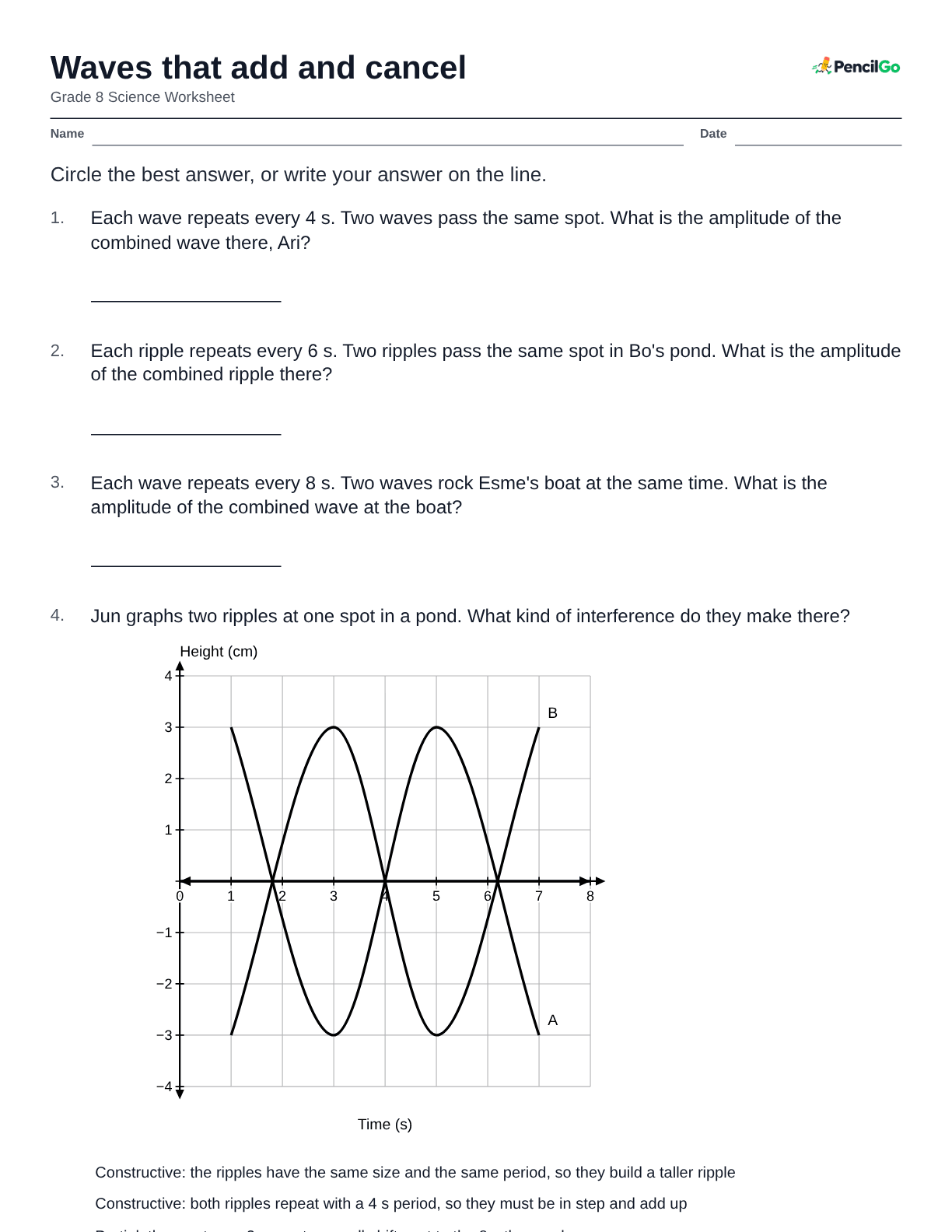
Jun graphs two ripples at one spot in a pond. What kind of interference do they make there?
- Constructive: the ripples have the same size and the same period, so they build a taller ripple
- Constructive: both ripples repeat with a 4 s period, so they must be in step and add up
- Partial: the crests are 2 s apart, a small shift next to the 8 s the graph spans
- Destructive: B is at a trough whenever A is at a crest, so the water stays flat there
Each wave repeats every 4 s. Two waves cross at one spot, and the table lists their crest times there. What kind of interference is it, Kira?
- Destructive: two crests arriving at the same moment push on each other, so they cancel
- Neither: waves arriving at a spot at the same moment cannot combine with each other
- Destructive: waves with matching crest times are the same wave, so one removes the other
- Constructive: the crests arrive together, so the combined wave is taller
Read this first
Seat and two speakers (example data)
first speaker (m) second speaker (m) wavelength of the note (m) 5.0 6.5 0.5 Room echoes are ignored.
Two speakers play one note in step. By how many wavelengths do Milo's distances to the speakers differ?
Two speakers play one note in step. By how many wavelengths do the distances from Noah's seat to the speakers differ?
Seats and two speakers (example data)
seat distance to speaker 1 (m) distance to speaker 2 (m) A 4.0 5.0 B 4.0 4.25 C 5.0 5.5 The note has a wavelength of 0.5 m. Room echoes are ignored.
Two speakers play one note in step. Which seat is quiet, Ren?
- Seat B, where the paths differ by 0.25 m, half a wavelength, so crests meet troughs
- Seat C, where the paths differ by 0.5 m, a whole wavelength, so the waves cancel
- No seat: two speakers playing in step add up everywhere, so the room stays loud
- Seat A, where the paths differ by 1.0 m, the biggest gap of the three, so the waves cancel there
Two speakers play one note in step. At which seat is the sound loudest, Tala?
- Seat A, where the paths differ by 0.75 m, 1.5 wavelengths, so the waves add
- Seat C, since the waves from the nearer speaker are louder than those from the farther one
- Seat C, where the paths differ least, 0.25 m, so the two waves arrive nearly together
- Seat B, where the paths differ by 1.0 m, which is 2 whole wavelengths
Room echoes are ignored. Two speakers play one note in step. Seat D is 4.0 m from both speakers. What does Zee hear at D?
- A normal note: two speakers playing in step cannot add up to a louder note
- A quiet note: waves that arrive at the same moment from two speakers cancel
- A quiet note: equal distances leave no path difference to add anything to the sound
- A loud note: the waves travel equal distances, so crests arrive together and add