PencilGo

Grade 8 · Science

8th grade Transverse, longitudinal and sound waves worksheet

6 printable versionsOn Level10 questions · answer keyFree · no account

Level: Building Confidence · On Level · Challenge Me

When it’s done, scan the sheet with your phone and PencilGo marks it and picks the next one. Create a free account

Version
Print

Transverse, longitudinal and sound waves

Grade 8 Science Worksheet

NameDate

Circle the best answer.

  1. Ari beats a drum, and a sound wave moves east through the air. How do the air particles move?

    • East with the wave, right to your ear
    • Up and down, across the wave's path
    • Back and forth, east and west
    • They stay still
  2. Esme's book describes a wave whose particles move at right angles to the wave's direction. Which wave is it?

    • A longitudinal wave
    • A transverse wave
    • A wave that carries particles along
    • A sound wave in air
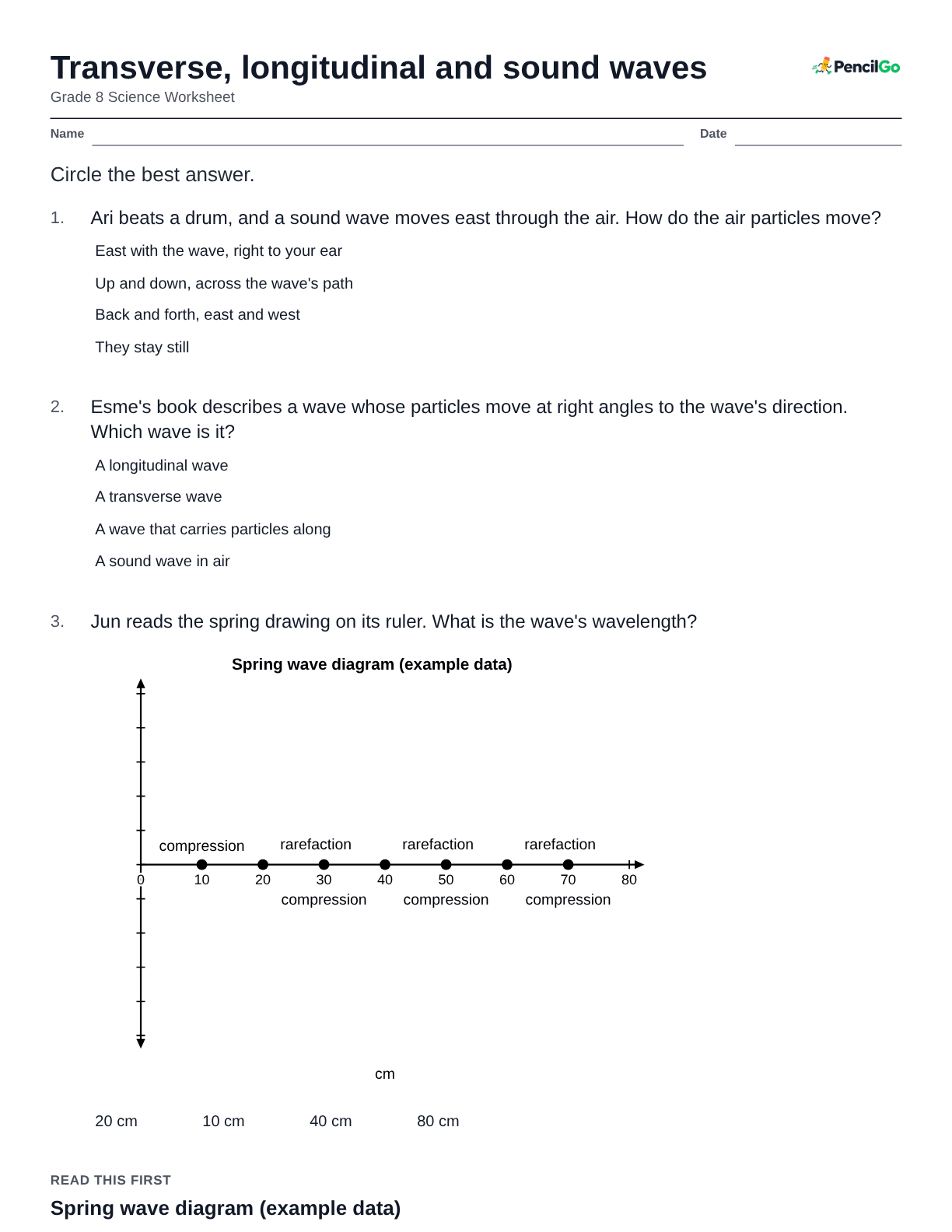
  3. Jun reads the spring drawing on its ruler. What is the wave's wavelength?

    • 20 cm
    • 10 cm
    • 40 cm
    • 80 cm
  4. Read this first

    Spring wave diagram (example data)

    a spring lying along a ruler marked 0 to 90 cm. Compressions (bunched coils) at 15, 45, 75 cm. Rarefactions (spread-out coils) at 30, 60 cm.

  5. Kira draws a slower push on the spring, so the compressions are farther apart. What is the wavelength?

    • 60 cm
    • 30 cm
    • 15 cm
    • 90 cm
  6. Luz measures a very long spring stretched across the gym floor. What is the wavelength?

    • 0.8 m
    • 1.6 m
    • 2.4 m
    • 0.4 m
  7. Table (OpenStax data)

    Material, speed of sound (m/s). Air at 20 °C, about 343; fresh water, about 1,480; steel, about 5,900 to 6,000.

  8. Milo studies the speed of sound table. In which material does sound travel fastest?

    • Each one, since sound has one speed
    • Air, since it is the easiest to move through
    • Fresh water
    • Steel
  9. A whale's call travels through water. Using the table, about how many times faster is sound in water than in air, Noah?

    • About 40 times faster
    • About the same speed
    • About 4 times faster
    • Slower in water than in air
  10. Pia wonders why sound moves faster in water than in air. Which reason fits the science?

    • Water carries the sound along as a current
    • Water is much harder to squeeze than air
    • It doesn't: sound is faster in air
    • Sound turns into light in water
  11. Ren looks at the night sky. Which wave can cross the empty space between a far star and Earth?

    • A ripple on a pond
    • Sound from the star
    • A wave along a rope
    • The star's light
  12. Tala reads that sound and water waves are mechanical waves. What do mechanical waves need?

    • Matter to travel through, called a medium
    • A battery
    • Light to carry them
    • Empty space with nothing in it
PencilGopencilgo.com

8th grade Transverse, longitudinal and sound waves worksheet – printable
Print: 123456

About this worksheet

Transverse, longitudinal and sound waves. Every version has 10 questions, and the answer key prints on the second page.

What your child will learn

  • I can tell a transverse wave (the material moves across the wave's path) from a longitudinal wave (it moves back and forth along the path).
  • I can label compressions, rarefactions and one wavelength on a spring wave.
  • I can explain that sound needs a medium, is longitudinal in air and water, and travels faster in water and steel than in air.

Standard: supports MS-PS4-1, MS-PS4-2

Words to know

transverse wave: The material moves across the direction the wave travels

longitudinal wave: The material moves back and forth along the wave's direction

compression: A place where the coils or particles are bunched together

rarefaction: A place where the coils or particles are spread apart

medium: The matter a wave travels through, such as air, water or steel

mechanical wave: A wave that needs a medium, like sound or a rope wave

Common mistakes

Your child named the wave type from where the wave goes, not from how the material moves. Shake a rope up and down together and watch one spot.

Your child swapped the names transverse and longitudinal. Say it together: transverse goes across, longitudinal goes along the length.

Your child pictured sound in air as an up-and-down wiggle. In air and water, sound is squeezes and spreads of particles along its path.

Questions parents ask

What is the most common mistake with transverse, longitudinal and sound waves?

Your child named the wave type from where the wave goes, not from how the material moves. Shake a rope up and down together and watch one spot.

Are these 8th grade science worksheets free to print?

Yes. All 6 printable versions at each level are free to print, with the answer key, and no account is needed.

More grade 8 science

See all grade 8 science

Every sheet you scan goes into your child’s record: dated, marked and ready for the year-end portfolio. Homeschool records