PencilGo

Grade 8 · Science

8th grade Transverse, longitudinal and sound waves worksheet

6 printable versionsChallenge Me10 questions · answer keyFree · no account

Level: Building Confidence · On Level · Challenge Me

When it’s done, scan the sheet with your phone and PencilGo marks it and picks the next one. Create a free account

Version
Print

Transverse, longitudinal and sound waves

Grade 8 Science Worksheet - Challenge Me

NameDate

Circle the best answer.

  1. Ari presses an ear to a long steel railing while a friend taps the far end. Two taps are heard: one through the steel, one through the air. Which comes first?

    • The tap through the air, as air is easy to push
    • The tap through the air, as it is louder
    • Both together: sound has one speed
    • The tap through the steel
  2. Sound travels about 1,480 m/s in fresh water and 343 m/s in 20 °C air. About how long does sound take to cross 3,000 m of lake water, Bo?

    • About 9 s
    • About 4,400 s
    • About 2 s
    • About 0.5 s
  3. Sound crosses 343 m of 20 °C air in about 1 s. Steel carries sound at about 5,900 to 6,000 m/s. About how long do 343 m of steel take, Esme?

    • About 17 s
    • About 0.06 s
    • About 1 s
    • About 0.6 s
  4. Jun plays a 343 Hz note near a pool, and the sound passes from the air into the water. Which property of the sound stays the same?

    • Its wavelength
    • Its speed
    • Its frequency
    • Nothing: sound cannot enter water
  5. Luz hears a sound pass from the water back into the air. What happens to its wavelength?

    • It gets shorter, as sound slows down
    • It gets longer, as air is easier to move through
    • It drops to zero
    • It stays the same
  6. Milo says sound in air must be a transverse wave, because books draw it as a wiggly line. Agree or disagree?

    • Agree: waves are transverse
    • Disagree: the air moves along the path
    • Disagree: sound is not a wave
    • Agree: the wiggle shows air moving up and down
  7. Noah says the sound from a speaker pushes the same air all the way across the room to your ear. Agree or disagree?

    • Agree: louder sounds carry more air along
    • Agree: the air flows to your ear like a breeze
    • Disagree: the air stays; the energy travels
    • Disagree: sound needs no air
  8. Ren chooses a model to show sound moving through air. Which model fits best?

    • A rope wiggling up and down
    • Balls of air rolling from speaker to ear
    • A spring with bunched and spread coils
    • A single still dot
  9. Tala chooses a model to show light from a lamp. Light is an electromagnetic wave. Which model fits best?

    • A spring standing still
    • Air particles carrying the light along
    • Bunched and spread coils along the path
    • A wiggle across the direction of travel
  10. Zee moves a toy spring side to side, then pushes it along its length. Which pair names the two waves, in order?

    • Both longitudinal: it is a spring
    • Longitudinal, then transverse
    • Both transverse: the spring moves each time
    • Transverse, then longitudinal
PencilGopencilgo.com

8th grade Transverse, longitudinal and sound waves worksheet – printable
Print: 123456

About this worksheet

Transverse, longitudinal and sound waves. Every version has 10 questions, and the answer key prints on the second page.

What your child will learn

  • I can tell a transverse wave (the material moves across the wave's path) from a longitudinal wave (it moves back and forth along the path).
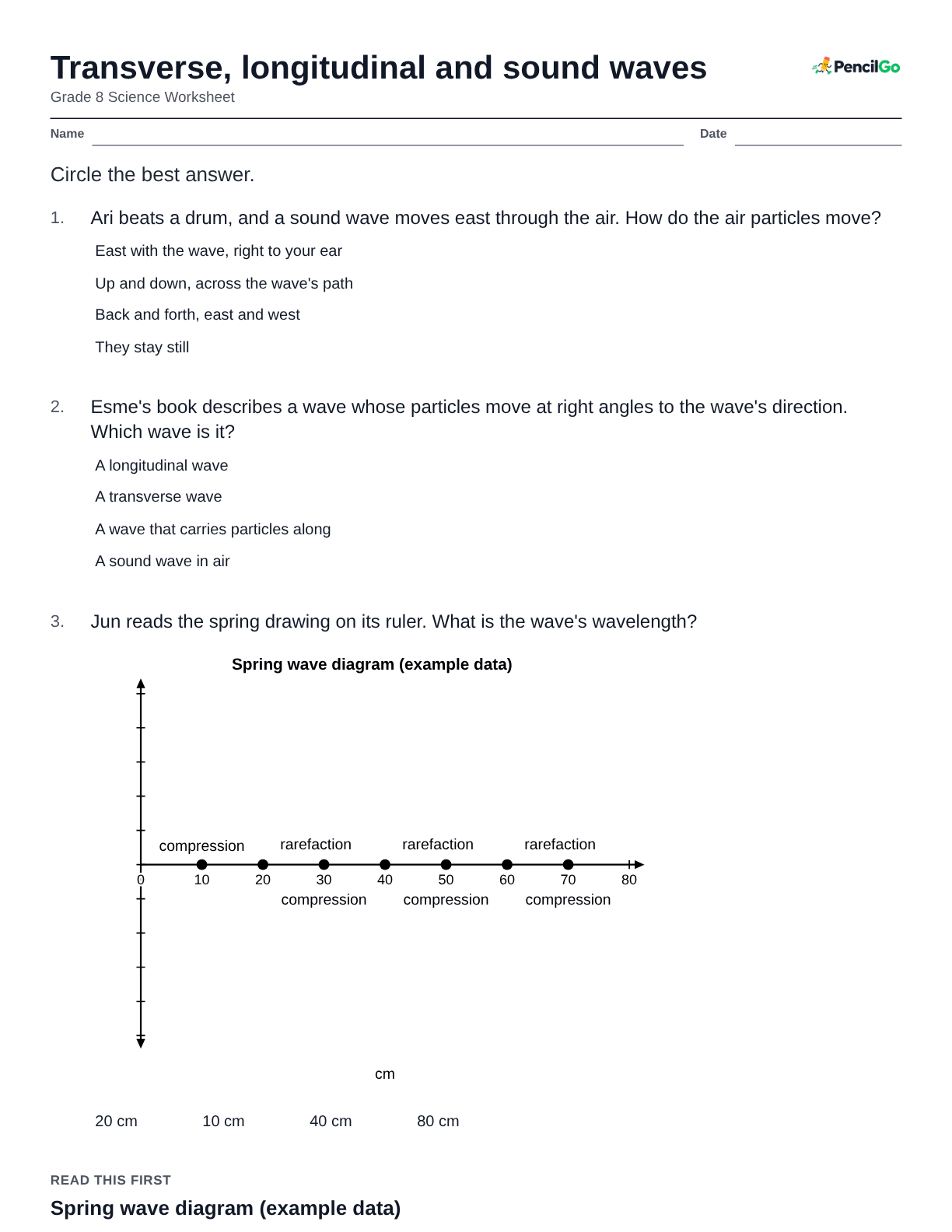
  • I can label compressions, rarefactions and one wavelength on a spring wave.
  • I can explain that sound needs a medium, is longitudinal in air and water, and travels faster in water and steel than in air.

Standard: supports MS-PS4-1, MS-PS4-2

Words to know

transverse wave: The material moves across the direction the wave travels

longitudinal wave: The material moves back and forth along the wave's direction

compression: A place where the coils or particles are bunched together

rarefaction: A place where the coils or particles are spread apart

medium: The matter a wave travels through, such as air, water or steel

mechanical wave: A wave that needs a medium, like sound or a rope wave

Common mistakes

Your child named the wave type from where the wave goes, not from how the material moves. Shake a rope up and down together and watch one spot.

Your child swapped the names transverse and longitudinal. Say it together: transverse goes across, longitudinal goes along the length.

Your child pictured sound in air as an up-and-down wiggle. In air and water, sound is squeezes and spreads of particles along its path.

Questions parents ask

What is the most common mistake with transverse, longitudinal and sound waves?

Your child named the wave type from where the wave goes, not from how the material moves. Shake a rope up and down together and watch one spot.

Are these 8th grade science worksheets free to print?

Yes. All 6 printable versions at each level are free to print, with the answer key, and no account is needed.

More grade 8 science

See all grade 8 science

Every sheet you scan goes into your child’s record: dated, marked and ready for the year-end portfolio. Homeschool records