The greenhouse effect
Grade 9 Science Worksheet

Circle the best answer.
Read this first
Energy flows as a share of incoming sunlight (NASA)
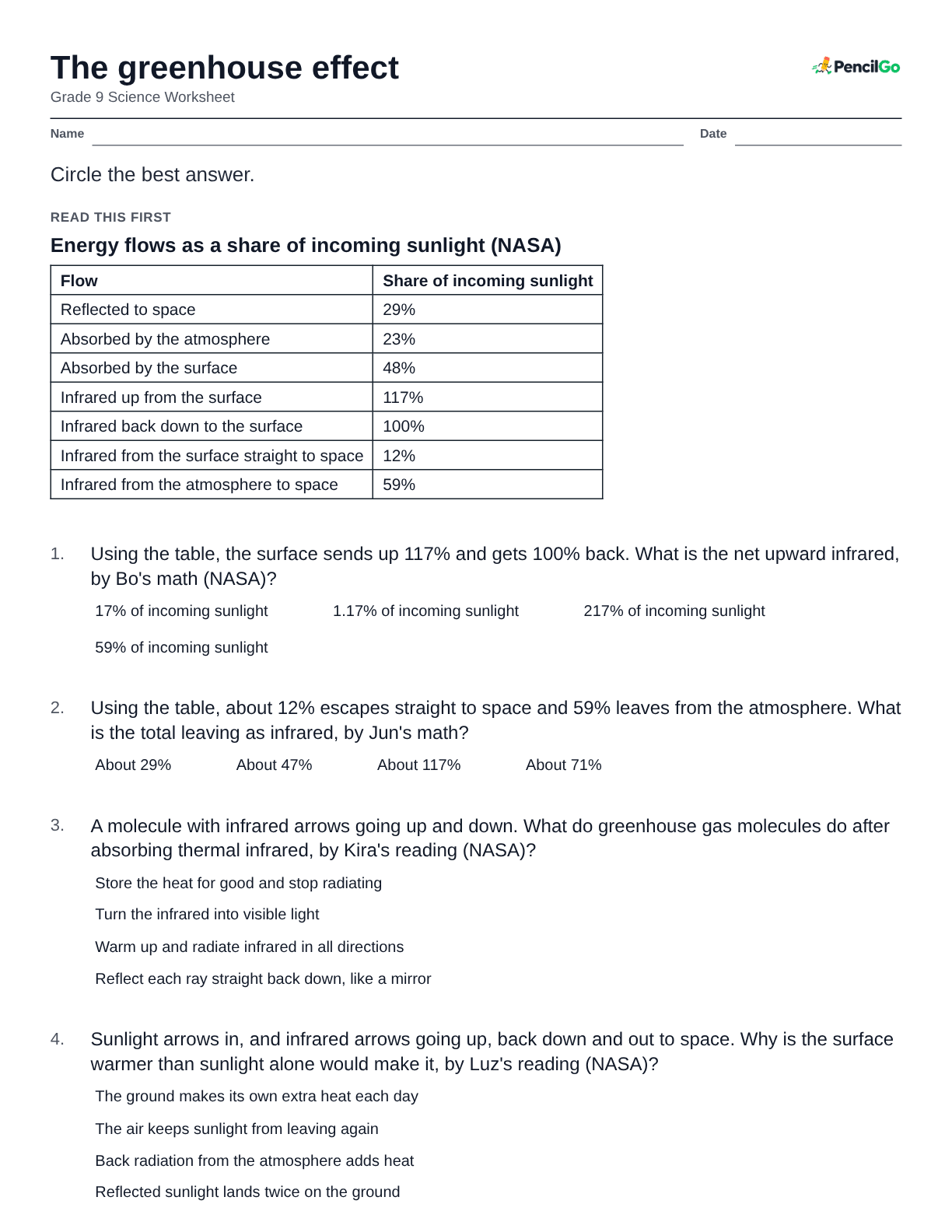
Flow Share of incoming sunlight Reflected to space 29% Absorbed by the atmosphere 23% Absorbed by the surface 48% Infrared up from the surface 117% Infrared back down to the surface 100% Infrared from the surface straight to space 12% Infrared from the atmosphere to space 59% Using the table, the surface sends up 117% and gets 100% back. What is the net upward infrared, by Bo's math (NASA)?
- 17% of incoming sunlight
- 1.17% of incoming sunlight
- 217% of incoming sunlight
- 59% of incoming sunlight
Using the table, about 12% escapes straight to space and 59% leaves from the atmosphere. What is the total leaving as infrared, by Jun's math?
- About 29%
- About 47%
- About 117%
- About 71%
A molecule with infrared arrows going up and down. What do greenhouse gas molecules do after absorbing thermal infrared, by Kira's reading (NASA)?
- Store the heat for good and stop radiating
- Turn the infrared into visible light
- Warm up and radiate infrared in all directions
- Reflect each ray straight back down, like a mirror
Sunlight arrows in, and infrared arrows going up, back down and out to space. Why is the surface warmer than sunlight alone would make it, by Luz's reading (NASA)?
- The ground makes its own extra heat each day
- The air keeps sunlight from leaving again
- Back radiation from the atmosphere adds heat
- Reflected sunlight lands twice on the ground
Use this
Absorption bands for water vapor and CO₂, with a window near 10 micrometers.
NASA: water vapor lets some infrared through a window. Around what wavelength is that window centered, by Noah's reading?
- About 1 micrometer
- About 100 micrometers
- About 0.5 micrometers
- About 10 micrometers
NASA: CO₂ strongly absorbs infrared longer than about 12 to 13 micrometers. What does more CO₂ do to the window, by Pia's reading?
- Opens it wider, so more heat escapes
- Leaves it unchanged, since water vapor controls it
- Partly closes it, so less heat escapes
- Blocks more sunlight from coming in
Why does adding CO₂ matter even though water vapor is the most abundant greenhouse gas, by Ren's reading (NASA)?
- Water vapor does not absorb any infrared
- CO₂ absorbs the same wavelengths, so it adds little
- CO₂ absorbs wavelengths that water vapor lets through
- CO₂ reflects incoming sunlight back to space
Table, Greenhouse gas levels (IPCC AR6; NOAA), with columns Gas, Level
Carbon dioxide (CO₂), 2019, 410 ppm; Carbon dioxide, before about 1750, 280 ppm or less; Methane (CH₄), 2019, 1866 ppb; Nitrous oxide (N₂O), 2019, 332 ppb.
Using the table, how much higher was CO₂ in 2019 than before about 1750, by Tala's math?
- About 130 ppm
- About 1,456 ppm
- About 1.5 ppm
- About 690 ppm
Using the table, the 2019 CO₂ level is about how many times the level before about 1750, by Zee's math?
- About 1.5 times
- About 15 times
- About 0.7 times
- About 130 times
Which two gases in the table are given in parts per billion, by Ari's reading?
- Carbon dioxide and methane
- Methane and nitrous oxide
- Oxygen and nitrogen
- Carbon dioxide and nitrous oxide