PencilGo

Grade 10 · Math · Geometry

10th grade Model a real object with a shape, and design problems with limits worksheet

6 printable versionsOn Level10 questions · answer keyFree · no account

Level: Building Confidence · On Level · Challenge Me

When it’s done, scan the sheet with your phone and PencilGo marks it and picks the next one. Create a free account

Version
Print

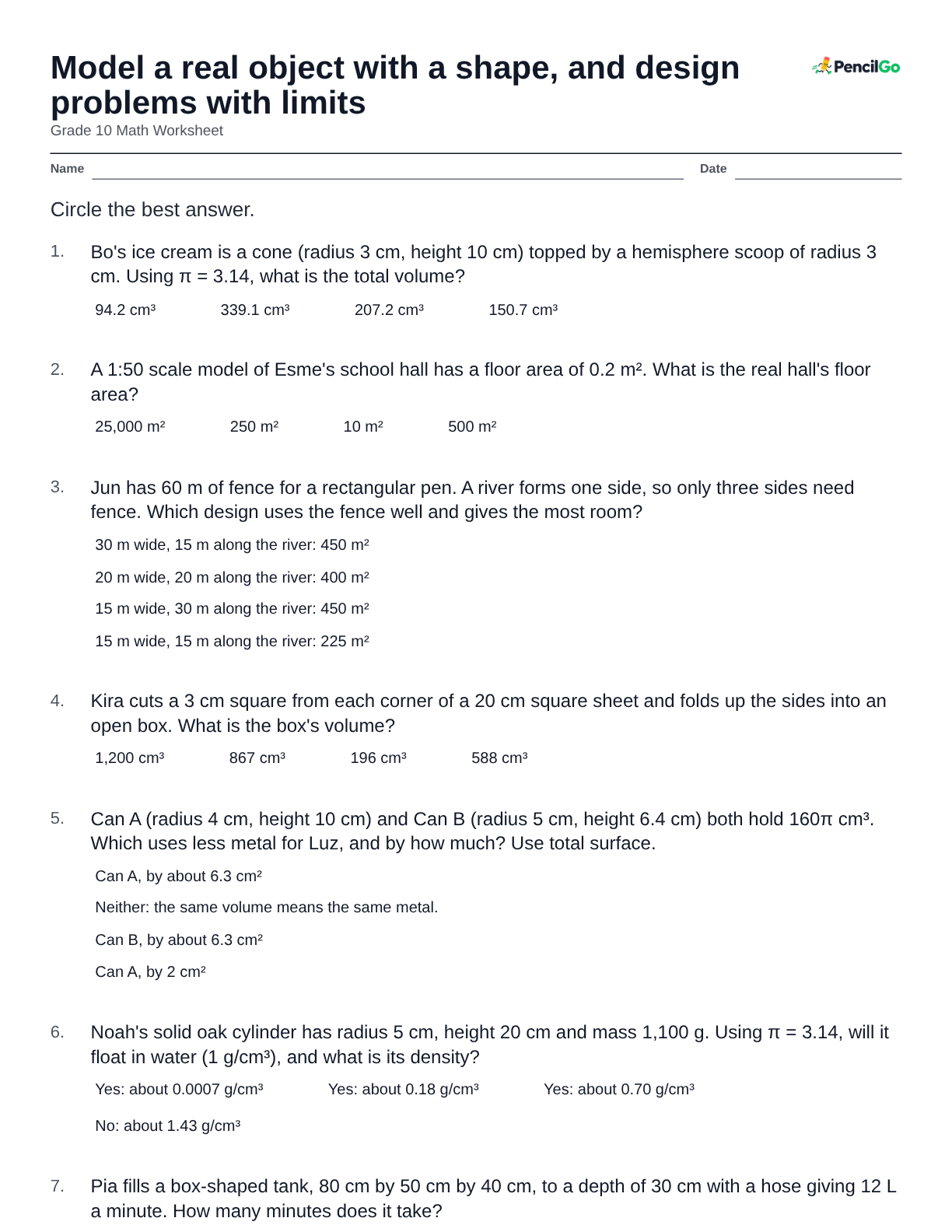
Model a real object with a shape, and design problems with limits

Grade 10 Math Worksheet

NameDate

Circle the best answer.

  1. Bo's ice cream is a cone (radius 3 cm, height 10 cm) topped by a hemisphere scoop of radius 3 cm. Using π = 3.14, what is the total volume?

    • 94.2 cm³
    • 339.1 cm³
    • 207.2 cm³
    • 150.7 cm³
  2. A 1:50 scale model of Esme's school hall has a floor area of 0.2 m². What is the real hall's floor area?

    • 25,000 m²
    • 250 m²
    • 10 m²
    • 500 m²
  3. Jun has 60 m of fence for a rectangular pen. A river forms one side, so only three sides need fence. Which design uses the fence well and gives the most room?

    • 30 m wide, 15 m along the river: 450 m²
    • 20 m wide, 20 m along the river: 400 m²
    • 15 m wide, 30 m along the river: 450 m²
    • 15 m wide, 15 m along the river: 225 m²
  4. Kira cuts a 3 cm square from each corner of a 20 cm square sheet and folds up the sides into an open box. What is the box's volume?

    • 1,200 cm³
    • 867 cm³
    • 196 cm³
    • 588 cm³
  5. Can A (radius 4 cm, height 10 cm) and Can B (radius 5 cm, height 6.4 cm) both hold 160π cm³. Which uses less metal for Luz, and by how much? Use total surface.

    • Can A, by about 6.3 cm²
    • Neither: the same volume means the same metal.
    • Can B, by about 6.3 cm²
    • Can A, by 2 cm²
  6. Noah's solid oak cylinder has radius 5 cm, height 20 cm and mass 1,100 g. Using π = 3.14, will it float in water (1 g/cm³), and what is its density?

    • Yes: about 0.0007 g/cm³
    • Yes: about 0.18 g/cm³
    • Yes: about 0.70 g/cm³
    • No: about 1.43 g/cm³
  7. Pia fills a box-shaped tank, 80 cm by 50 cm by 40 cm, to a depth of 30 cm with a hose giving 12 L a minute. How many minutes does it take?

    • 120 minutes
    • 10 minutes
    • 13.3 minutes
    • 10,000 minutes
  8. Soup cans, each 7 cm across and 12 cm tall, are packed upright in a box 21 cm by 28 cm by 12 cm inside. Ren wants the most cans. How many fit?

    • 15
    • 16
    • 9
    • 12
  9. Tala paints the curved side of a round tower, 6 m across and 18 m tall. One liter covers 9 m²; cans hold 5 L. Using π = 3.14, how many cans are needed?

    • 16
    • 8
    • 7
    • 38
  10. Zee's tent is a square pyramid with a 4 m square base and a height of 3 m. The fabric covers the four sloping faces only. How much fabric is needed?

    • About 28.8 m²
    • 57.7 m²
    • 24 m²
    • 44.8 m²
PencilGopencilgo.com

10th grade Model a real object with a shape, and design problems with limits worksheet – printable
Print: 123456

About this worksheet

Model a real object with a shape, and design problems with limits. Every version has 10 questions, and the answer key prints on the second page.

What your child will learn

  • I can say which way a simple model errs, and convert units for volume, area and cost.
  • I can find the volume or surface of a composite object, a fenced pen, a box cut from a sheet, a scale model, a tank and a pack of cans, and round up when whole items are bought.
  • I can compare two designs and read a table of options, an estimate with bounds, and a claim about scaling.

Standard: G-MG.A.1, G-MG.A.3

Words to know

model: A simple shape that stands for a real object, close enough to measure.

constraint (limit): A rule the design must keep: a fixed fence, whole bags, a price.

surface area: The material that covers the outside: paper, cardboard, paint.

rate: How much for each one unit: liters a minute, dollars a square foot.

Common mistakes

Your child got the direction of the modeling error backwards. Compare the model's size with the real object's size at every height.

Your child assumed a model is exact. A model is a simplification, so say whether it is too big or too small.

Your child said it could not be decided when the figures already settle the direction. Ask what changes with height.

Questions parents ask

What is the most common mistake with model a real object with a shape, and design problems with limits?

Your child got the direction of the modeling error backwards. Compare the model's size with the real object's size at every height.

Are these 10th grade math worksheets free to print?

Yes. All 6 printable versions at each level are free to print, with the answer key, and no account is needed.

More geometry

See all Geometry

Every sheet you scan goes into your child’s record: dated, marked and ready for the year-end portfolio. Homeschool records