Why the volume formulas work (Cavalieri's principle)
Grade 10 Math Worksheet

Circle the best answer, or write your answer on the line.
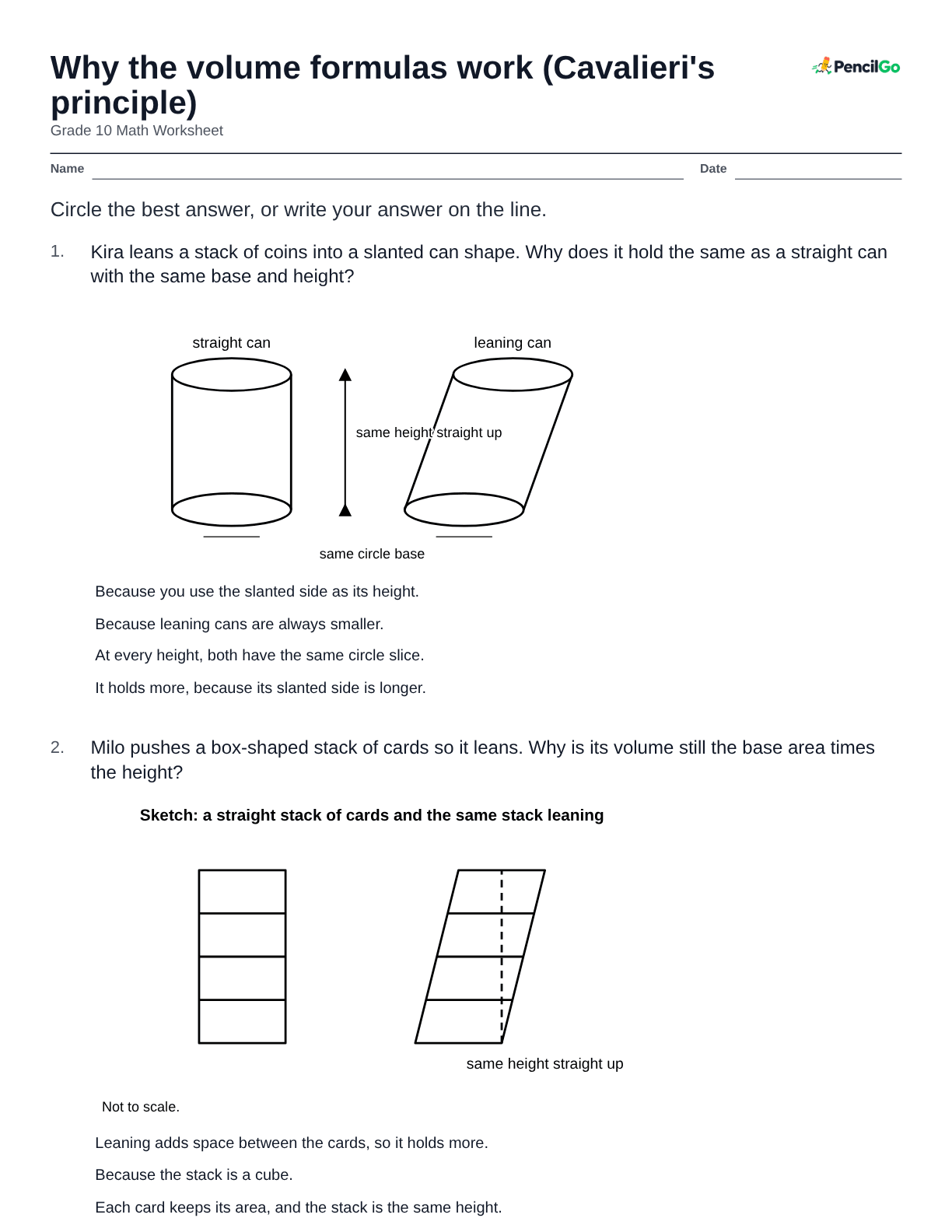
Kira leans a stack of coins into a slanted can shape. Why does it hold the same as a straight can with the same base and height?
- Because you use the slanted side as its height.
- Because leaning cans are always smaller.
- At every height, both have the same circle slice.
- It holds more, because its slanted side is longer.
Milo pushes a box-shaped stack of cards so it leans. Why is its volume still the base area times the height?
- Leaning adds space between the cards, so it holds more.
- Because the stack is a cube.
- Each card keeps its area, and the stack is the same height.
- Because the slanted edge is now the height.
Noah stacks 10 square paper plates straight, then twists another 10 so their corners turn. Why do the two stacks have the same volume?
- Twisting adds corners, so it holds more.
- Each turned plate still has the same area at its height.
- They don't: turned squares make different slices.
- Twisting packs them tighter, so it holds less.
Pia's clay can has radius and height 6 cm, with a cone scooped out, tip at the bottom center. What is the area of its slice 2 cm up, in terms of π (like 14π)?
Ren's clay can has radius and height 7 cm, with a cone scooped out, tip at the bottom center. What is the area of its slice 3 cm up, in terms of π (like 14π)?
Tala's clay can has radius and height 9 cm, with a cone scooped out, tip at the bottom center. What is the area of its slice 5 cm up, in terms of π (like 14π)?
Zee's clay can has radius and height 5 cm, with a cone scooped out, tip at the bottom center. What is the area of its slice 2 cm up, in terms of π (like 14π)?
Read this first
Sketch, not to scale
The leaning cone with radius 3 cm, the height 11 cm drawn straight up from the base to the tip's level, and its longest side 12 cm.
Ari's clay volcano leans: radius 3 cm, height 11 cm straight up, and its longest side is 12 cm. What is its volume in cubic cm, in terms of π (like 14π)?
Bo's leaning ice cream cone leans: radius 6 cm, height 5 cm straight up, and its longest side is 8 cm. What is its volume in cubic cm, in terms of π (like 14π)?
Use this
Sketch, not to scale: the leaning cone with radius 9 cm, the height 4 cm drawn straight up from the base to the tip's level, and its longest side 15 cm.
Jun's leaning sand volcano leans: radius 9 cm, height 4 cm straight up, and its longest side is 15 cm. What is its volume in cubic cm, in terms of π (like 14π)?