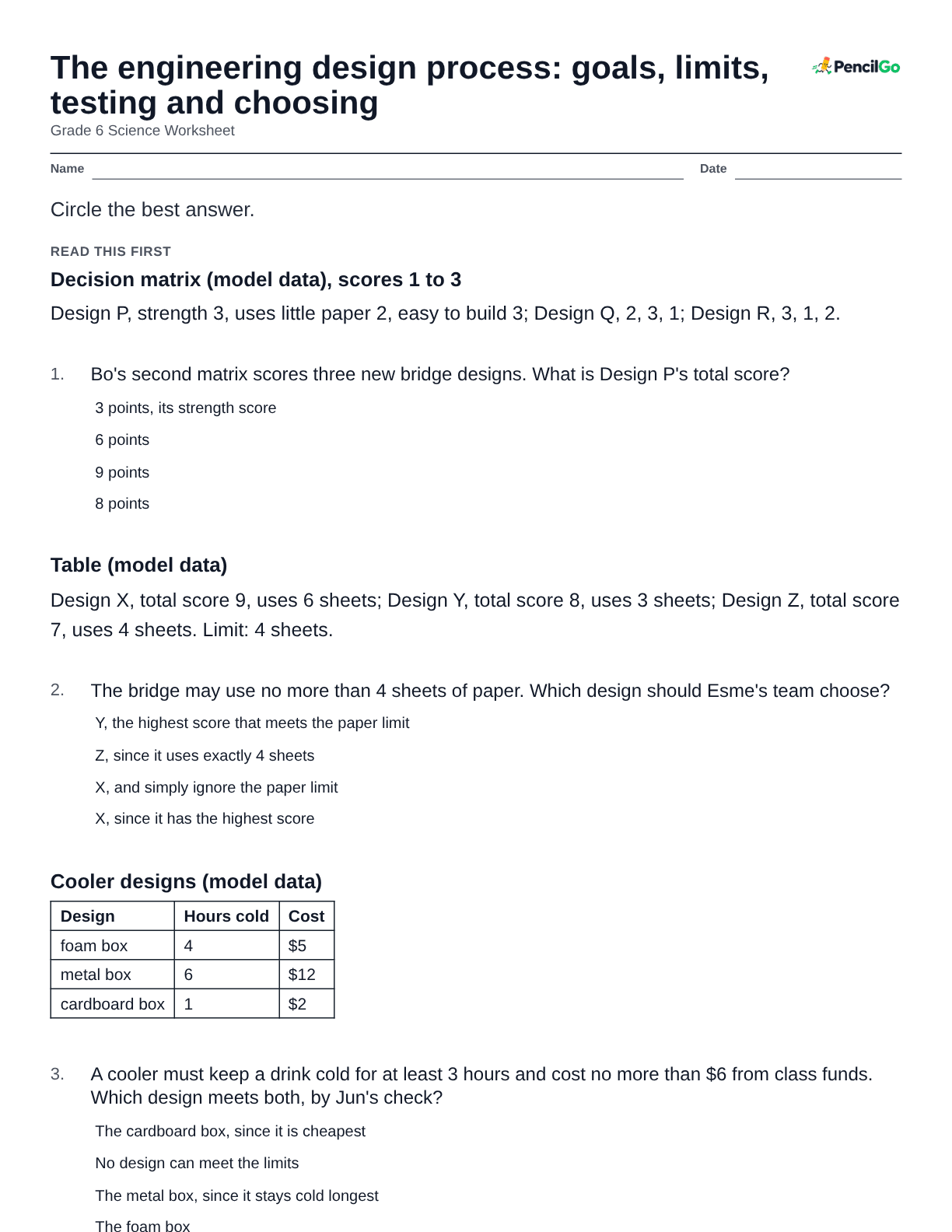
The engineering design process: goals, limits, testing and choosing
Grade 6 Science Worksheet - Building Confidence

Circle the best answer.
Ari's team must keep a playground slide cool on sunny days. What is the first step of the engineering design process?
- Test a shade before drawing any plan
- Pick the prettiest color for the shade before anything else
- Build the final shade right away
- Define the problem: its criteria and constraints
Marked and an arrow to the next box. A test shows the model shade tips over in strong wind. Which step comes next for Kira's team?
- Give up on shades altogether
- Paint it so it looks sturdier in the wind
- Install it anyway
- Improve the design and test it again
Paper bridge across a 30 cm gap; hold pennies; use no more than 4 sheets of paper. Jun's class is building paper bridges across a 30 cm gap. Which one is a constraint?
- Use no more than 4 sheets of paper
- Hold as many pennies as possible on top
- Be strong in the middle
- Stay level across the gap
Lunch cooler; keep a drink cold for 4 hours; fit in a backpack; use class craft supplies; finish by Friday. Luz's team designs a lunch cooler with class craft supplies. Which one is a criterion?
- Fit inside a backpack
- Keep a drink cold for 4 hours
- Use class craft supplies
- Be finished by Friday
Garden-water filter; make muddy water clearer; work quickly; use only classroom materials. Milo's class designs a filter to clean muddy water for watering the garden. Which one is a constraint?
- Catch the sand
- Use only classroom materials
- Make the water clearer
- Let water through the filter quickly
Read this first
Decision matrix (model data), scores 1 to 3
Design A, strength 3, uses little paper 1, easy to build 2; Design B, 2, 3, 3; Design C, 3, 2, 1.
Noah's team scored three bridge designs from 1 (low) to 3 (high). Which design has the highest total?
- Design B, with 8 points
- They tie, so any one will do
- Design C, also top for strength
- Design A, the strongest
Using the same matrix, which design is best at using little paper, by Pia's reading?
- Design A, scoring 1
- Design B, scoring 3
- Design C, the strongest one
- Design A, since strength matters most
Cooler tests (model data)
Trial Result 1 cold after 4 hours 2 not yet tested 3 not yet tested Tala's team tests their cooler once, and the drink stays cold. What should they do next?
- Switch to a different cooler design instead
- Call it done after one test
- Change three things at once and test
- Test it several more times to be sure
Table, Repeated trials (model data), with columns Trial 1, Trial 2, Trial 3. Why do engineers repeat tests on the same design, as Zee explains?
- One test is plenty; repeats waste time
- Because first tests do not count
- To use up the extra materials
- One test could be a fluke; repeats show if results hold
Cooler trials (model data)
Trial Hours cold 1 4.0 2 4.2 3 3.9 The cooler kept a drink cold for 4.0, 4.2 and 3.9 hours in three trials. What do the trials show Esme?
- No more tests should ever be run
- Just the first trial counts
- The result is steady, about 4 hours
- The cooler failed, since the trials differ