How helpful traits become more common over many generations
Grade 7 Science Worksheet - Challenge Me

Circle the best answer.
Read this first
Use the table
Three rounds of an antibiotic on a lab plate (model data). Agar plate diagram, zones: Zone 1: Round 1: antibiotic on the plate | a few small colonies; Zone 2: Round 2: bacteria from those colonies, same antibiotic | many colonies; Zone 3: Round 3: bacteria from the Round 2 colonies, same antibiotic | colonies cover most of the plate. Comparison chart.
Round Able to grow with the antibiotic (per 1,000 bacteria) Round 1 3 Round 2 480 Round 3 910 Bar graph: x axis Round; y axis Able to grow with the antibiotic (per 1,000), ticks every 200 from 0 to 1000. Bars: Round 1 3; Round 2 480; Round 3 910.
Ari reads the three plates and the chart together. Which claim fits both?
- Bacteria that could already grow with it became more common
- The medicine got weaker, so more bacteria grew
- Each bacterium changed itself to resist the antibiotic in Round 1
- The whole group became resistant in Round 2
The chart shows 3 per 1,000 in Round 1 and 480 per 1,000 in Round 2. Bo asks where the Round 2 resistant bacteria came from. What fits the plates?
- The few in Round 1 multiplied and passed the trait on
- The bacteria needed to resist it, so they grew resistance
- The medicine got weaker in Round 2
- The trait reached the whole group at once
Esme plans Round 4 with the same antibiotic. Using the plates and the chart, what will Round 4 most likely show?
- More grow, since the medicine gets weaker each round
- Fewer grow, since each bacterium slowly loses its resistance over time
- Few grow, since bacteria of this kind are stopped by it
- Most still grow, since resistant bacteria are most of the group
Dark moths helped in 1895, yet light moths rose after the clean-air laws. Jun asks how that fits natural selection. Which explanation fits?
- A trait helps where it matches the place, and the bark changed
- Dark moths turned light when the air cleared, to match the bark
- The change finished within a single year
- Clean air made light moths appear from nowhere
Seeds saved in 1997 and 2004 were grown together in one greenhouse, yet the 2004 plants flowered earlier. Luz asks what that shows. What fits?
- The greenhouse was warmer for the 2004 plants
- They grew in the same place, so the difference is inherited
- The drought made the seeds flower earlier in the greenhouse
- Each plant hurried its own flowers after the drought
Milo says: "The moths needed light wings, so they grew light wings after the air cleared." What is the flaw?
- A need does not cause a trait, and light moths were already there
- No flaw, since moths that need to match will quickly change their wings
- The flaw is that bark cannot become lighter
- The flaw is that the light form took a single year
Noah says: "Each finch grew a deeper beak during the drought, so the average beak depth rose." Which flaw fits the chart?
- The flaw is that beak depth cannot vary, so the average cannot rise
- No flaw, since each finch changed its beak to fit the large seeds
- Beaks do not grow to fit; deeper-beaked finches had more young
- The flaw is that seeds do not matter to a beak
Pia says: "The plants flowered earlier because the drought made them need to." Which flaw fits the chart?
- The flaw is that the whole group changed in one year
- No flaw, since each plant sped up its own flowering to escape the dry weather
- The flaw is that the drought lasted several years
- A need does not cause a trait; early-flowering plants had more young
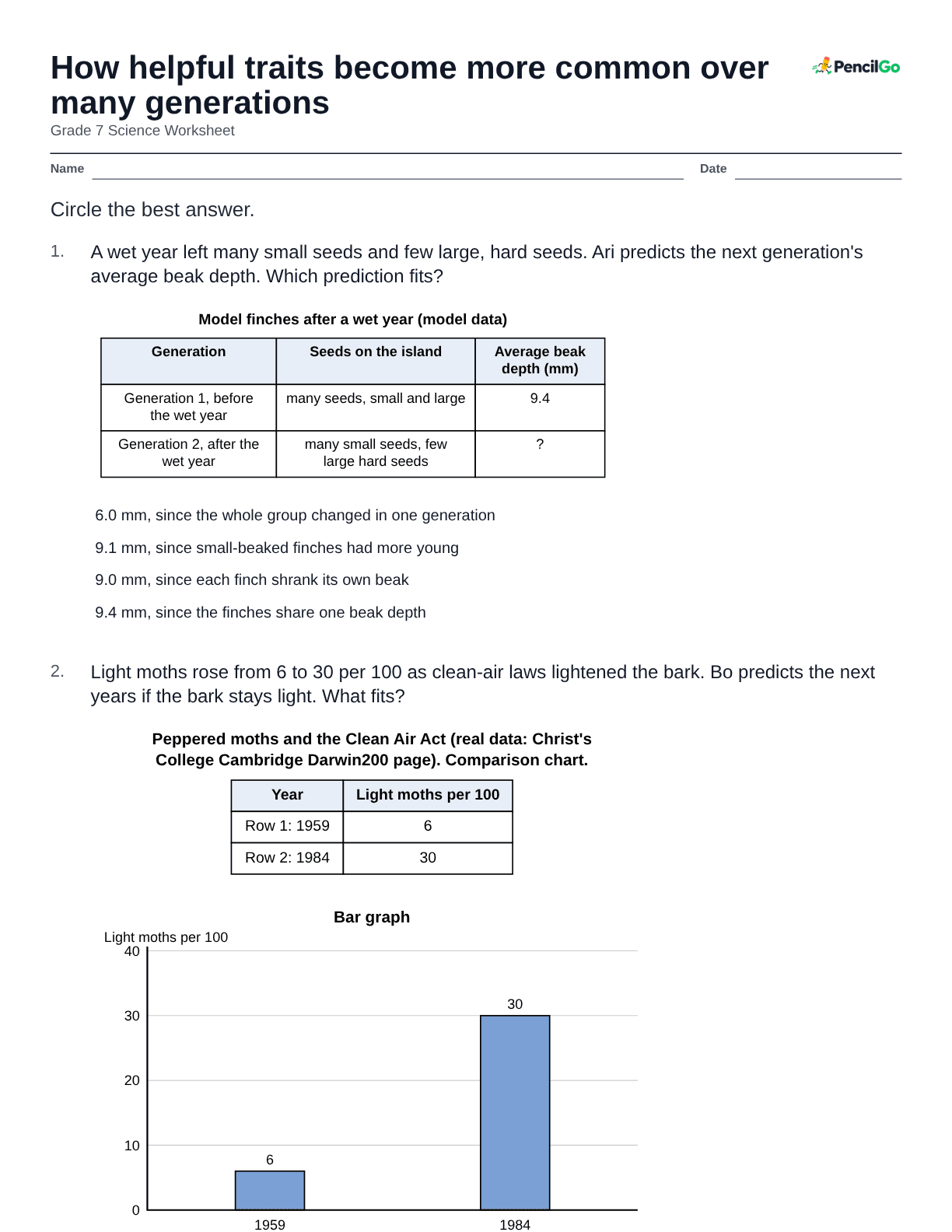
Ren reads the moth chart for 1959 and 1984. Which claim and reason fit it?
- Light moths became common in one year; selection is instant
- Light moths stayed rare; the moths share one color and cannot vary
- Dark moths became light; each moth changed to match the clean bark
- Light moths rose; those matching pale bark had more young
Zee reads the flowering chart for both sites. Which claim and reason fit it?
- Flowering stayed the same; the plants share one flowering time
- Flowering moved earlier; the plants needed to escape the dry weather
- Flowering moved earlier; early-flowering plants had more young
- Flowering moved earlier; each plant sped up its own flowers