PencilGo

Grade 7 · Science

7th grade How helpful traits become more common over many generations worksheet

6 printable versionsBuilding Confidence10 questions · answer keyFree · no account

Level: Building Confidence · On Level · Challenge Me

When it’s done, scan the sheet with your phone and PencilGo marks it and picks the next one. Create a free account

Version
Print

How helpful traits become more common over many generations

Grade 7 Science Worksheet - Building Confidence

NameDate

Circle the best answer.

  1. Ari measures seeds from four plants in one wildflower patch. The sizes differ. Which step of natural selection does the chart show?

    • Fitting: the plants changed to suit the patch
    • Variation: the plants differ in seed size
    • Inheritance: seeds copy the parent plant
    • Selection: the biggest seeds are picked
  2. Bo counts what two wildflower plants made. Each made many seeds, but few grew into plants. Which step does the chart show?

    • Fitting: the plants changed to suit the patch
    • Too many young: more seeds than can grow
    • Inheritance: seedlings copy the parent plant
    • Variation: the seeds differ in size
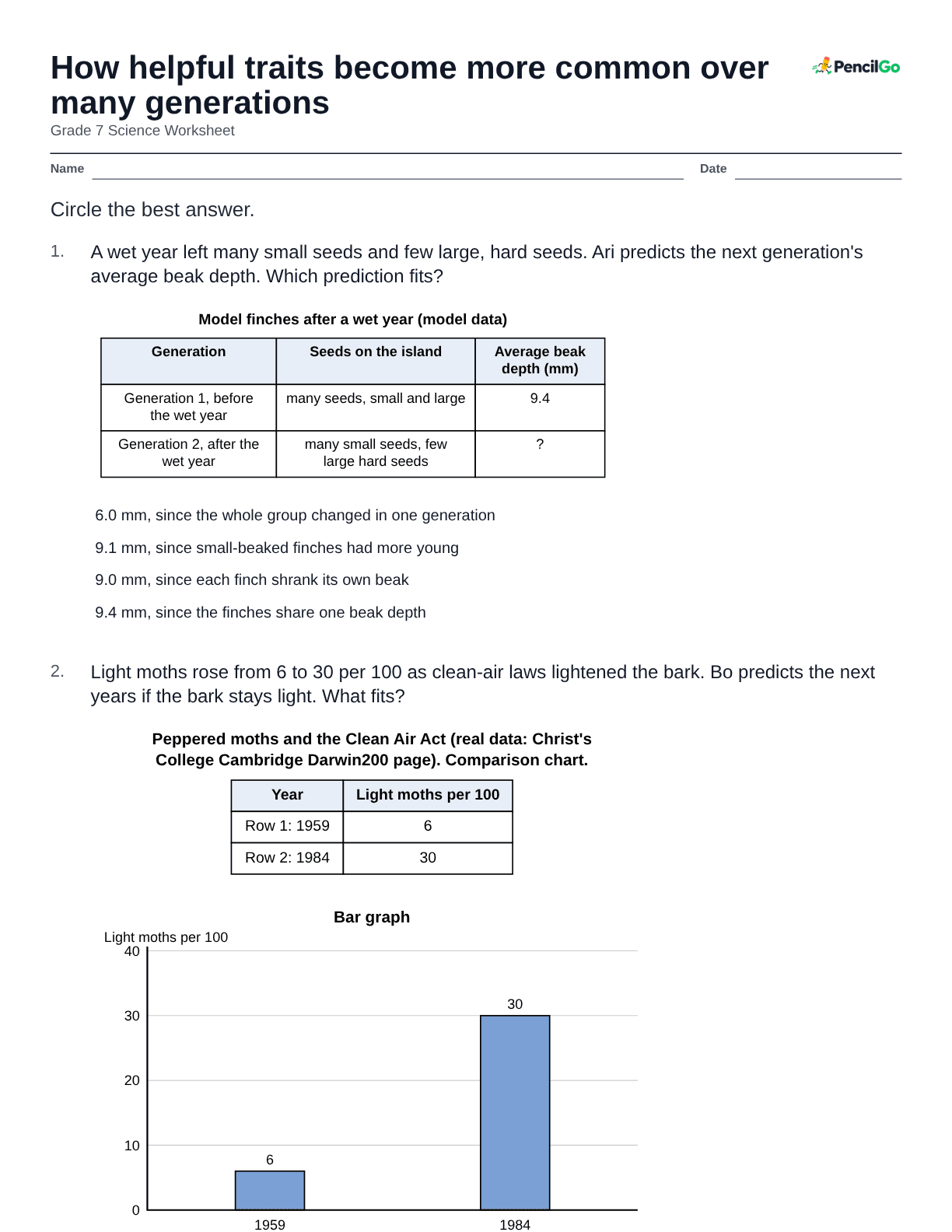
  3. Jun reads the finch chart. What was the average beak depth of the medium ground finches before the 1977 drought?

    • 9.7 mm
    • 9.0 mm
    • 10.2 mm
    • 9.2 mm
  4. Kira reads the finch chart. What was the average beak depth of the offspring born after the drought?

    Use the picture in question 3.

    • 9.7 mm
    • 7.9 mm
    • 9.2 mm
    • 10.7 mm
  5. Milo reads a science word list. Which meaning goes with the word variation?

    • Differences in a trait among living things of one kind
    • A trait that helps a living thing where it lives
    • A change a body makes to fit its place
    • A change that is complete after one generation
  6. Noah reads a science word list. Which meaning goes with the word adaptation?

    • A difference seen between two kinds of living things
    • A trait shared by the whole group, with no differences
    • A change a body makes when it needs something
    • An inherited trait that helps a living thing survive and have young
  7. Pia reads a science word list. Which meaning goes with the words natural selection?

    • Helpful inherited traits become more common over generations
    • A trait that shows up in the whole group at once
    • Each living thing changes its body to fit its place
    • People choose which plants or animals have young
  8. Ren fills in the finch chart for the 1977 drought. Which answer goes in the cell with the question mark?

    • Finches with shallower beaks
    • Finches with deeper beaks
    • Finches that grew deeper beaks
    • Finches that needed deeper beaks
  9. Tala fills in the peppered moth chart. Which answer goes in the cell with the question mark?

    • half dark, half light
    • light-colored
    • dark-colored
    • changing color to match
  10. Zee fills in the chart about tree bark. Which answer goes in the cell with the question mark?

    • unchanged from before the laws
    • lighter again
    • still darkened by soot
    • darker and darker
PencilGopencilgo.com

7th grade How helpful traits become more common over many generations worksheet – printable
Print: 123456

About this worksheet

Natural selection: how helpful traits become more common over generations. Every version has 10 questions, and the answer key prints on the second page.

What your child will learn

  • I can name the steps of natural selection: individuals vary, traits are inherited, more young are made than can survive, and those with helpful traits have more young.
  • I can read a value from a comparison chart or bar graph of generations and say how a trait changed.
  • I can say that individuals do not change their bodies to fit; the population changes over generations.
  • I can explain three real cases: Galapagos finch beaks after the 1977 drought, peppered moths and soot, and bacteria on a plate with an antibiotic.
  • I can tell natural selection from artificial selection, where people choose which plants or animals have young.

Standard: MS-LS4-4, MS-LS4-6

Words to know

variation: Differences in a trait among living things of one kind

inherited trait: A trait passed from parents to young through genes

adaptation: An inherited trait that helps a living thing survive and have young where it lives

generation: A group of living things born around the same time

natural selection: Helpful inherited traits become more common over generations

artificial selection: People choose which plants or animals have young

resistant bacteria: Bacteria that can grow even with an antibiotic present

model data: Numbers made up to show an idea

Common mistakes

Your child thought a living thing changes its own body because it needs to. Try a finch or a moth: each one keeps its beak or color for life. Ask, 'Which individuals had more young?'

Your child thought a need or the weather causes a new trait. Try asking, 'Was the trait already in some of them before the change?' Say that a drought picks among traits that already exist.

Your child put the resistance in the medicine or the plate instead of in the bacteria. Try a plate: a few bacteria could already grow with the antibiotic. Ask, 'Which bacteria could already grow with it?'

Questions parents ask

What is the most common mistake with how helpful traits become more common over many generations?

Your child thought a living thing changes its own body because it needs to. Try a finch or a moth: each one keeps its beak or color for life. Ask, 'Which individuals had more young?'

Are these 7th grade science worksheets free to print?

Yes. All 6 printable versions at each level are free to print, with the answer key, and no account is needed.

More grade 7 science

See all grade 7 science

Every sheet you scan goes into your child’s record: dated, marked and ready for the year-end portfolio. Homeschool records