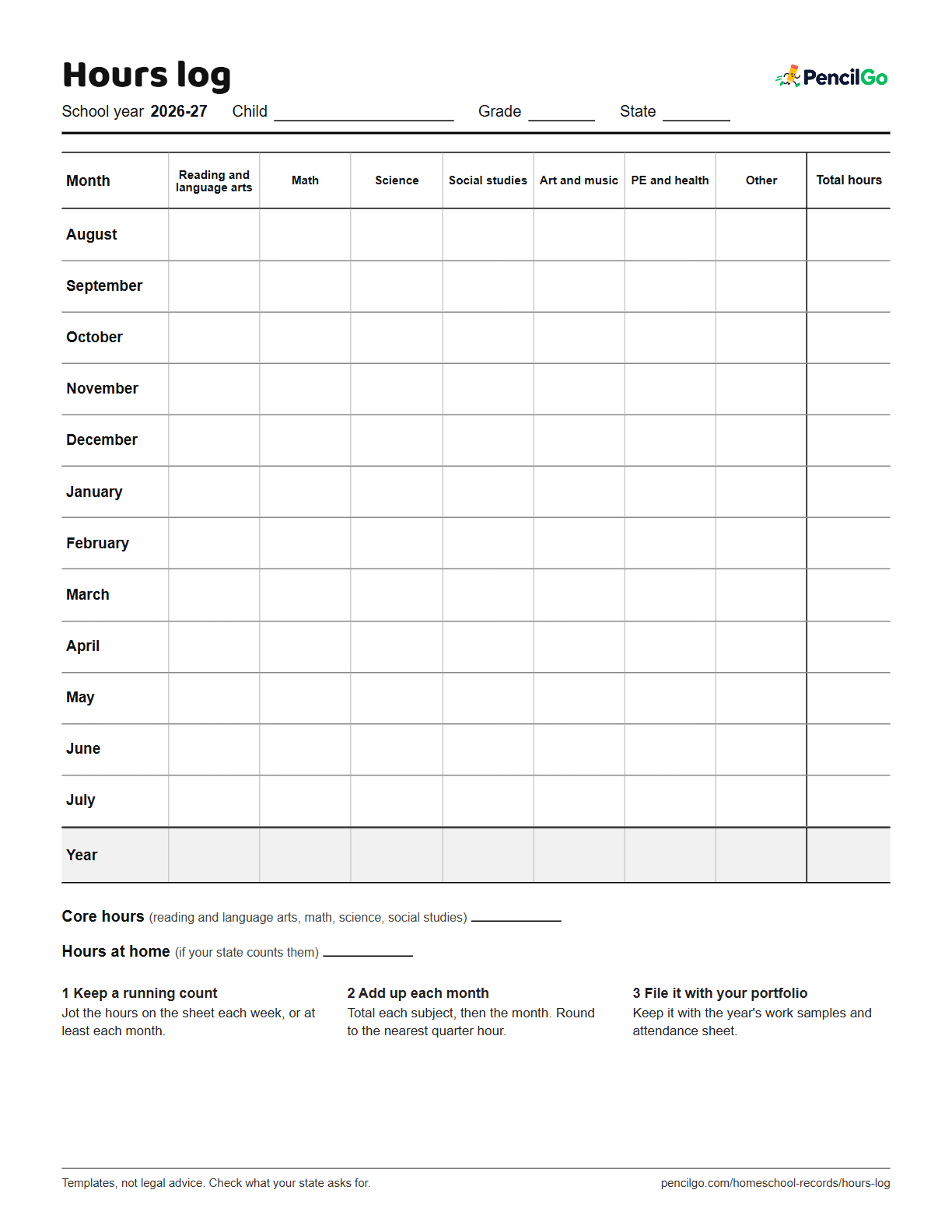
Choose the month your year starts and a state if you want a line about its days or hours under the title.
Month rows start at the month you pick
A column for each subject and a Year row for the totals
An optional state line, only for states we have checked
How to count hours
What counts as an hour of school is your state’s call, and many states do not say. The suggestions below are habits that make a log easy to defend, not rules.
Count time spent learning. Worksheets, reading aloud, lessons, projects and practice count for most families. Breaks and long stretches of play usually do not.
Round to the nearest quarter hour. Fifteen minutes is a clear unit, and it adds up quickly.
Write it down the same week. A log made at the time is easy to trust. One rebuilt in June is easy to question.
Keep subjects apart. If your state names core subjects, a column for each lets you total them in a minute.
Hours some states name
We read the law or the state’s own page for each row, and show the source. States not listed here either name no number in what we read, or we have not checked them yet. Last checked October 30, 2026.
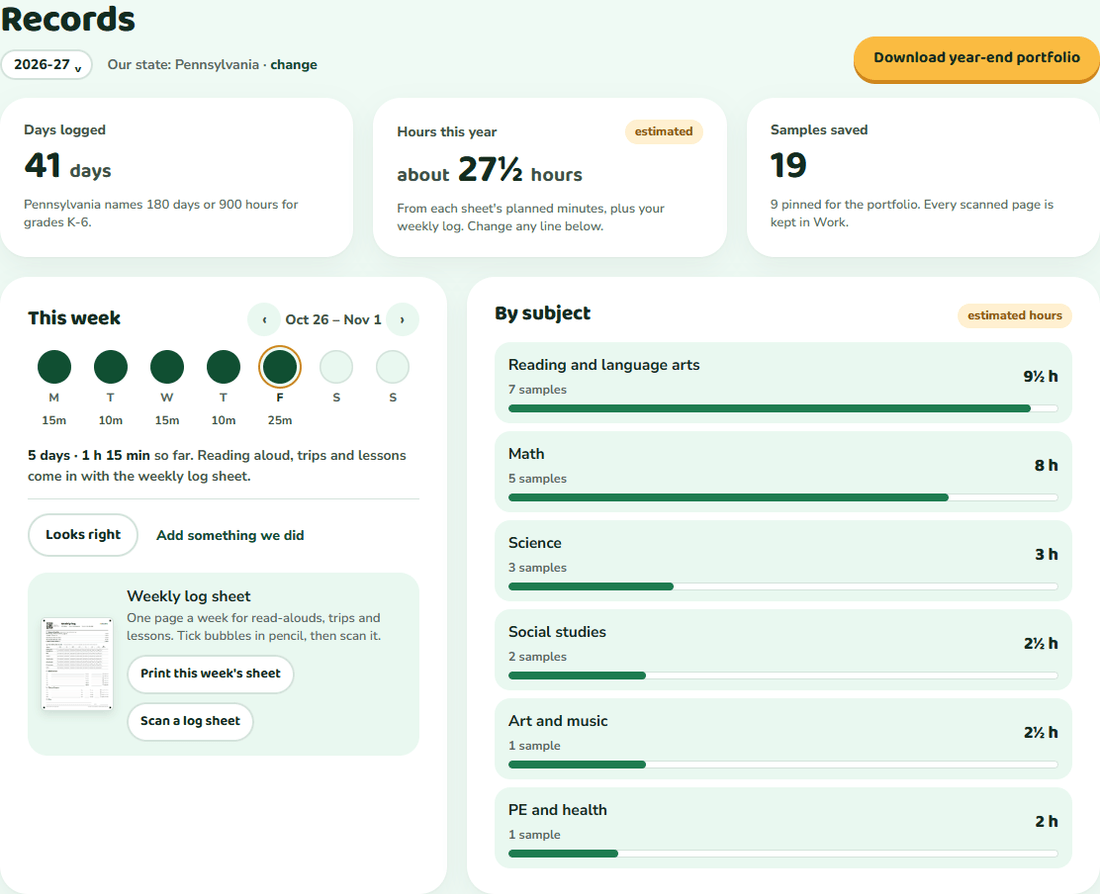
When PencilGo adds up hours for you, it starts from the planned minutes of each sheet your child finished and from your weekly log sheet. That is an estimate, not a stopwatch. You can change any line, and nothing is called “compliant” or “approved.” If your state asks for exact hours, your own weekly log is the better record, and PencilGo helps you keep it.
If your child does a PencilGo sheet most days, the hours add up by themselves: each scanned sheet adds its subject and about how long it took to your child’s record, and you can see the year by subject. You still keep the final say on every number.
About five minutes a day for you. No screen time for your child.
That depends on your state. Colorado, for example, names an average of about four hours a day over 172 days, and Pennsylvania names 900 hours a year at the elementary level, which is five hours over 180 days. Many states name no daily number. Ask your evaluator or district what they expect. Look up your state.
Do I count field trips and read-alouds?
Your state decides what counts, so ask if it matters for you. Many families count read-alouds, music, PE and trips when they were real learning. The weekly log sheet gives each of them a place, with a tick for time away from home. Get the weekly log sheet.
Do I log hours for each subject?
Only if your state or evaluator asks. The sheet has a column for each subject because it is easier to add up in pieces, and it has a Year row for the totals. If your state names core subjects, the Core hours line is there for that.
Does PencilGo count the minutes my child spent?
It estimates. A scan proves a sheet was done, not how long it took, so PencilGo starts from each sheet’s planned minutes. You can change any line, and the weekly log sheet is where you add real minutes and time that is not a worksheet.
What if I forget a week?
Fill in what you can remember and mark the rest as an estimate. A record that is honest and a little rough is better than one rebuilt to look perfect. From here on, a weekly log sheet takes a few minutes on Sunday. Try the weekly log sheet.
Print. Scan. The record fills itself.
Print a sheet, your child works in pencil, and you scan it when it’s done. PencilGo marks it, picks the next sheet and keeps the record. Free, about five minutes a day, and your child never touches a screen.