Mendel's laws of segregation and independent assortment
Grade 9 Science Worksheet - Building Confidence

Circle the best answer.
Read this first
Two pea lines (model)
plant line offspring when crossed with itself violet-flowered line violet flowers in each generation white-flowered line white flowers in each generation Bo reads that Mendel started with true-breeding pea plants. What does true-breeding mean?
- They have two recessive alleles, so they show the recessive trait
- They are a mix of two lines, so their flowers show a pale blend
- They carry a violet and a white allele, so they give both colors
- Crossed with themselves, they always give offspring that look like them
Mendel's real F1 results (real data: Mendel)
characteristic plants crossed (P) F1 offspring seed texture round × wrinkled 100 percent round seed color yellow × green 100 percent yellow flower color violet × white 100 percent violet Esme reads Mendel's F1 results. What did the F1 seeds show when round plants were crossed with wrinkled plants?
- Half round and half wrinkled, because each trait gets a turn
- All wrinkled, because the wrinkled allele wins
- All round, because round is the dominant trait
- Slightly bumpy, because the two shapes blend
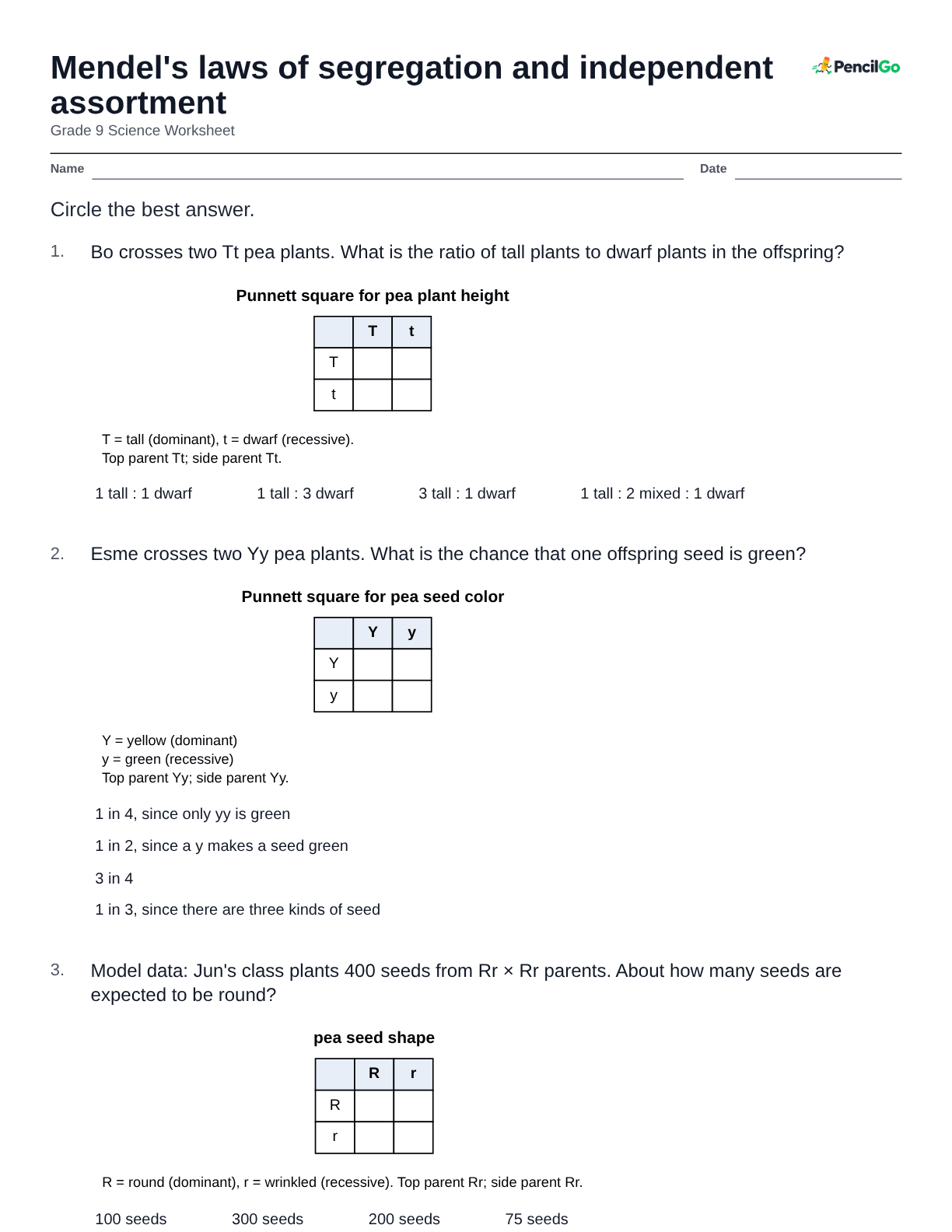
Kira fills a Punnett square for pea plant height. Which genotype goes in the blank box?
- tt (two dwarf alleles)
- TT (two tall alleles)
- Tt (one tall, one dwarf allele)
- T (one tall allele)
Luz reads a filled Punnett square for seed color. How many of the four boxes show a plant with yellow seeds?
- 1 box
- 2 boxes
- 3 boxes: YY, Yy and Yy
- 4 boxes, since both parents have a Y
Milo sees each box of the grid take one allele from each parent. Which idea explains this?
- Dominance: one allele hides the other allele
- Segregation: the two alleles of a gene separate
- Independent assortment: different genes are passed on separately
- Blending: the two alleles mix into one allele
One plant, two genes (model)
gene plant's alleles where the gene sits flower color Vv one chromosome plant height Tt a different chromosome Noah reads a card about two genes on different chromosomes. Which idea says they are passed on separately?
- Blending: the two genes mix into one trait
- Independent assortment: the two genes are passed on separately
- Segregation: the two alleles of a gene separate
- Dominance: one gene hides the other gene
Flower color across two generations (model)
generation plants flower color P true-breeding VV and vv plants violet and white F1 all Vv all violet Pia reads that every F1 plant is Vv and has violet flowers. Which idea explains the violet color?
- Segregation: the Vv plant passes on one of its two alleles
- Blending: V and v mix into a pale violet
- Dominance: V hides v in a Vv plant
- Independent assortment: V and v are passed on separately
Mendel's real counts, flower color (real data: Mendel)
generation what the plants showed F1 100 percent violet F2 705 violet and 224 white Ren reads Mendel's flower-color counts. How many F2 plants had white flowers?
- 929 plants
- 705 plants
- 224 plants, the white-flowered ones
- 0 plants, because white was lost in the F1
Mendel's real counts, seed shape (real data: Mendel)
generation what the plants showed F1 100 percent round F2 5,474 round and 1,850 wrinkled Tala reads Mendel's seed-shape counts. What does the table show about wrinkled seeds?
- Present in the F1 and the F2
- Gone for good after the F1
- Back in the F2 with 5,474 seeds, more than round
- Missing in the F1, back in the F2
Mendel's real counts, seed color (real data: Mendel)
generation what the plants showed F1 100 percent yellow F2 6,022 yellow and 2,001 green Zee adds up Mendel's F2 seed-color counts. How many seeds did Mendel count in the F2?
- 8,023 seeds
- 2,001 seeds
- 6,022 seeds
- 4,021 seeds