PencilGo

Grade 11 · Science · Physics

11th grade The Doppler effect worksheet

6 printable versionsBuilding Confidence10 questions · answer keyFree · no account

Level: Building Confidence · On Level · Challenge Me

When it’s done, scan the sheet with your phone and PencilGo marks it and picks the next one. Create a free account

Version
Print

The Doppler effect

Grade 11 Science Worksheet - Building Confidence

NameDate

Circle the best answer, or write your answer on the line.

  1. A train horn sounds at 400 Hz; as the train approaches, it is heard at 420 Hz. By how many hertz is the pitch raised, Ari?

  2. A toy buzzer on a moving cart makes 350 Hz; as it approaches, it is heard at 368 Hz. By how many hertz is the pitch raised, Bo?

  3. A model train's whistle makes 500 Hz; as it approaches, it is heard at 531 Hz. By how many hertz is the pitch raised, Esme?

  4. Read this first

    Use this

    Wave diagram seen from above (example data):

  5. In the wave diagram, where are the ripples closest together, Jun?

    • In front of the dipper
    • Behind the dipper
    • They are evenly spaced
  6. In the wave diagram, where would a floating cork bob up and down most often, Kira?

    Use the picture in question 4.

    • Behind the dipper
    • Just as often in front as behind
    • In front of the dipper
  7. A train blows its horn as it comes toward a listener on a platform. How does the pitch sound, Milo?

    • Lower, since the train is still far away
    • The same, just louder
    • Higher than the horn's own pitch
  8. What does a listener notice as a buzzing toy car rolls past, Pia?

    • The pitch stays the same
    • The pitch drops as it passes
    • The pitch rises as it passes
  9. As a train approaches and passes, what happens to the frequency the horn itself makes, Ren?

    • It rises, then falls
    • It falls, then rises
    • It stays the same
  10. Why does the horn sound higher to the listener as the train approaches, Tala?

    • The horn is blown harder
    • Its waves reach the listener bunched together
    • Sound moves faster near a train
  11. A toy buzzer sits still on a table. Does a listener hear a Doppler shift, Zee?

    • Yes, a higher pitch
    • Yes, a lower pitch
    • No, since nothing is moving
PencilGopencilgo.com

11th grade The Doppler effect worksheet – printable
Print: 123456

About this worksheet

The Doppler effect. Every version has 10 questions, and the answer key prints on the second page.

What your child will learn

  • I can explain the Doppler effect from bunched and spread wave fronts. An approaching source sounds higher, one moving away sounds lower, and the pitch drops as it passes.
  • I can tell the source's own frequency, which never changes, from the frequency heard. I can tell pitch from loudness.
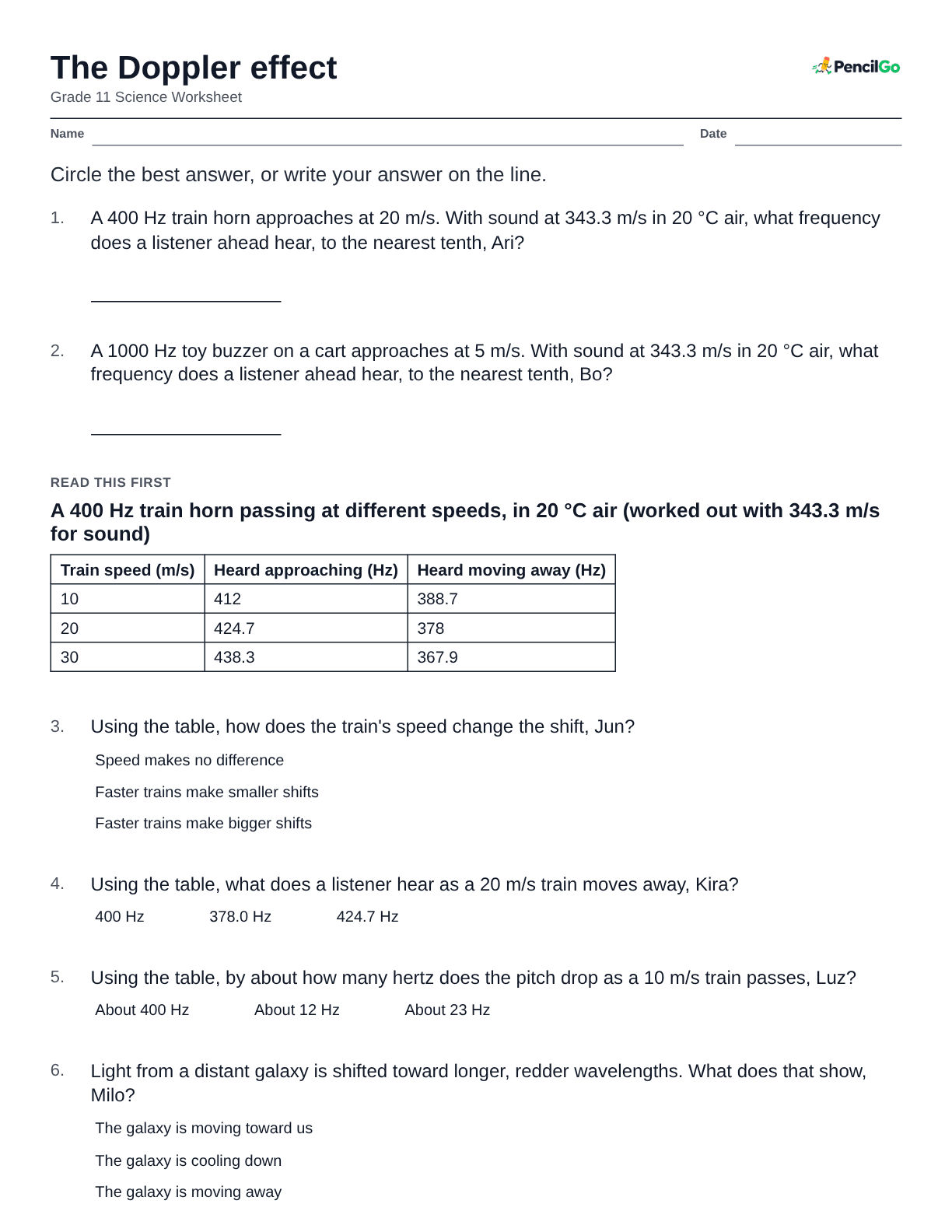
  • I can use f = f₀v ÷ (v − vₛ) for an approaching source and f₀v ÷ (v + vₛ) for one moving away, with sound at 343.3 m/s in 20 °C air. I know a moving listener also hears a shift.
  • I can read redshift (moving away) and blueshift (approaching) in light, and name uses: weather radar, radar speed sensors and astronomy.

Standard: none (TX, FL)

Words to know

Doppler effect: A change in the frequency heard because the source or listener moves

source: The object making the waves, like a horn

redshift: Light stretched to longer wavelengths because its source moves away

blueshift: Light squeezed to shorter wavelengths because its source approaches

pitch: How high or low a sound is; set by frequency

Common mistakes

Your child added the frequencies. The shift is the heard frequency minus the source's frequency.

Your child used the wrong sign. An approaching source bunches the waves, so use v − vₛ; a source moving away spreads them, so use v + vₛ.

Your child thought the source itself changes pitch. The source keeps its frequency; the listener hears a shifted one because of the motion.

Questions parents ask

What is the most common mistake with the doppler effect?

Your child added the frequencies. The shift is the heard frequency minus the source's frequency.

Are these 11th grade science worksheets free to print?

Yes. All 6 printable versions at each level are free to print, with the answer key, and no account is needed.

More physics

See all Physics

Every sheet you scan goes into your child’s record: dated, marked and ready for the year-end portfolio. Homeschool records