Acceleration
Grade 11 Science Worksheet

Circle the best answer, or write your answer on the line.
East is positive. A cart's sensor reads 14 m/s at t = 1 s and 2 m/s at t = 5 s. What is its acceleration, Ari?
East is positive. A cyclist reads 4 m/s at t = 2 s and -6 m/s at t = 10 s, after turning around. What is the acceleration, Bo?
East is positive. A ball arrives at 25 m/s at t = 0.1 s and leaves at -18 m/s at t = 0.12 s. What is its acceleration, Esme?
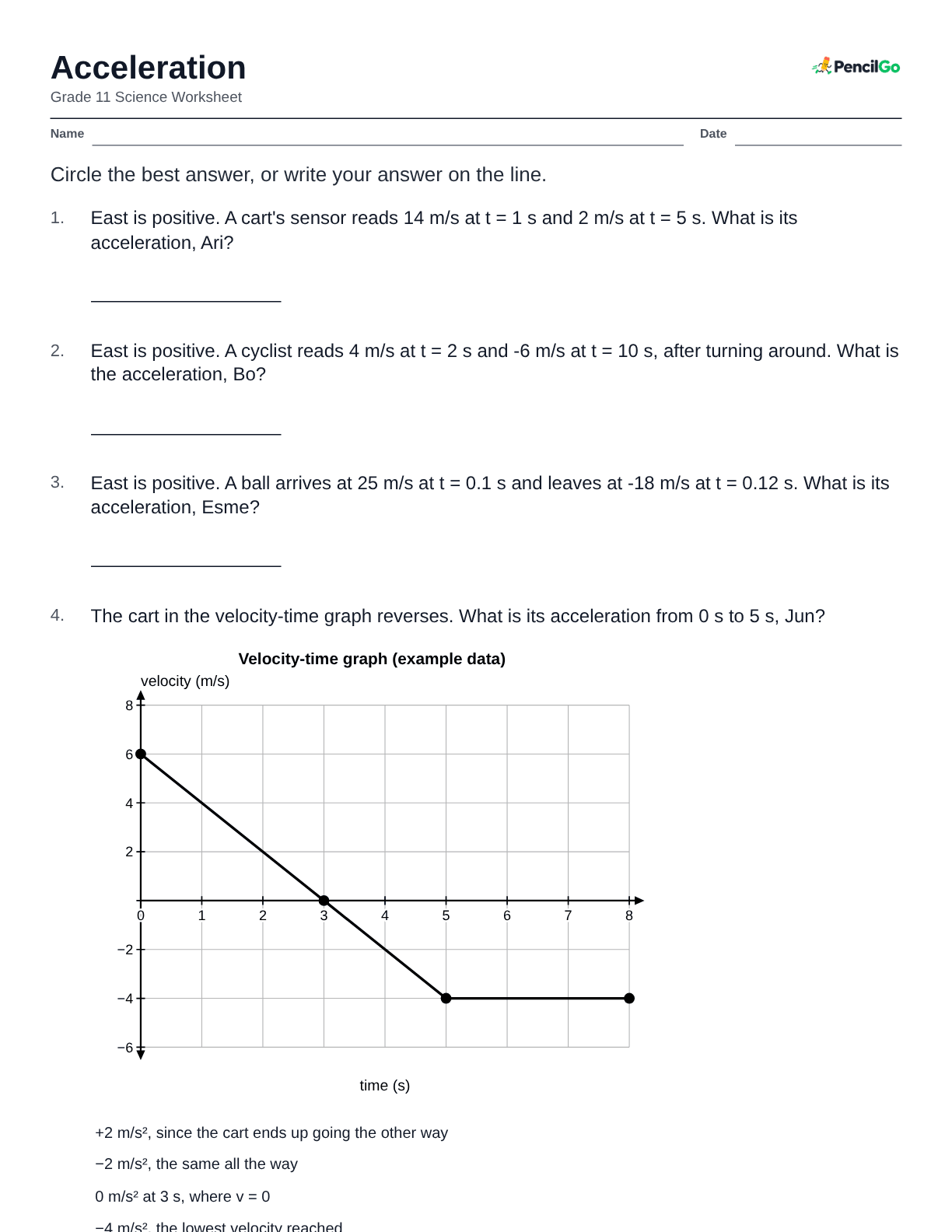
The cart in the velocity-time graph reverses. What is its acceleration from 0 s to 5 s, Jun?
- +2 m/s², since the cart ends up going the other way
- −2 m/s², the same all the way
- 0 m/s² at 3 s, where v = 0
- −4 m/s², the lowest velocity reached
The curved velocity-time graph rises, then levels at 4 s. What are the average acceleration from 0 to 4 s and the acceleration at 4 s, Kira?
- Average 16 m/s²; at 4 s the slope is 0
- Average 4 m/s²; at 4 s it is still 4 m/s²
- Average 4 m/s²; at 4 s it is 16 m/s²
- Average 4 m/s²; at 4 s the slope is 0
Using the same curve, in which one-second step is the average acceleration largest, and how large, Luz?
Use the picture in question 5.
- 0 to 4 s: 4 m/s², the longest step
- The first second: 7 m/s²
- The first second: 16 m/s²
- The last second: −1 m/s², the final slope
East is positive. A cart starts at v = +6 m/s with a constant a = −2 m/s². What is it doing at t = 5 s, Noah?
- Moving west at 4 m/s and slowing
- Moving east at 4 m/s and slowing
- Moving west at 4 m/s and speeding up
- At rest, since a negative a brings v to zero
A cart speeds from 3.0 m/s to 11 m/s over 28 m. The time is unknown. Which equation fits, and what is a, Pia?
- v² = v₀² + 2ad, giving a = 2.0 m/s²
- v² = v₀² + 2ad, giving a = 1.0 m/s²
- v = v₀ + at, giving a = 0.29 m/s²
- v² = v₀² + 2ad, giving a = 4.0 m/s²
Read this first
Two balls dropped from rest (example data)
time (s) ball A in vacuum speed (m/s) ball B in air speed (m/s) 0 0 0 1 9.8 9.5 2 19.6 17.2 3 29.4 23.4 Ren drops two balls and records speed each second. Ball A falls in a vacuum, ball B in air. Which statement fits the table?
- A's acceleration grows because its speed grows
- Both have a = 9.8 m/s², since gravity is the same
- B's acceleration shrinks each second; A's stays 9.8 m/s²
- B is slowing down, since its gains get smaller
A ball is thrown down at 4.0 m/s from a bridge and hits the water after 2.0 s. How high is the bridge, Zee?
- About 47 m, using g t² without the one half
- About 20 m, if the ball were simply dropped
- About 28 m: 8.0 m from the throw, 19.6 m from gravity
- About 24 m, the final speed used as the height