PencilGo

Grade 11 · Science · Physics

11th grade Compare devices that change energy from one form to another worksheet

6 printable versionsOn Level10 questions · answer keyFree · no account

Level: Building Confidence · On Level · Challenge Me

When it’s done, scan the sheet with your phone and PencilGo marks it and picks the next one. Create a free account

Version
Print

Compare devices that change energy from one form to another

Grade 11 Science Worksheet

NameDate

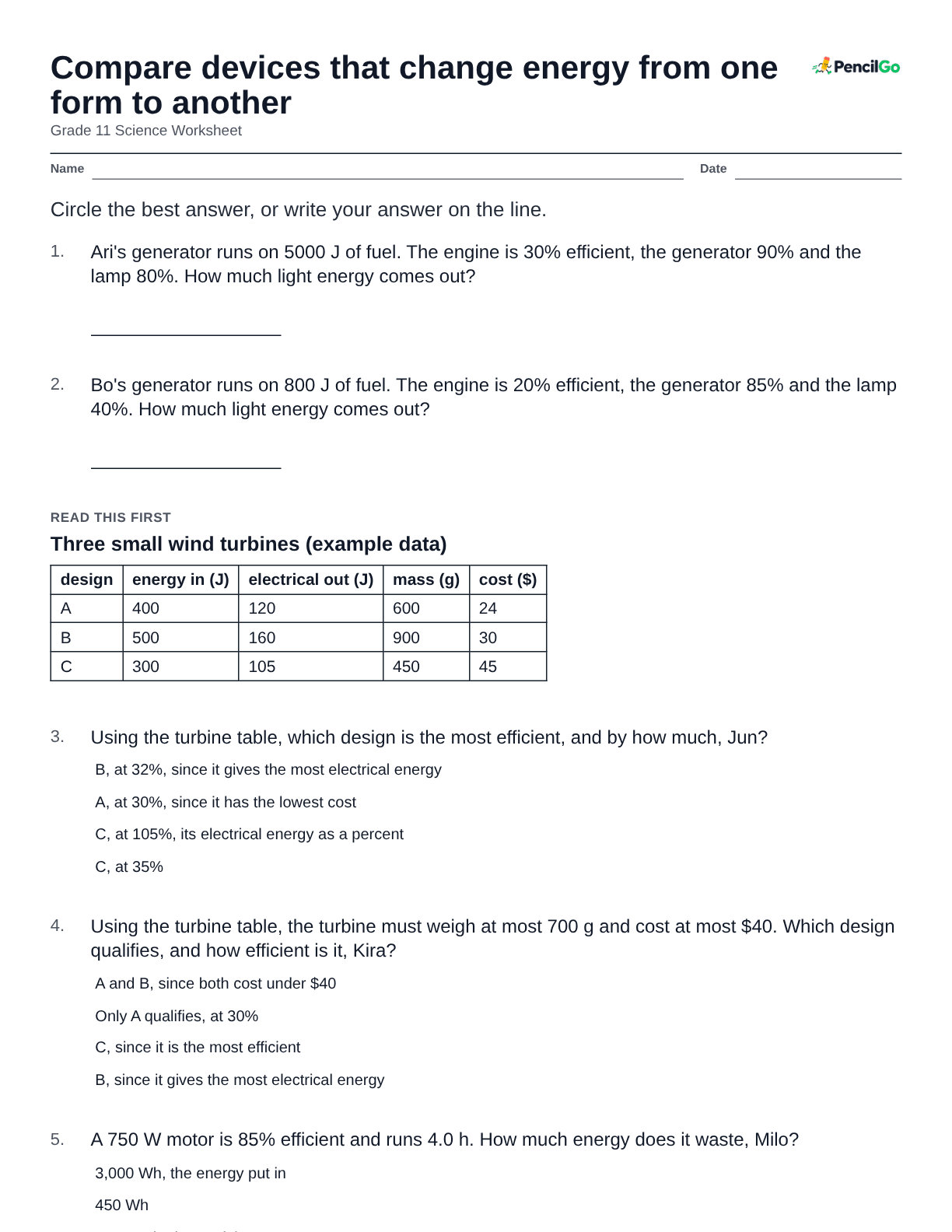
Circle the best answer, or write your answer on the line.

  1. Ari's generator runs on 5000 J of fuel. The engine is 30% efficient, the generator 90% and the lamp 80%. How much light energy comes out?

  2. Bo's generator runs on 800 J of fuel. The engine is 20% efficient, the generator 85% and the lamp 40%. How much light energy comes out?

  3. Read this first

    Three small wind turbines (example data)

    designenergy in (J)electrical out (J)mass (g)cost ($)
    A40012060024
    B50016090030
    C30010545045
  4. Using the turbine table, which design is the most efficient, and by how much, Jun?

    • B, at 32%, since it gives the most electrical energy
    • A, at 30%, since it has the lowest cost
    • C, at 105%, its electrical energy as a percent
    • C, at 35%
  5. Using the turbine table, the turbine must weigh at most 700 g and cost at most $40. Which design qualifies, and how efficient is it, Kira?

    • A and B, since both cost under $40
    • Only A qualifies, at 30%
    • C, since it is the most efficient
    • B, since it gives the most electrical energy
  6. A 750 W motor is 85% efficient and runs 4.0 h. How much energy does it waste, Milo?

    • 3,000 Wh, the energy put in
    • 450 Wh
    • 2,550 Wh, the useful energy
    • 112.5 Wh, one hour of the waste
  7. A pump must lift 60 kg of water each second through 5.0 m. It is 60% efficient. What input power does it need, Noah?

    • 2,940 W, the useful power
    • 4,900 W
    • 490 W
    • 1,764 W, from 2,940 × 0.60
  8. An electric car stores 60 kWh. Its motor is 90% efficient and its wheels need 0.18 kWh per km. What is its range, Pia?

    • About 333 km, leaving out the motor loss
    • About 270 km, taking 90% of 300 km
    • About 300 km
    • About 370 km, from 60 ÷ (0.18 × 0.90)
  9. Kettle A is 90% efficient at 1,800 W; kettle B is 85% efficient at 2,400 W. Which heats 1.0 kg of water by 80 °C (334,880 J) in under 3 min, Ren?

    • Only B, in about 164 s
    • A, since it is more efficient
    • Neither, since both take over 3 minutes
    • Both, since both are over 85% efficient
  10. A 1,200 kg car slows from 20 m/s to rest. Regenerative braking recovers 60% of its kinetic energy. How much is recovered, Tala?

    • 144 kJ
    • 240 kJ, the whole of the kinetic energy
    • 288 kJ, using mv² without the one half
    • 96 kJ, 40% of the kinetic energy
  11. Sunlight gives 1,000 W per m². A solar panel is 20% efficient. What area gives 1,200 W, Zee?

    • 6.0 m²
    • 1.2 m², leaving out the efficiency
    • 0.24 m², multiplying by 0.20
    • 30 m², using 4% efficiency
PencilGopencilgo.com

11th grade Compare devices that change energy from one form to another worksheet – printable
Print: 123456

About this worksheet

Compare devices that change energy from one form to another. Every version has 10 questions, and the answer key prints on the second page.

What your child will learn

  • I can find efficiency from powers (useful power m g h ÷ t over input power), and complete an energy balance from bars.
  • I can multiply efficiencies along a chain and work backwards from a target output, and find range, input power and kettle times with efficiency.
  • I can compare designs against constraints and goals (mass, cost, output per dollar), and know the Carnot limit 1 − Tc ÷ Th.
  • I can judge claims (a 100%-efficient heater, a round-trip battery rating, ten points at 40% against ten points at 80%) and design a test that finds where energy is lost.

Standard: HS-PS3-3

Words to know

efficiency: Useful energy out ÷ energy in, as a percent

useful output: The energy in the form the device is for

energy balance: Energy in = useful out + wasted out

criterion / constraint: A goal to do well on / a limit not to break

percentage point: One percent of the whole, as in 40% to 50% = 10 points

Common mistakes

Your child left out g when finding the useful power. Lifting a mass needs m g h, with g = 9.8 m/s².

Your child divided the input by the useful output. Efficiency is useful out over in, so it stays below 100%.

Your child used only the first efficiency. Every stage in a chain loses some energy.

Questions parents ask

What is the most common mistake with compare devices that change energy from one form to another?

Your child left out g when finding the useful power. Lifting a mass needs m g h, with g = 9.8 m/s².

Are these 11th grade science worksheets free to print?

Yes. All 6 printable versions at each level are free to print, with the answer key, and no account is needed.

More physics

See all Physics

Every sheet you scan goes into your child’s record: dated, marked and ready for the year-end portfolio. Homeschool records