PencilGo

Grade 11 · Science · Physics

11th grade Polarization of light worksheet

6 printable versionsOn Level10 questions · answer keyFree · no account

Level: Building Confidence · On Level · Challenge Me

When it’s done, scan the sheet with your phone and PencilGo marks it and picks the next one. Create a free account

Version
Print

Polarization of light

Grade 11 Science Worksheet

NameDate

Circle the best answer, or write your answer on the line.

  1. Unpolarized light of 200 W/m² passes two filters whose slots are 30° apart. How intense is the light after both, Ari?

  2. Unpolarized light of 120 W/m² passes two filters whose slots are 60° apart. How intense is the light after both, Bo?

  3. Unpolarized light of 80 W/m² passes two filters whose slots are 45° apart. How intense is the light after both, Esme?

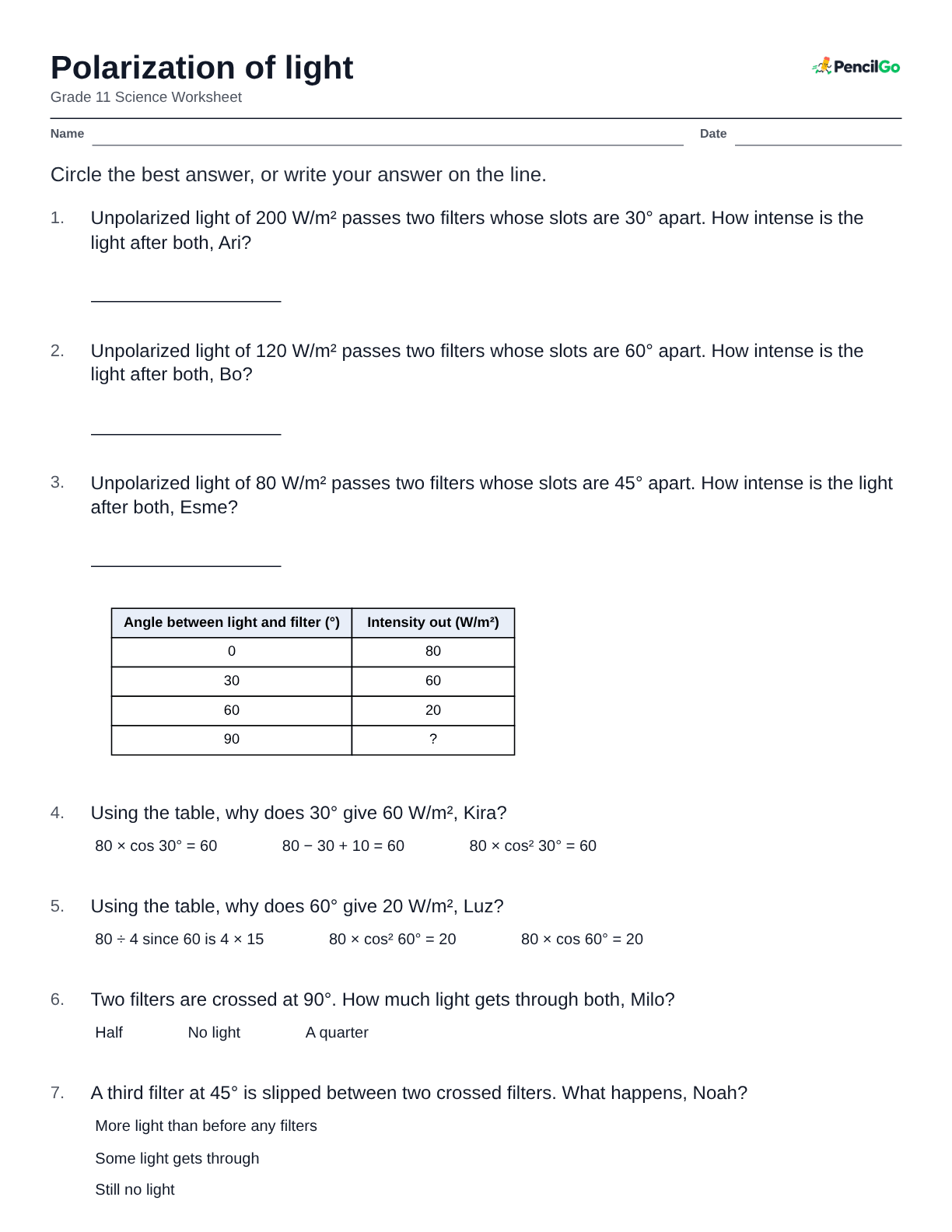
  4. Using the table, why does 30° give 60 W/m², Kira?

    • 80 × cos 30° = 60
    • 80 − 30 + 10 = 60
    • 80 × cos² 30° = 60
  5. Using the table, why does 60° give 20 W/m², Luz?

    Use the picture in question 4.

    • 80 ÷ 4 since 60 is 4 × 15
    • 80 × cos² 60° = 20
    • 80 × cos 60° = 20
  6. Two filters are crossed at 90°. How much light gets through both, Milo?

    • Half
    • No light
    • A quarter
  7. A third filter at 45° is slipped between two crossed filters. What happens, Noah?

    • More light than before any filters
    • Some light gets through
    • Still no light
  8. Two filters have their slots lined up. What fraction of the light from the first passes the second, Pia?

    • None of it
    • All of it
    • Half of it
  9. Light reflected off a lake is mostly polarized in which direction, Ren?

    • Horizontally
    • Vertically
    • In many directions at once
  10. Which way should the slots in polarized sunglasses run to block glare off water, Tala?

    • Up and down
    • At random
    • Side to side
PencilGopencilgo.com

11th grade Polarization of light worksheet – printable
Print: 123456

About this worksheet

Polarization of light. Every version has 10 questions, and the answer key prints on the second page.

What your child will learn

  • I can use Malus's law, I = I₀ cos² θ, for polarized light through a filter.
  • I can find the light through two filters from unpolarized light: half after the first, then cos² θ.
  • I can work backwards to the angle, θ = cos⁻¹ √(I ÷ I₀), and handle three filters step by step.
  • I can explain why only transverse waves (light, not sound) can be polarized, and how sunglasses, 3-D glasses and LCD screens use it.

Standard: none (TX)

Words to know

polarized: Light vibrating in one direction only

unpolarized: Light vibrating in many directions, like sunlight or a bulb's

filter (polarizer): A sheet that passes only light vibrating along its slots

crossed: Two filters with slots at 90° to each other

transverse: A wave vibrating across its direction of travel

Common mistakes

Your child used cos θ, not cos² θ. Malus's law squares the cosine: I = I₀ cos² θ.

Your child skipped the first halving. A filter passes half of unpolarized light before Malus's law applies.

Your child left out the square root. From I = I₀ cos² θ, cos θ = √(I ÷ I₀).

Questions parents ask

What is the most common mistake with polarization of light?

Your child used cos θ, not cos² θ. Malus's law squares the cosine: I = I₀ cos² θ.

Are these 11th grade science worksheets free to print?

Yes. All 6 printable versions at each level are free to print, with the answer key, and no account is needed.

More physics

See all Physics

Every sheet you scan goes into your child’s record: dated, marked and ready for the year-end portfolio. Homeschool records