PencilGo

Grade 11 · Science · Physics

11th grade Objects launched at an angle worksheet

6 printable versionsOn Level10 questions · answer keyFree · no account

Level: Building Confidence · On Level · Challenge Me

When it’s done, scan the sheet with your phone and PencilGo marks it and picks the next one. Create a free account

Version
Print

Objects launched at an angle

Grade 11 Science Worksheet

NameDate

Circle the best answer, or write your answer on the line.

  1. A spring toy launches a ball with a vertical part of 7 m/s. With no air, how high does it rise, Ari?

  2. A spring toy launches a ball with a vertical part of 14 m/s. With no air, how high does it rise, Bo?

  3. A spring toy launches a ball with a vertical part of 4.9 m/s. With no air, how high does it rise, Esme?

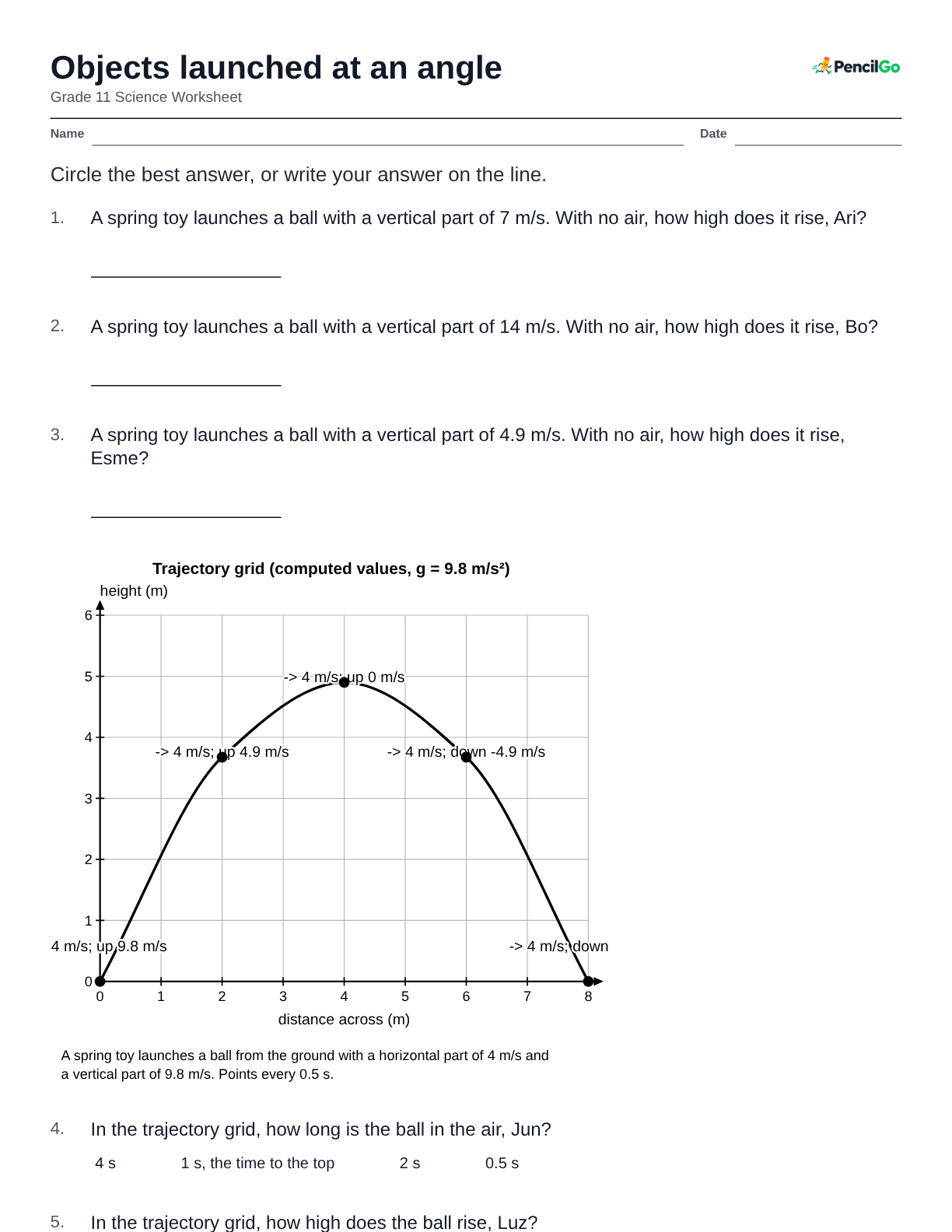
  4. In the trajectory grid, how long is the ball in the air, Jun?

    • 4 s
    • 1 s, the time to the top
    • 2 s
    • 0.5 s
  5. In the trajectory grid, how high does the ball rise, Luz?

    Use the picture in question 4.

    • 4.9 m
    • 8 m
    • 9.8 m
    • 3.675 m
  6. On level ground with no air, which launch angle sends a ball farthest at the same speed, Milo?

    • 80°, the steepest
    • Each angle the same
    • 15°
    • 45°
  7. Two balls are launched at the same speed, at 30° and 60°. With no air, how do their ranges compare, Noah?

    • The 60° ball lands at 0 m
    • They are equal
    • The 30° ball goes twice as far
    • The 60° ball goes farther, since it is steeper
  8. At the same speed, what does raising the launch angle from 30° to 60° do to the time in the air, Pia?

    • It stays the same
    • It halves it
    • It increases it
    • It decreases it
  9. At the top of a fountain's water arc, what is the water's velocity, Ren?

    • Horizontal only
    • Straight up
    • Zero; it has stopped
    • Straight down
  10. A pump is turned up so the jet leaves faster at the same angle. What happens to its range, Zee?

    • It goes farther
    • It drops straight down
    • It gets shorter
    • It stays the same
PencilGopencilgo.com

11th grade Objects launched at an angle worksheet – printable
Print: 123456

About this worksheet

Objects launched at an angle. Every version has 10 questions, and the answer key prints on the second page.

What your child will learn

  • I can split a launch velocity into a horizontal part (v cos θ) and a vertical part (v sin θ).
  • I can find the time to the top (vertical part ÷ g), the highest point ((vertical part)² ÷ 2g), the whole flight (twice the time to the top) and the range (horizontal part × flight time).
  • I can read a trajectory grid. The horizontal arrow stays the same, the vertical arrow shrinks to 0 at the top and then grows downward, and the ball is not stopped at the top.
  • I can compare launch angles: 45° goes farthest on level ground, 30° and 60° tie, and steeper launches stay up longer.

Standard: supports HS-PS2-1

Words to know

launch angle: The angle between the launch direction and the ground

horizontal part: The sideways part of the launch velocity: v cos θ

vertical part: The upward part of the launch velocity: v sin θ

time of flight: Time from launch until landing

range: How far away it lands on level ground

Common mistakes

Your child mixed up the trip to the top with the whole flight. Going up and coming down take equal times, so the whole flight is twice the time to the top.

Your child left out the 2 in v² = 2gh. The highest point is (vertical part)² ÷ (2 × 9.8).

Your child thought the ball stops at the top. Only the vertical motion stops; the horizontal part keeps going, and gravity still acts.

Questions parents ask

What is the most common mistake with objects launched at an angle?

Your child mixed up the trip to the top with the whole flight. Going up and coming down take equal times, so the whole flight is twice the time to the top.

Are these 11th grade science worksheets free to print?

Yes. All 6 printable versions at each level are free to print, with the answer key, and no account is needed.

More physics

See all Physics

Every sheet you scan goes into your child’s record: dated, marked and ready for the year-end portfolio. Homeschool records