PencilGo

Grade 11 · Science · Physics

11th grade Reflection, refraction and diffraction of waves worksheet

6 printable versionsOn Level10 questions · answer keyFree · no account

Level: Building Confidence · On Level · Challenge Me

When it’s done, scan the sheet with your phone and PencilGo marks it and picks the next one. Create a free account

Version
Print

Reflection, refraction and diffraction of waves

Grade 11 Science Worksheet

NameDate

Circle the best answer, or write your answer on the line.

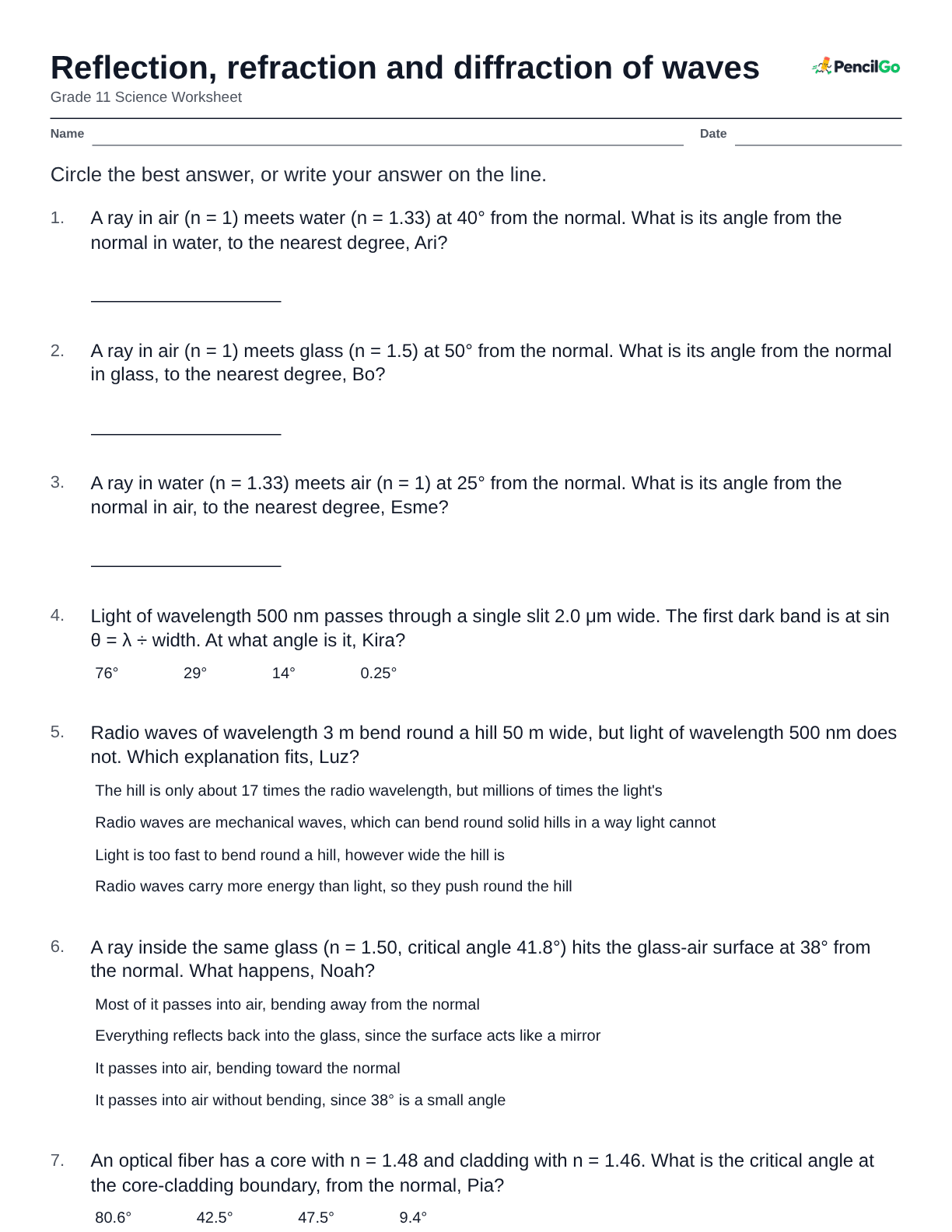
  1. A ray in air (n = 1) meets water (n = 1.33) at 40° from the normal. What is its angle from the normal in water, to the nearest degree, Ari?

  2. A ray in air (n = 1) meets glass (n = 1.5) at 50° from the normal. What is its angle from the normal in glass, to the nearest degree, Bo?

  3. A ray in water (n = 1.33) meets air (n = 1) at 25° from the normal. What is its angle from the normal in air, to the nearest degree, Esme?

  4. Light of wavelength 500 nm passes through a single slit 2.0 μm wide. The first dark band is at sin θ = λ ÷ width. At what angle is it, Kira?

    • 76°
    • 29°
    • 14°
    • 0.25°
  5. Radio waves of wavelength 3 m bend round a hill 50 m wide, but light of wavelength 500 nm does not. Which explanation fits, Luz?

    • The hill is only about 17 times the radio wavelength, but millions of times the light's
    • Radio waves are mechanical waves, which can bend round solid hills in a way light cannot
    • Light is too fast to bend round a hill, however wide the hill is
    • Radio waves carry more energy than light, so they push round the hill
  6. A ray inside the same glass (n = 1.50, critical angle 41.8°) hits the glass-air surface at 38° from the normal. What happens, Noah?

    • Most of it passes into air, bending away from the normal
    • Everything reflects back into the glass, since the surface acts like a mirror
    • It passes into air, bending toward the normal
    • It passes into air without bending, since 38° is a small angle
  7. An optical fiber has a core with n = 1.48 and cladding with n = 1.46. What is the critical angle at the core-cladding boundary, from the normal, Pia?

    • 80.6°
    • 42.5°
    • 47.5°
    • 9.4°
  8. Sound in air meets the surface of calm water, where sound is faster. How does the sound that enters the water bend, Ren?

    • Toward the normal, like light entering glass
    • Along the surface of the water
    • Away from the normal
    • It does not bend, because sound is not light
  9. Sound in 20 °C air (343.3 m/s) meets calm fresh water (1481 m/s). Above what angle from the normal is it totally reflected, Tala?

    • About 13°
    • About 0.23°
    • About 77°
    • About 4.3°
  10. A sonar pulse returns from a school of fish after 0.060 s in water at 1481 m/s. How far below the boat is the school, Zee?

    • About 10 m
    • About 89 m
    • About 22 m
    • About 44 m
PencilGopencilgo.com

11th grade Reflection, refraction and diffraction of waves worksheet – printable
Print: 123456

About this worksheet

Reflection, refraction and diffraction. Every version has 10 questions, and the answer key prints on the second page.

What your child will learn

  • I can find a wavelength in a new material from its refractive index, and say what stays the same (frequency) and what changes (speed, wavelength) at a boundary.
  • I can use the law of reflection from the normal, and the angle between rays and the turning of a mirror.
  • I can use Snell's law and the critical angle, and decide between refraction and total internal reflection.
  • I can compare a wavelength with a gap or an obstacle to judge how much a wave diffracts, and use echoes and sonar with the there-and-back halving.

Standard: supports HS-PS4-1

Words to know

reflection: A wave bouncing off a surface

refraction: A wave changing direction as its speed changes at a boundary

diffraction: A wave spreading out through a gap or around an edge

normal: A line at right angles to a surface, where angles are measured from

wave front: A line joining neighboring crests, seen from above

refractive index (n): How many times slower light is in a material than in air

critical angle: Smallest angle from the normal at which light inside is totally reflected

total internal reflection: All the light bounces back inside the denser material

Common mistakes

Your child multiplied the wavelength by the refractive index. Light is slower in glass, so its wavelength gets shorter: divide.

Your child gave the whole there-and-back trip. An echo travels to the wall and back, so the wall is half of speed × time away.

Your child measured an angle from the surface. The angles of incidence and refraction are measured from the normal, at 90° to the surface.

Questions parents ask

What is the most common mistake with reflection, refraction and diffraction of waves?

Your child multiplied the wavelength by the refractive index. Light is slower in glass, so its wavelength gets shorter: divide.

Are these 11th grade science worksheets free to print?

Yes. All 6 printable versions at each level are free to print, with the answer key, and no account is needed.

More physics

See all Physics

Every sheet you scan goes into your child’s record: dated, marked and ready for the year-end portfolio. Homeschool records