PencilGo

Grade 11 · Science · Physics

11th grade Refraction and Snell's law worksheet

6 printable versionsOn Level10 questions · answer keyFree · no account

Level: Building Confidence · On Level · Challenge Me

When it’s done, scan the sheet with your phone and PencilGo marks it and picks the next one. Create a free account

Version
Print

Refraction and Snell's law

Grade 11 Science Worksheet

NameDate

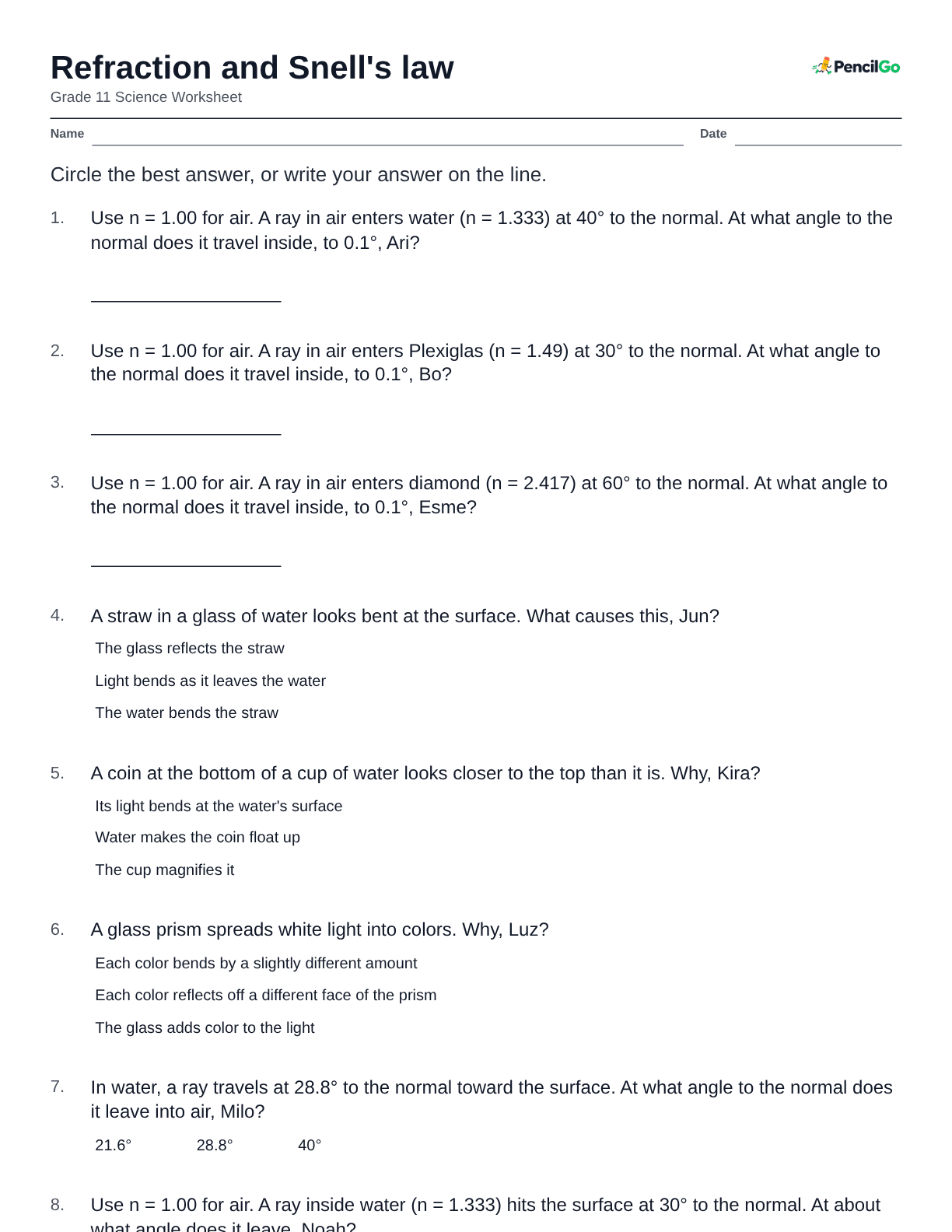
Circle the best answer, or write your answer on the line.

  1. Use n = 1.00 for air. A ray in air enters water (n = 1.333) at 40° to the normal. At what angle to the normal does it travel inside, to 0.1°, Ari?

  2. Use n = 1.00 for air. A ray in air enters Plexiglas (n = 1.49) at 30° to the normal. At what angle to the normal does it travel inside, to 0.1°, Bo?

  3. Use n = 1.00 for air. A ray in air enters diamond (n = 2.417) at 60° to the normal. At what angle to the normal does it travel inside, to 0.1°, Esme?

  4. A straw in a glass of water looks bent at the surface. What causes this, Jun?

    • The glass reflects the straw
    • Light bends as it leaves the water
    • The water bends the straw
  5. A coin at the bottom of a cup of water looks closer to the top than it is. Why, Kira?

    • Its light bends at the water's surface
    • Water makes the coin float up
    • The cup magnifies it
  6. A glass prism spreads white light into colors. Why, Luz?

    • Each color bends by a slightly different amount
    • Each color reflects off a different face of the prism
    • The glass adds color to the light
  7. In water, a ray travels at 28.8° to the normal toward the surface. At what angle to the normal does it leave into air, Milo?

    • 21.6°
    • 28.8°
    • 40°
  8. Use n = 1.00 for air. A ray inside water (n = 1.333) hits the surface at 30° to the normal. At about what angle does it leave, Noah?

    • About 41.8°
    • About 22.0°
    • 30°
  9. A ray leaves a diamond into air. How does its angle to the normal change, Pia?

    • It gets smaller
    • It gets bigger
    • It stays the same
  10. Read this first

    Refractive indices (Engineering ToolBox)

    MaterialRefractive index n
    air (0 °C)1.00029
    ice1.31
    water (20 °C)1.333
    quartz glass1.46
    Plexiglas1.49
    diamond2.417
  11. Using the table, about how many times as fast does light travel in water as in diamond, Ren?

    • About 0.55 times
    • About 3.75 times
    • About 1.81 times
PencilGopencilgo.com

11th grade Refraction and Snell's law worksheet – printable
Print: 123456

About this worksheet

Refraction and Snell's law. Every version has 10 questions, and the answer key prints on the second page.

What your child will learn

  • I can use refractive indices from a sourced table (water 1.333, Plexiglas 1.49, diamond 2.417) to find light's speed, v = c ÷ n.
  • I can use Snell's law, n₁ sin θ₁ = n₂ sin θ₂, with angles from the normal, for light entering and leaving water, Plexiglas and diamond.
  • I can predict the bending: toward the normal entering a higher index, away from it leaving one, and none along the normal.
  • I can find critical angles, sin θc = 1 ÷ n, and explain total internal reflection in optical fibers and diamonds. I can also explain everyday refraction: a bent-looking straw, a raised-looking coin and a prism's colors.

Standard: none (TX, FL)

Words to know

refraction: Light bending as it crosses into a material where its speed changes

refractive index (n): How many times slower light is in a material: n = c ÷ v

Snell's law: n₁ sin θ₁ = n₂ sin θ₂

critical angle: The angle beyond which light reflects totally inside a material

total internal reflection: All light reflecting back inside at a boundary

Common mistakes

Your child multiplied by the index. Light slows in a material: v = c ÷ n.

Your child divided the angle by the index. Snell's law works with sines: sin θ₂ = sin θ₁ ÷ n₂ for light from air.

Your child measured the critical angle from the surface. Like every angle in Snell's law, it is measured from the normal.

Questions parents ask

What is the most common mistake with refraction and snell's law?

Your child multiplied by the index. Light slows in a material: v = c ÷ n.

Are these 11th grade science worksheets free to print?

Yes. All 6 printable versions at each level are free to print, with the answer key, and no account is needed.

More physics

See all Physics

Every sheet you scan goes into your child’s record: dated, marked and ready for the year-end portfolio. Homeschool records