PencilGo

Grade 11 · Science · Physics

11th grade SI units, prefixes and checking units worksheet

6 printable versionsOn Level10 questions · answer keyFree · no account

Level: Building Confidence · On Level · Challenge Me

When it’s done, scan the sheet with your phone and PencilGo marks it and picks the next one. Create a free account

Version
Print

SI units, prefixes and checking units

Grade 11 Science Worksheet

NameDate

Circle the best answer, or write your answer on the line.

  1. A car travels at 72 km/h. What is this speed in m/s, Ari?

  2. A train travels at 90 km/h. What is this speed in m/s, Bo?

  3. A bus travels at 54 km/h. What is this speed in m/s, Esme?

  4. Force = mass × acceleration. What is a newton in SI base units, Jun?

    • m/s²
    • kg·m/s²
    • kg·m/s
    • kg·m²/s²
  5. Power = energy ÷ time. What is a watt in SI base units, Luz?

    • kg·m²/s³
    • kg·m/s³
    • kg·m²·s
    • kg·m²/s²
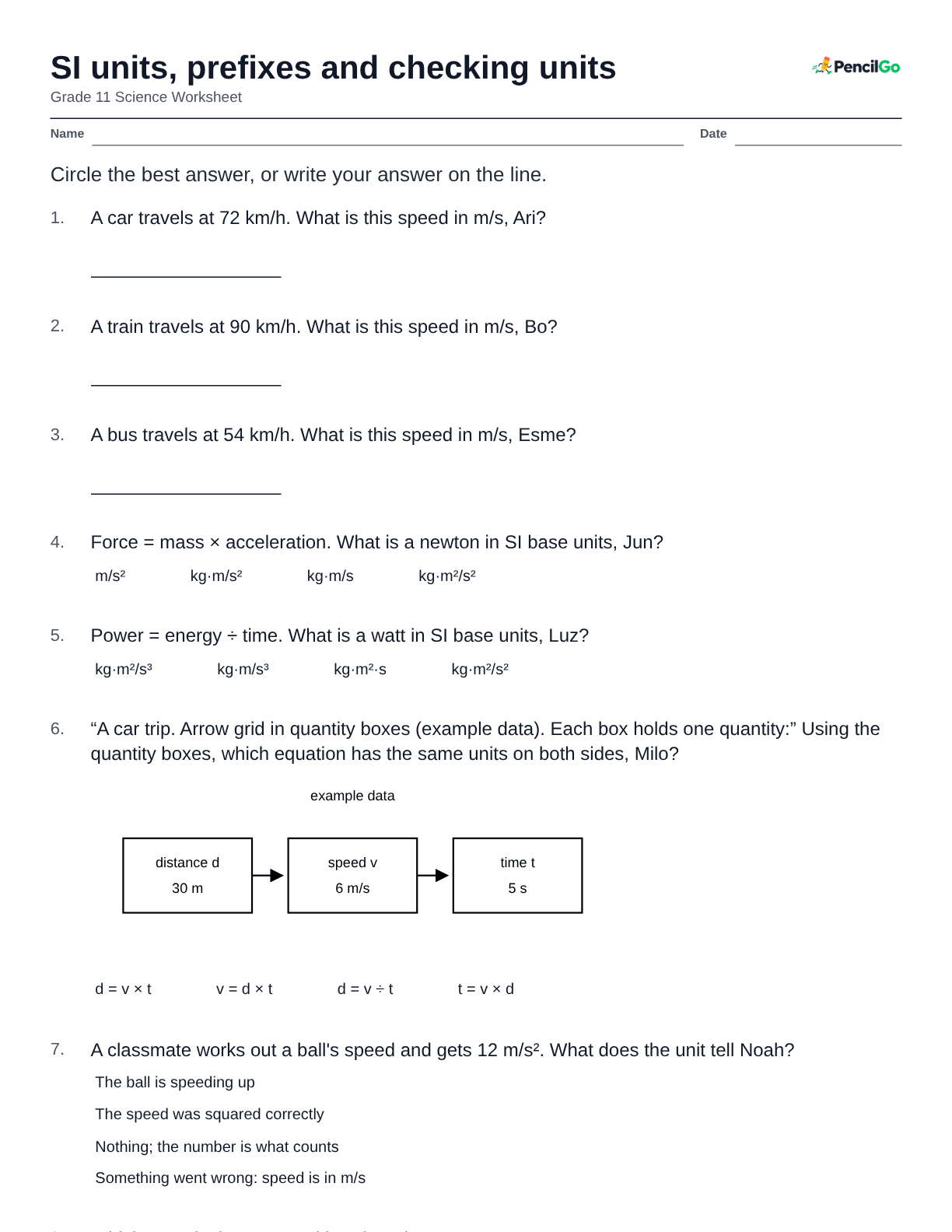
  6. “A car trip. Arrow grid in quantity boxes (example data). Each box holds one quantity:” Using the quantity boxes, which equation has the same units on both sides, Milo?

    • d = v × t
    • v = d × t
    • d = v ÷ t
    • t = v × d
  7. A classmate works out a ball's speed and gets 12 m/s². What does the unit tell Noah?

    • The ball is speeding up
    • The speed was squared correctly
    • Nothing; the number is what counts
    • Something went wrong: speed is in m/s
  8. Which quantity is measured in m/s², Pia?

    • Distance
    • Force
    • Velocity
    • Acceleration
  9. How is 3.2 × 10⁻⁶ m written with a prefix, Ren?

    • 3.2 mm
    • 3.2 nm
    • 3.2 Mm
    • 3.2 μm
  10. Light in a vacuum travels exactly 299,792,458 m/s (NIST). What is this to three significant figures, Tala?

    • 3.00 × 10⁸ m/s
    • 3.00 × 10⁷ m/s
    • 3.00 × 10⁹ m/s
    • 2.99 × 10⁸ m/s
PencilGopencilgo.com

11th grade SI units, prefixes and checking units worksheet – printable
Print: 123456

About this worksheet

SI units, prefixes and checking units. Every version has 10 questions, and the answer key prints on the second page.

What your child will learn

  • I can name the seven SI base units (m, kg, s, A, K, mol, cd). I know the kilogram is the base unit of mass, and that the newton, joule, watt and pascal are derived.
  • I can convert with prefixes from giga- to micro-, and convert km/h to m/s by changing both kilometers and hours.
  • I can build a derived unit from a formula (N = kg·m/s², J = kg·m²/s², W = kg·m²/s³, Pa = kg/(m·s²)). I can use units to check an equation or catch a slip.

Standard: practices (no PE)

Words to know

SI base unit: One of seven units every other SI unit is built from

derived unit: A unit built from base units, such as the newton

prefix: A power of ten in front of a unit, such as milli-

unit analysis: Carrying units through a calculation to check it

scientific notation: A number written as a value times a power of ten

Common mistakes

Your child divided where they should multiply (or the reverse).

Your child multiplied by 3.6. 1 m/s is 3.6 km/h, so going from km/h to m/s means dividing by 3.6.

Your child changed kilometers to meters but left hours as hours. Both parts of the unit must be converted.

What to say

Ask: is a meter bigger or smaller than this unit? Then check the answer's size.

Questions parents ask

What is the most common mistake with si units, prefixes and checking units?

Your child divided where they should multiply (or the reverse).

How can I help my child with si units, prefixes and checking units?

Ask: is a meter bigger or smaller than this unit? Then check the answer's size.

Are these 11th grade science worksheets free to print?

Yes. All 6 printable versions at each level are free to print, with the answer key, and no account is needed.

More physics

See all Physics

Every sheet you scan goes into your child’s record: dated, marked and ready for the year-end portfolio. Homeschool records