PencilGo

Grade 11 · Science · Physics

11th grade Weight, mass and the normal force worksheet

6 printable versionsBuilding Confidence10 questions · answer keyFree · no account

Level: Building Confidence · On Level · Challenge Me

When it’s done, scan the sheet with your phone and PencilGo marks it and picks the next one. Create a free account

Version
Print

Weight, mass and the normal force

Grade 11 Science Worksheet - Building Confidence

NameDate

Circle the best answer, or write your answer on the line.

  1. A box has a mass of 3 kg. With g = 9.8 m/s², what is its weight, Ari?

  2. A box has a mass of 7 kg. With g = 9.8 m/s², what is its weight, Bo?

  3. A box has a mass of 0.6 kg. With g = 9.8 m/s², what is its weight, Esme?

  4. Read this first

    Use this

    The elevator is not moving.

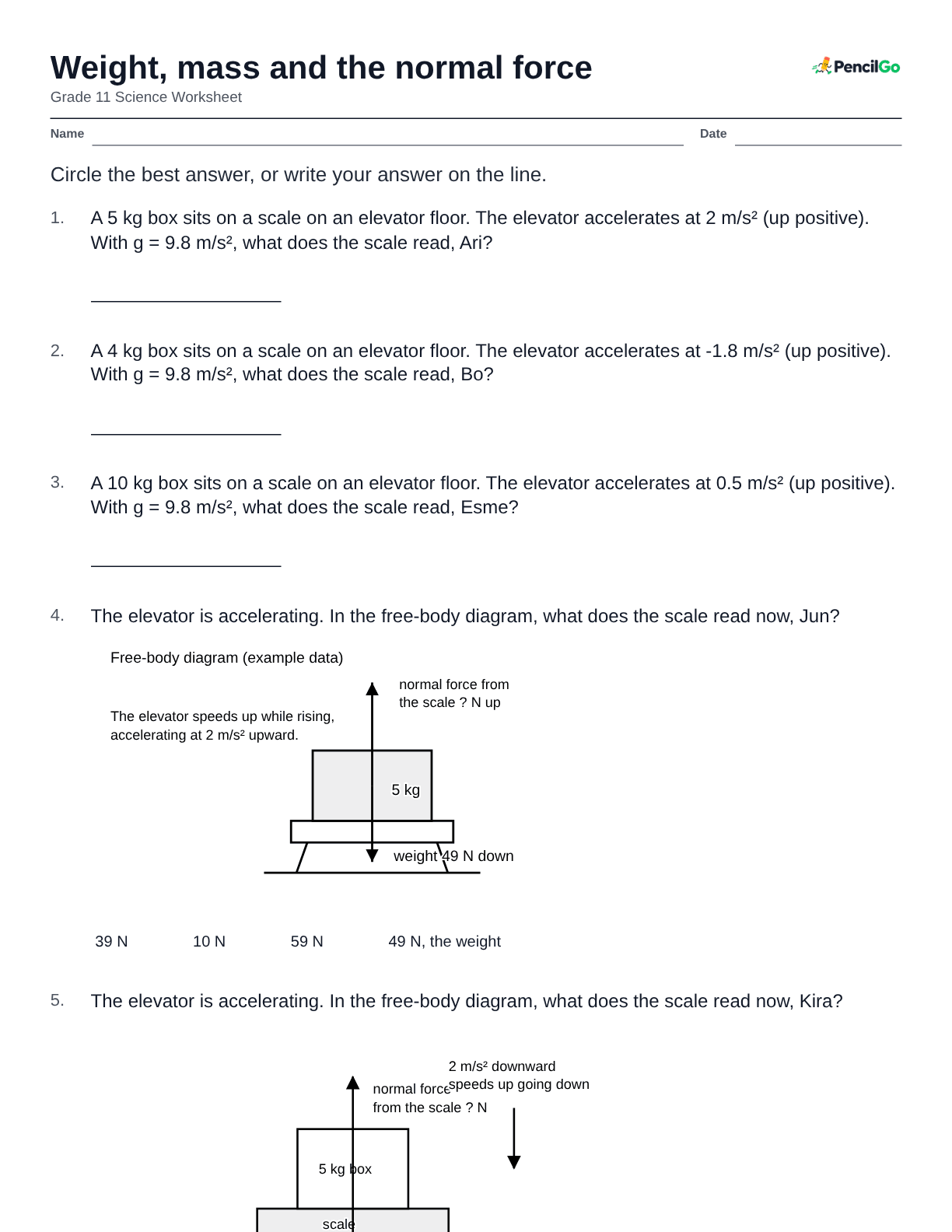
  5. In the free-body diagram, what does the scale read, Jun?

    • 49 N
    • 5 N, the box's mass
    • 0 N
  6. In the free-body diagram, which force does the scale actually measure, Kira?

    Use the picture in question 4.

    • The elevator's speed
    • The normal force it pushes up with
    • The box's mass in kilograms
  7. The elevator now rises at a steady 2 m/s with the same box. What does the scale read, Luz?

    • More than 49 N, since it is moving up
    • Less than 49 N
    • 49 N, the same as at rest
  8. Which unit should Noah use for a box's weight?

    • Kilograms
    • Meters
    • Newtons
  9. When a box goes from Earth to the Moon, which changes, Pia?

    • Neither
    • Its weight
    • Its mass
  10. A 1 kg mass hangs still from a spring scale. What does the scale read, Tala?

    • 9.8 N
    • 0 N
    • 1 N
  11. A drone lifts a box straight up at a steady speed. How does the cable's pull compare with the box's weight, Zee?

    • The pull is bigger, since the box is moving up
    • The pull is zero
    • They are equal
PencilGopencilgo.com

11th grade Weight, mass and the normal force worksheet – printable
Print: 123456

About this worksheet

Weight, mass and the normal force. Every version has 10 questions, and the answer key prints on the second page.

What your child will learn

  • I can find weight with W = mg. I know mass (kg) stays the same everywhere while weight (N) changes with g: the Moon's g is 1.62 m/s² and Mars's about 3.69 m/s² (NASA).
  • I can explain that a scale reads the normal force. At rest or at a steady speed it equals the weight; with acceleration it is N = m(g + a), with up positive.
  • I can work backward from a scale reading to the elevator's acceleration (a = N ÷ m − g).
  • I can find normal forces that are not the weight: stacked loads, and ramps (mg cos θ).

Standard: HS-PS2-1

Words to know

mass: Amount of matter, in kilograms; the same everywhere

weight: Gravity's pull on an object: W = mg, in newtons

normal force: A surface's push straight out from itself

scale reading: The normal force the scale pushes with

apparent weight: What a scale reads when it is accelerating

Common mistakes

Your child used 10 for g. With g = 9.8 m/s² given, use 9.8; 10 is a rough estimate.

Your child used the weight as the scale reading. When the elevator accelerates, the scale must also supply m × a, so the reading changes.

Your child got the direction of the acceleration backward. With up positive, accelerating upward makes the scale read more.

Questions parents ask

What is the most common mistake with weight, mass and the normal force?

Your child used 10 for g. With g = 9.8 m/s² given, use 9.8; 10 is a rough estimate.

Are these 11th grade science worksheets free to print?

Yes. All 6 printable versions at each level are free to print, with the answer key, and no account is needed.

More physics

See all Physics

Every sheet you scan goes into your child’s record: dated, marked and ready for the year-end portfolio. Homeschool records