PencilGo

Grade 11 · Science · Physics

11th grade Elastic and inelastic collisions worksheet

6 printable versionsOn Level10 questions · answer keyFree · no account

Level: Building Confidence · On Level · Challenge Me

When it’s done, scan the sheet with your phone and PencilGo marks it and picks the next one. Create a free account

Version
Print

Elastic and inelastic collisions

Grade 11 Science Worksheet

NameDate

Circle the best answer, or write your answer on the line.

  1. A 4 kg cart at 5 m/s hits a 1 kg cart at rest, and they stick together. How much kinetic energy is lost, Bo?

  2. A 1 kg cart at 9 m/s hits a 2 kg cart at rest, and they stick together. How much kinetic energy is lost, Esme?

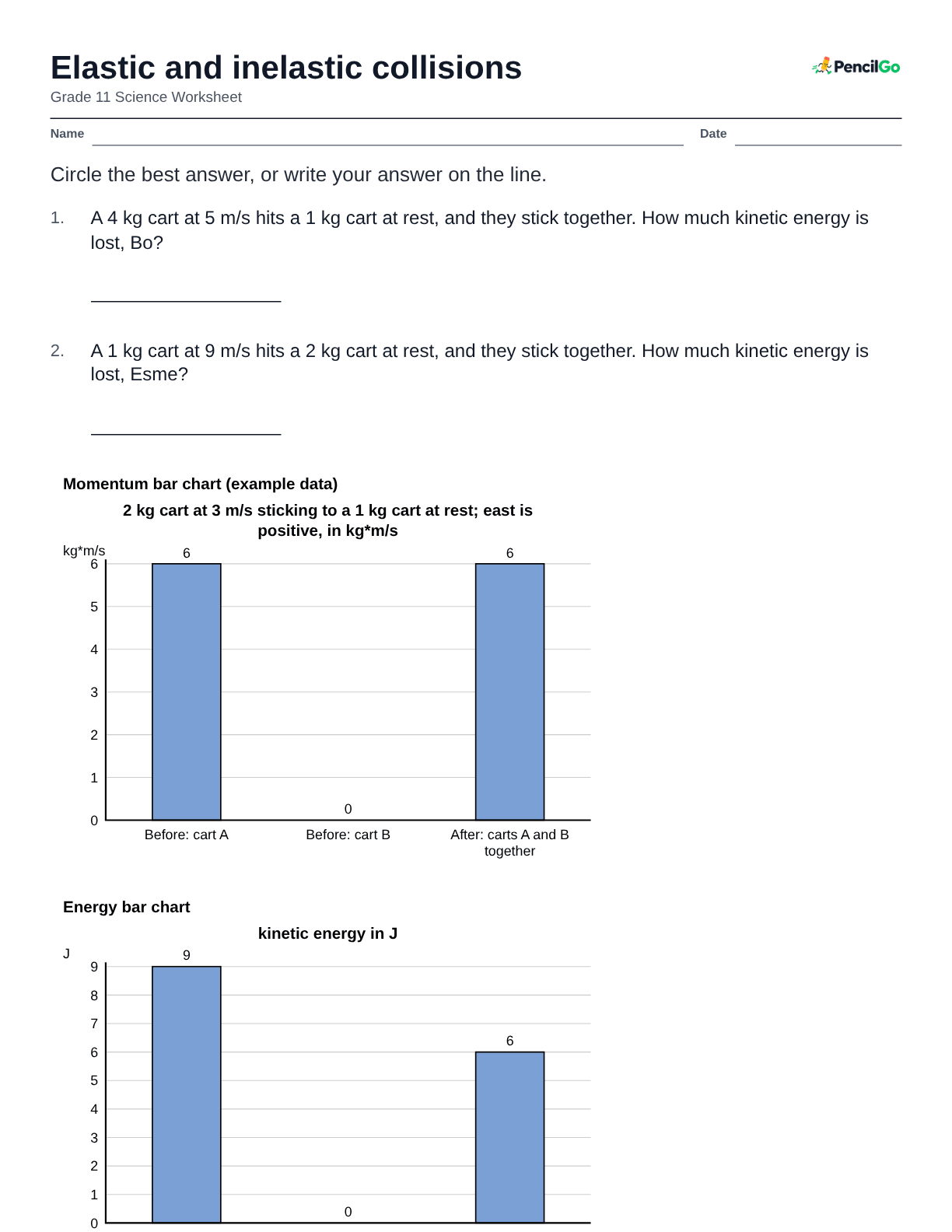
  3. In the charts, what happens to the momentum, Jun?

    • It drops to 0
    • It stays 6 kg·m/s
    • It doubles
    • It drops, since they stuck
  4. Looking at both charts, how should Luz classify this collision?

    Use the picture in question 3.

    • Perfectly inelastic
    • Not a collision; momentum was lost
    • Super-elastic
    • Elastic, since momentum is kept
  5. Read this first

    Collision trials for two carts (example data)

    trialkinetic energy before (J)kinetic energy after (J)carts after
    P1212bounce apart
    Q128bounce apart
    R124stuck together
  6. In the trials table, which trial is elastic, Milo?

    • Each of the three
    • Trial Q, since the carts bounced apart
    • Trial P
    • Trial R
  7. In the trials table, what kind of collision is trial Q, Noah?

    • Super-elastic
    • Inelastic
    • Elastic, since the carts bounced
    • Perfectly inelastic
  8. In the trials table, which trial lost the most kinetic energy, Pia?

    • Trial P
    • They lost the same
    • Trial Q
    • Trial R
  9. A rubber ball and a clay ball are dropped from the same height. The rubber ball bounces high; the clay ball stays put. Which collision is closer to elastic, Ren?

    • The rubber ball's
    • The clay ball's
    • Neither has a collision
    • Both are elastic
  10. The clay ball lands and doesn't bounce. What happened to its kinetic energy, Tala?

    • It stayed as kinetic energy
    • It was destroyed
    • It became momentum
    • It turned into thermal energy, sound and denting
  11. With a perfectly elastic floor and no air, how high would a dropped ball bounce, Zee?

    • Back to its starting height
    • Half as high
    • Twice as high
    • It wouldn't bounce
PencilGopencilgo.com

11th grade Elastic and inelastic collisions worksheet – printable
Print: 123456

About this worksheet

Elastic and inelastic collisions. Every version has 10 questions, and the answer key prints on the second page.

What your child will learn

  • I can find kinetic energy, KE = ½mv², and tell elastic collisions (KE kept) from inelastic ones (some KE lost) and perfectly inelastic ones (the carts stick). Momentum is conserved in all three.
  • I can find the kinetic energy lost when carts stick, and the fraction kept, m₁ ÷ (m₁ + m₂).
  • I can say where lost kinetic energy goes (thermal energy, sound, bending). Total energy is conserved.
  • I can classify trials and bounces from data. Equal carts in an elastic hit swap velocities; the same carts sticking share them.

Standard: HS-PS2-2

Words to know

elastic collision: Total kinetic energy is the same before and after

inelastic collision: Some kinetic energy turns into other forms

perfectly inelastic: The objects stick together; the most kinetic energy is lost

kinetic energy: Energy of motion: ½mv²

thermal energy: Energy stored as warmth in the objects

Common mistakes

Your child left out the ½ in KE = ½mv².

Your child gave the energy left after the collision. The question asks how much was lost: before minus after.

Your child used the wrong mass on top. For sticking carts, the fraction of kinetic energy kept is the moving cart's mass ÷ the total mass.

Questions parents ask

What is the most common mistake with elastic and inelastic collisions?

Your child left out the ½ in KE = ½mv².

Are these 11th grade science worksheets free to print?

Yes. All 6 printable versions at each level are free to print, with the answer key, and no account is needed.

More physics

See all Physics

Every sheet you scan goes into your child’s record: dated, marked and ready for the year-end portfolio. Homeschool records