Define a design problem and weigh trade-offs
Grade 11 Science Worksheet

Circle the best answer, or write your answer on the line.
A motor lifts a 120 kg load at 0.5 m/s and is 75% efficient. With g = 9.8 m/s², how much power does it draw, Bo?
A motor lifts a 30 kg load at 1.5 m/s and is 60% efficient. With g = 9.8 m/s², how much power does it draw, Esme?
Read this first
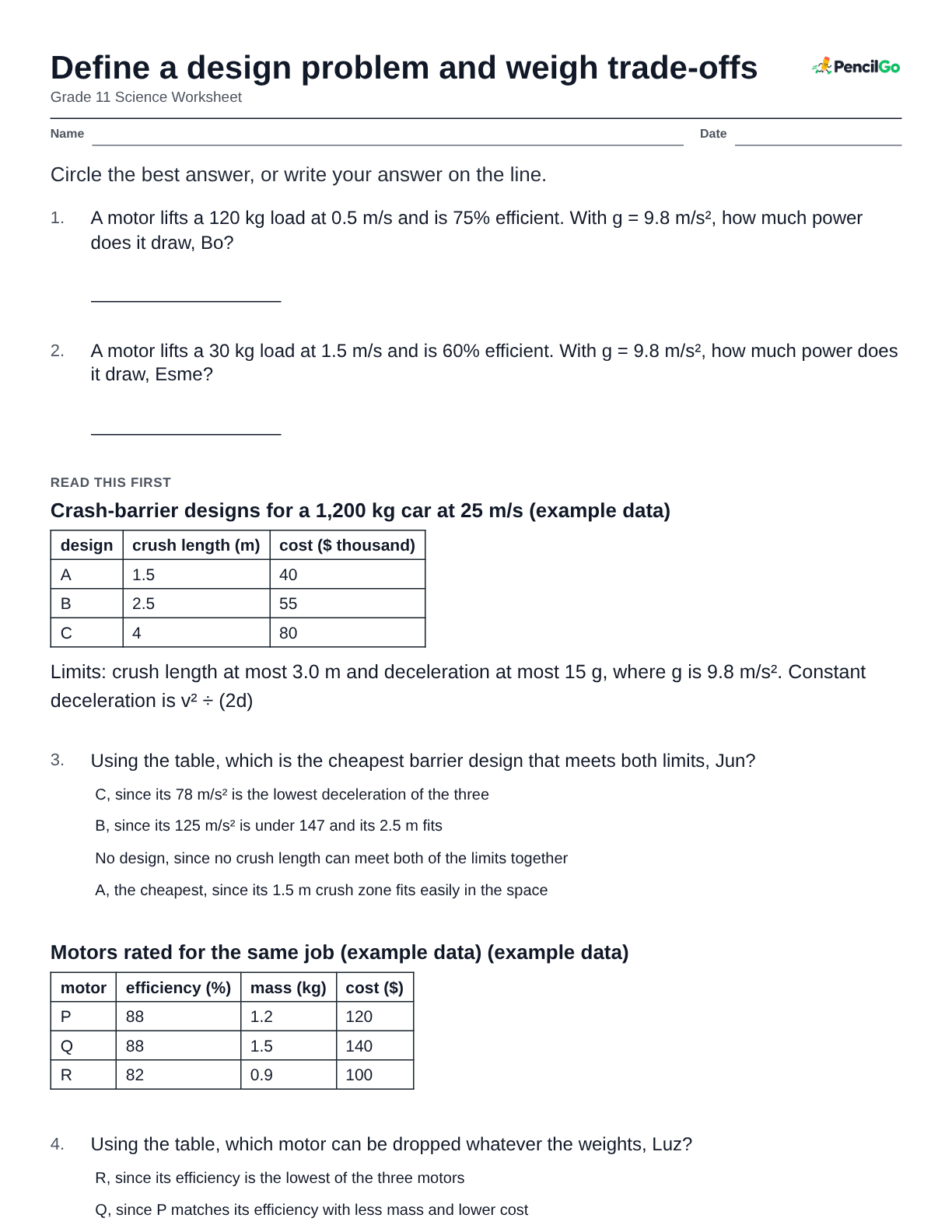
Crash-barrier designs for a 1,200 kg car at 25 m/s (example data)
design crush length (m) cost ($ thousand) A 1.5 40 B 2.5 55 C 4 80 Limits: crush length at most 3.0 m and deceleration at most 15 g, where g is 9.8 m/s². Constant deceleration is v² ÷ (2d)
Using the table, which is the cheapest barrier design that meets both limits, Jun?
- C, since its 78 m/s² is the lowest deceleration of the three
- B, since its 125 m/s² is under 147 and its 2.5 m fits
- No design, since no crush length can meet both of the limits together
- A, the cheapest, since its 1.5 m crush zone fits easily in the space
Motors rated for the same job (example data) (example data)
motor efficiency (%) mass (kg) cost ($) P 88 1.2 120 Q 88 1.5 140 R 82 0.9 100 Using the table, which motor can be dropped whatever the weights, Luz?
- R, since its efficiency is the lowest of the three motors
- Q, since P matches its efficiency with less mass and lower cost
- P, since it does not top the table on each column at once
- No motor, since any motor can win under some choice of the weights
A pump needs 500 W of output. Motor B (80%, 0.5 kg) replaces motor A (90%, 1.0 kg). What does B trade away, Milo?
- About 7 W more input power, to save 0.5 kg of mass
- About 50 W more input power, to save 0.5 kg of mass
- About 69 W more input power, to save 0.5 kg of mass
- About 10 W more input power, to save 0.5 kg of mass
Crash-barrier designs for a 1,200 kg car at 25 m/s (example data)
design crush length (m) cost ($ thousand) A 1.5 40 B 2.5 55 C 4 80 Limits: crush length at most 3.0 m and deceleration at most 15 g, where g is 9.8 m/s². Constant deceleration is v² ÷ (2d)
A team says barrier B is safe because it stops a 1,200 kg car in 2.5 m. B's average force is 150 kN. What is the flaw, Noah?
- It was tested at one mass; at 150 kN a 3,000 kg SUV needs 6.25 m
- Nothing is missing, since 2.5 m is under the 3.0 m limit for space
- The speed of 25 m/s was not given, so the test says little
- It should have used a lighter car, since light cars crush more
A designer doubles a barrier's crush length from 1.5 m to 3.0 m. What changes, Pia?
- Deceleration stays the same, but cost doubles
- Deceleration falls to a quarter, with the same road space
- Deceleration falls by a third, but it needs half the space
- Deceleration halves, but it needs twice the road space
Stopping distance of a car on two tire compounds, five trials each (m) (example data)
trial compound X compound Y 1 24.1 23.2 2 23.8 24.9 3 24.5 22.8 4 24 24.6 5 24.3 23.5 Mean X is 24.14 m with a spread of 0.7 m. Mean Y is 23.8 m with a spread of 2.1 m.
Ren claims compound Y stops the car in a shorter distance. Does the table support that claim?
- No: X's trials vary less, so X must be the better compound
- Yes: five trials are enough to show any difference
- Yes: Y's mean is shorter and it holds the single shortest stop
- No: the 0.34 m gap is smaller than Y's 2.1 m spread
First test of a barrier with a 2.0 m crush zone (1,200 kg car at 25 m/s) (example data)
measure result limit crush length (m) 2 at most 3.0 deceleration (g) 15.9 at most 15 A 2.0 m crush zone gave 15.9 g, over the 15 g limit. Which single next change should Tala test?
- Change the zone length and the car's mass together
- Shorten the zone to save road space and rerun the same test
- Raise the limit to 16 g so that the first test passes
- Lengthen the zone to about 2.5 m and rerun the same test
The spec says at least 80%. The mean is 80.8% and the spread is 7 points. The spec says the motor is at least 80% efficient. Does the table clearly support it, Zee?
- Yes: its top run reached 84%, which is well above the 80% spec
- Not clearly: two runs fall under 80% and the spread is 7 points
- No: two runs fell below 80%, so the motor fails the spec outright
- Yes: the mean of 80.8% is above the 80% that the spec asks for