Define a design problem and weigh trade-offs
Grade 11 Science Worksheet - Challenge Me

Circle the best answer, or write your answer on the line.
A barrier may slow a car at most 15 g (1 g = 9.8 m/s²). From 25 m/s, what is the shortest steady crush length, to 0.01 m, Ari?
A barrier may slow a car at most 20 g (1 g = 9.8 m/s²). From 30 m/s, what is the shortest steady crush length, to 0.01 m, Bo?
A barrier may slow a car at most 10 g (1 g = 9.8 m/s²). From 22 m/s, what is the shortest steady crush length, to 0.01 m, Esme?
A 2,400 kg SUV hits the 2.5 m barrier at 25 m/s. Using the model's pattern, what changes, Jun?
- Deceleration doubles to 25.6 g, and the force doubles to 300 kN
- Deceleration stays near 12.8 g, but the force doubles to 300 kN
- Deceleration stays near 12.8 g, but the force halves to 75 kN
- Deceleration and force both stay at 12.8 g and 150 kN
Read this first
Use this
Motor model and bench test, 100 W output (example data). Columns: source, input power (W). model, 80% efficient, 125; bench run 1, 138; bench run 2, 141; bench run 3, 140.
The model says 125 W in for 100 W out. Three bench runs read 138, 141 and 140 W. What do they show, Luz?
- The real efficiency is about 60%, since it is 60 W below 200 W
- The real efficiency is about 140%, since the input is bigger
- The real efficiency is about 71%, below the model's 80%
- The model is right, and the meter must be reading high
Materials for a bracket (example data) (example data)
material strength (MPa) density (g/cm³) cost ($/kg) steel 400 7.8 1 aluminum 250 2.7 3 Milo says an aluminum bracket costs 3 times a steel one, since aluminum is $3 per kg. For equal strength, agree or disagree?
- Disagree: it needs half the mass, so it costs 1.5 times as much
- Disagree: it needs 0.55 of the mass, so it costs about 1.7 times
- Disagree: aluminum is lighter, so it costs less than steel does
- Agree: the price per kg is 3 times, so the bracket costs 3 times as much
Old motor: 83.5 to 84.5. New motor: 85.0 to 86.5. Noah says the new motor is more efficient than the old one. Do the six runs each support the claim?
- No: six runs are too few to compare two motors with confidence
- Yes: the new motor's top run, 86.5%, is above the old one's mean
- No: the 1.8 point gap is too small to matter for a motor
- Yes: the ranges do not overlap, and the gap beats both spreads
Motor B (92%) costs $150 more than motor A (85%). Both give 2 kW for 3,000 h a year at 12¢ per kWh. About when does B repay its extra cost, Ren?
- About 4.6 years
- About 2.3 years
- About 1.2 years
- About 3 years
A drone's hover power scales as mass^1.5. Carbon arms cut its mass from 1,000 g to 960 g for $30 more. By how much does flight time rise, Tala?
- About 6%, since power falls to about 94% of before
- About 2%, since a $30 part cannot change flight by much
- About 4%, since mass falls by 4% and flight time follows it
- About 13%, since power scales as the cube of the mass
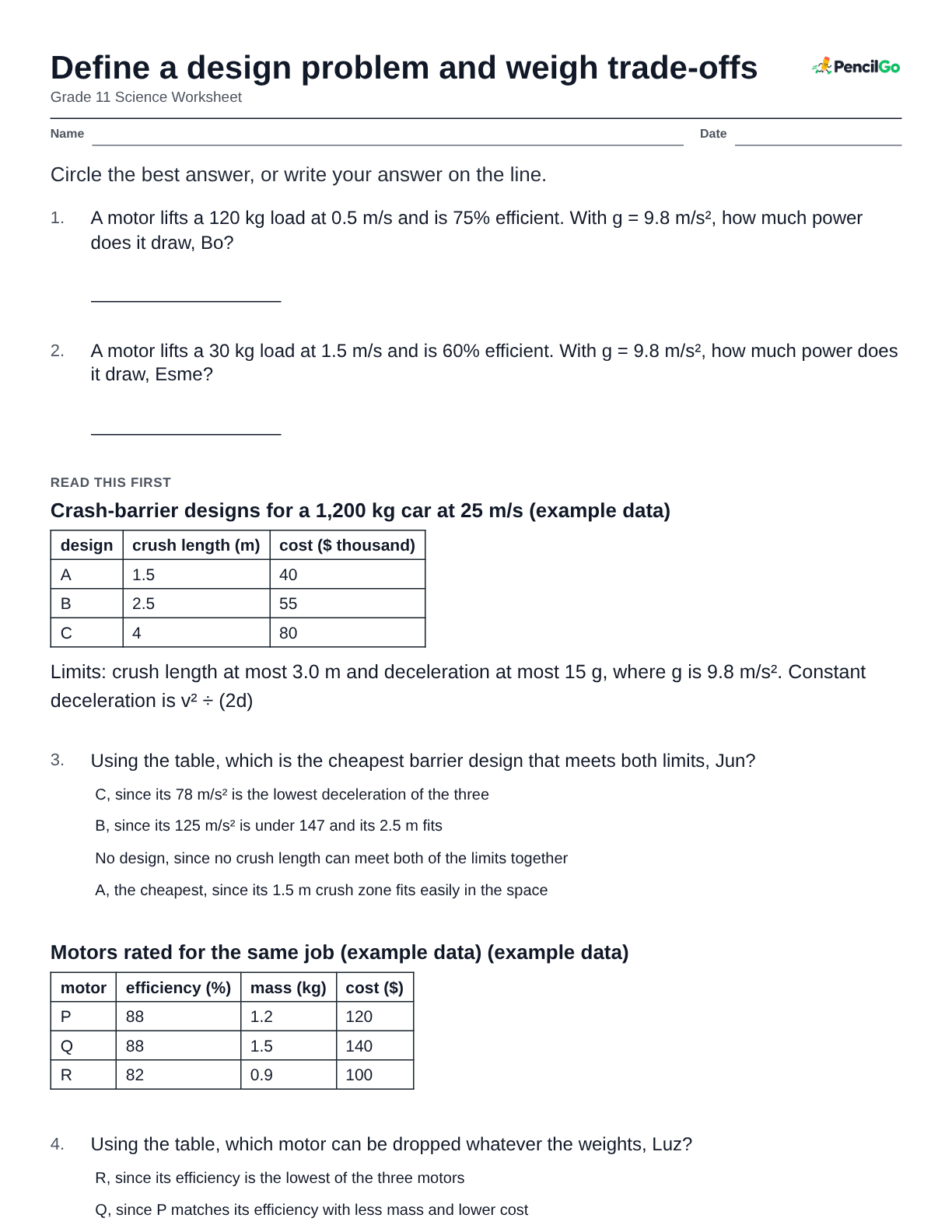
Crash-barrier designs for a 1,200 kg car at 25 m/s (example data)
design crush length (m) cost ($ thousand) A 1.5 40 B 2.5 55 C 4 80 Limits: crush length at most 3.0 m and deceleration at most 15 g, where g is 9.8 m/s². Constant deceleration is v² ÷ (2d)
Which line best records the barrier decision in a design report, Zee?
- B meets 3.0 m and 15 g for a 1,200 kg car; heavier ones are untested
- B is safest because its 2.5 m crush zone is long and its cost is lowest
- C is recommended, since its deceleration is lowest at 8 g, whatever the space
- B meets the 15 g limit, so it is safe for any vehicle