PencilGo

Grade 11 · Science · Physics

11th grade Interference and standing waves worksheet

6 printable versionsChallenge Me10 questions · answer keyFree · no account

Level: Building Confidence · On Level · Challenge Me

When it’s done, scan the sheet with your phone and PencilGo marks it and picks the next one. Create a free account

Version
Print

Interference and standing waves

Grade 11 Science Worksheet - Challenge Me

NameDate

Circle the best answer, or write your answer on the line.

  1. Waves travel at 240 m/s on a string 0.8 m long. What frequency makes a standing wave with 3 loops, Bo?

  2. Waves travel at 90 m/s on a string 0.5 m long. What frequency makes a standing wave with 2 loops, Esme?

  3. Read this first

    Standing waves on one string (example data)

    LoopsFrequency (Hz)
    1100
    2200
    3300
    4?
  4. Using the table, what frequency gives 4 loops, Jun?

    • 1600 Hz
    • 400 Hz
    • 500 Hz
  5. Using the table, the string is 0.5 m long. How fast do waves travel on it, Kira?

    • 100 m/s
    • 50 m/s
    • 200 m/s
  6. Using the table, why can't this string make a standing wave at 250 Hz, Luz?

    • It isn't a whole-number multiple of 100 Hz
    • Standing waves need odd numbers of loops
    • 250 Hz is too high for any string
  7. Milo says destructive interference destroys energy. Agree or disagree?

    • Disagree: the energy moves to the loud spots
    • Agree: cancelled waves lose their energy
    • Agree: the quiet spots soak it up for good
  8. Noah says two pulses that cancel while overlapping are gone for good. Agree or disagree?

    • Agree: cancelling uses them up
    • Agree: they join into one flat rope
    • Disagree: each carries on after they pass
  9. Pia says the nodes on a standing wave are points where two waves always cancel. Agree or disagree?

    • Agree: the two waves meet out of step there
    • Disagree: nodes move along the string
    • Disagree: nodes are where the string moves most
  10. A string's lowest note is 200 Hz. What is it if the string is held at half its length, Ren?

    • 100 Hz
    • 200 Hz
    • 400 Hz
  11. Waves travel at 150 m/s on a 0.75 m string. What is its lowest standing-wave frequency, Zee?

    • 100 Hz
    • 200 Hz
    • 112.5 Hz
PencilGopencilgo.com

11th grade Interference and standing waves worksheet – printable
Print: 123456

About this worksheet

Interference and standing waves. Every version has 10 questions, and the answer key prints on the second page.

What your child will learn

  • I can add overlapping displacements with signs, and tell constructive (crest on crest) from destructive (crest on trough) interference.
  • I can explain that pulses pass through each other unchanged and that cancelled energy reappears at the loud spots, not destroyed.
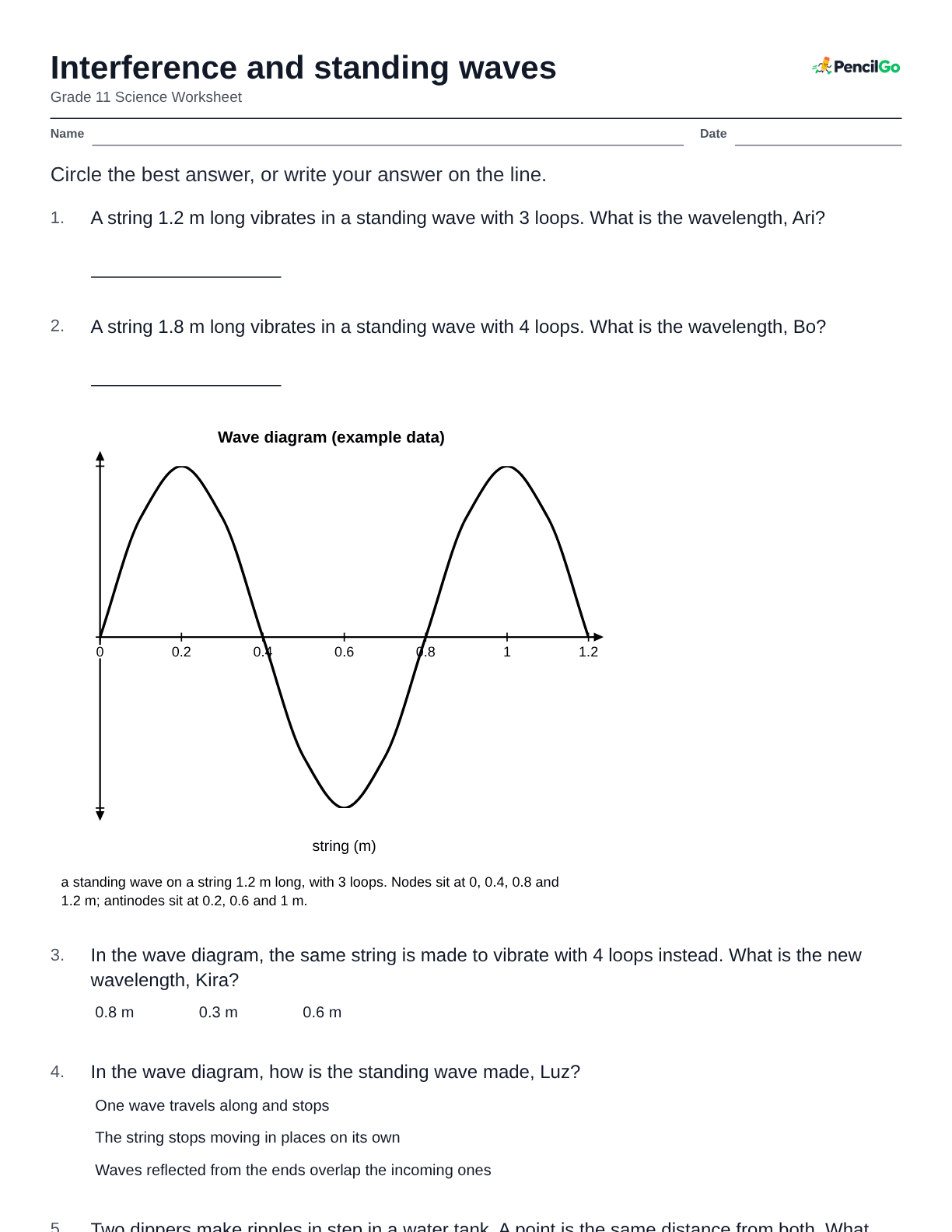
  • I can find nodes, antinodes and wavelength on a standing wave (λ = 2L ÷ n), and string frequencies (f = nv ÷ 2L, harmonics n × f₁).
  • I can use path difference: whole wavelengths give loud spots, half wavelengths quiet ones. I can explain noise-cancelling headphones and tuning a string.

Standard: none (TX)

Words to know

interference: Two waves overlapping and adding point by point

constructive: Waves adding to make a bigger wave

destructive: Waves cancelling to make a smaller wave

node / antinode: A point that stays still / a point that swings most

harmonic: A standing wave with a whole number of loops

Common mistakes

Your child ignored a minus sign. A displacement below the middle line is negative, so it subtracts.

Your child forgot that each loop is half a wavelength. On a string, λ = 2L ÷ n, and f = nv ÷ 2L.

Your child thought destructive interference destroys energy. The energy is moved to the loud spots; it isn't lost.

Questions parents ask

What is the most common mistake with interference and standing waves?

Your child ignored a minus sign. A displacement below the middle line is negative, so it subtracts.

Are these 11th grade science worksheets free to print?

Yes. All 6 printable versions at each level are free to print, with the answer key, and no account is needed.

More physics

See all Physics

Every sheet you scan goes into your child’s record: dated, marked and ready for the year-end portfolio. Homeschool records