PencilGo

Grade 11 · Science · Physics

11th grade Interference and standing waves worksheet

6 printable versionsBuilding Confidence10 questions · answer keyFree · no account

Level: Building Confidence · On Level · Challenge Me

When it’s done, scan the sheet with your phone and PencilGo marks it and picks the next one. Create a free account

Version
Print

Interference and standing waves

Grade 11 Science Worksheet - Building Confidence

NameDate

Circle the best answer, or write your answer on the line.

  1. Two pulses overlap on a rope. At one point, with up as positive, one gives 3 cm and the other gives -1 cm. What is the combined displacement, Ari?

  2. In the wave diagram, what is the amplitude of the combined wave, Jun?

    • 4 cm
    • 2 cm
    • 0 cm
  3. In the wave diagram, what kind of interference happens, Kira?

    Use the picture in question 2.

    • Destructive
    • No interference, since they don't touch
    • Constructive
  4. In the wave diagram, what would the combined amplitude be if wave B were shifted by half a wavelength, Luz?

    Use the picture in question 2.

    • 1 cm
    • 0 cm
    • 4 cm
  5. A crest of one wave meets a trough of an equal wave. What happens there, Milo?

    • They add together: constructive interference
    • They bounce off each other
    • They cancel: destructive interference
  6. At a quiet spot in front of two speakers, the sound waves cancel. What happened to their energy, Noah?

    • It turned into light
    • It shows up at the loud spots instead
    • It was destroyed
  7. Two pulses pass through each other on a rope. What are they like afterward, Pia?

    • Joined into one pulse
    • The same as before they met
    • Gone, since they cancelled
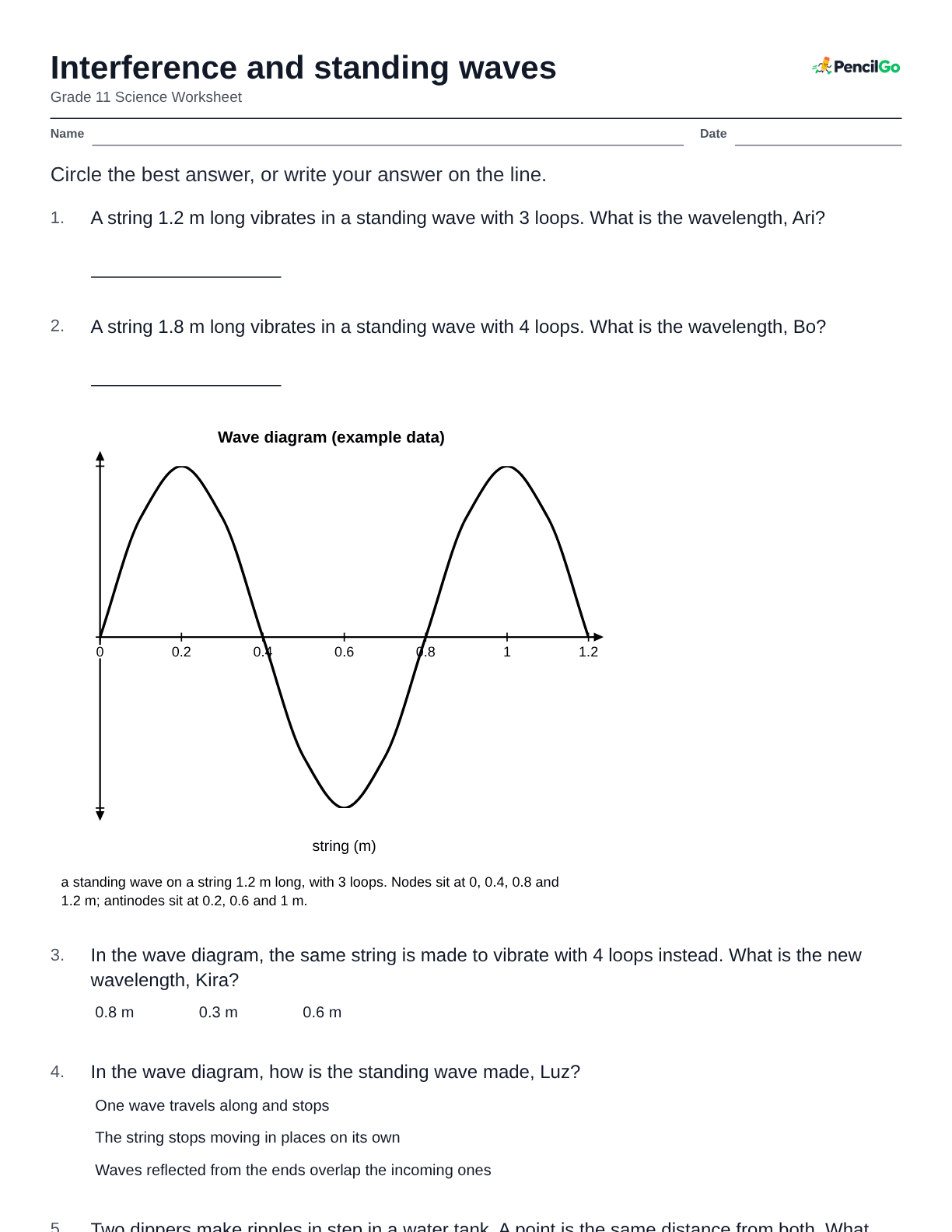
  8. In the wave diagram, how many nodes does the string have, Ren?

    • 6
    • 3
    • 4
  9. In the wave diagram, where does the string not move at all, Tala?

    Use the picture in question 8.

    • At the antinodes
    • Nowhere, since the whole string shakes
    • At the nodes
  10. In the wave diagram, where does the string swing the most, Zee?

    Use the picture in question 8.

    • At the two ends
    • At 0.4 and 0.8 m
    • At 0.2, 0.6 and 1 m
PencilGopencilgo.com

11th grade Interference and standing waves worksheet – printable
Print: 123456

About this worksheet

Interference and standing waves. Every version has 10 questions, and the answer key prints on the second page.

What your child will learn

  • I can add overlapping displacements with signs, and tell constructive (crest on crest) from destructive (crest on trough) interference.
  • I can explain that pulses pass through each other unchanged and that cancelled energy reappears at the loud spots, not destroyed.
  • I can find nodes, antinodes and wavelength on a standing wave (λ = 2L ÷ n), and string frequencies (f = nv ÷ 2L, harmonics n × f₁).
  • I can use path difference: whole wavelengths give loud spots, half wavelengths quiet ones. I can explain noise-cancelling headphones and tuning a string.

Standard: none (TX)

Words to know

interference: Two waves overlapping and adding point by point

constructive: Waves adding to make a bigger wave

destructive: Waves cancelling to make a smaller wave

node / antinode: A point that stays still / a point that swings most

harmonic: A standing wave with a whole number of loops

Common mistakes

Your child ignored a minus sign. A displacement below the middle line is negative, so it subtracts.

Your child forgot that each loop is half a wavelength. On a string, λ = 2L ÷ n, and f = nv ÷ 2L.

Your child thought destructive interference destroys energy. The energy is moved to the loud spots; it isn't lost.

Questions parents ask

What is the most common mistake with interference and standing waves?

Your child ignored a minus sign. A displacement below the middle line is negative, so it subtracts.

Are these 11th grade science worksheets free to print?

Yes. All 6 printable versions at each level are free to print, with the answer key, and no account is needed.

More physics

See all Physics

Every sheet you scan goes into your child’s record: dated, marked and ready for the year-end portfolio. Homeschool records