Diffusion and osmosis
Grade 9 Science Worksheet

Circle the best answer.
Read this first
Use this
Lab card (model data). Coloring particles in two chambers joined by a membrane they can cross. Table with 3 rows. Columns: Time (minutes) | Left chamber | Right chamber. Rows: 0 | 24 | 0; 5 | 16 | 8; 10 | 13 | 11. A teacher ran the test; read about only.
Ari's class reads counts of food-coloring particles in two chambers joined by a membrane they can cross. What will the counts be after a long time?
- About 12 in each chamber, with particles no longer crossing
- About 12 in each chamber, though no particle crosses back to the left
- About 24 in the right chamber, because particles end up on the far side
- About 12 in each chamber, with particles still crossing both ways
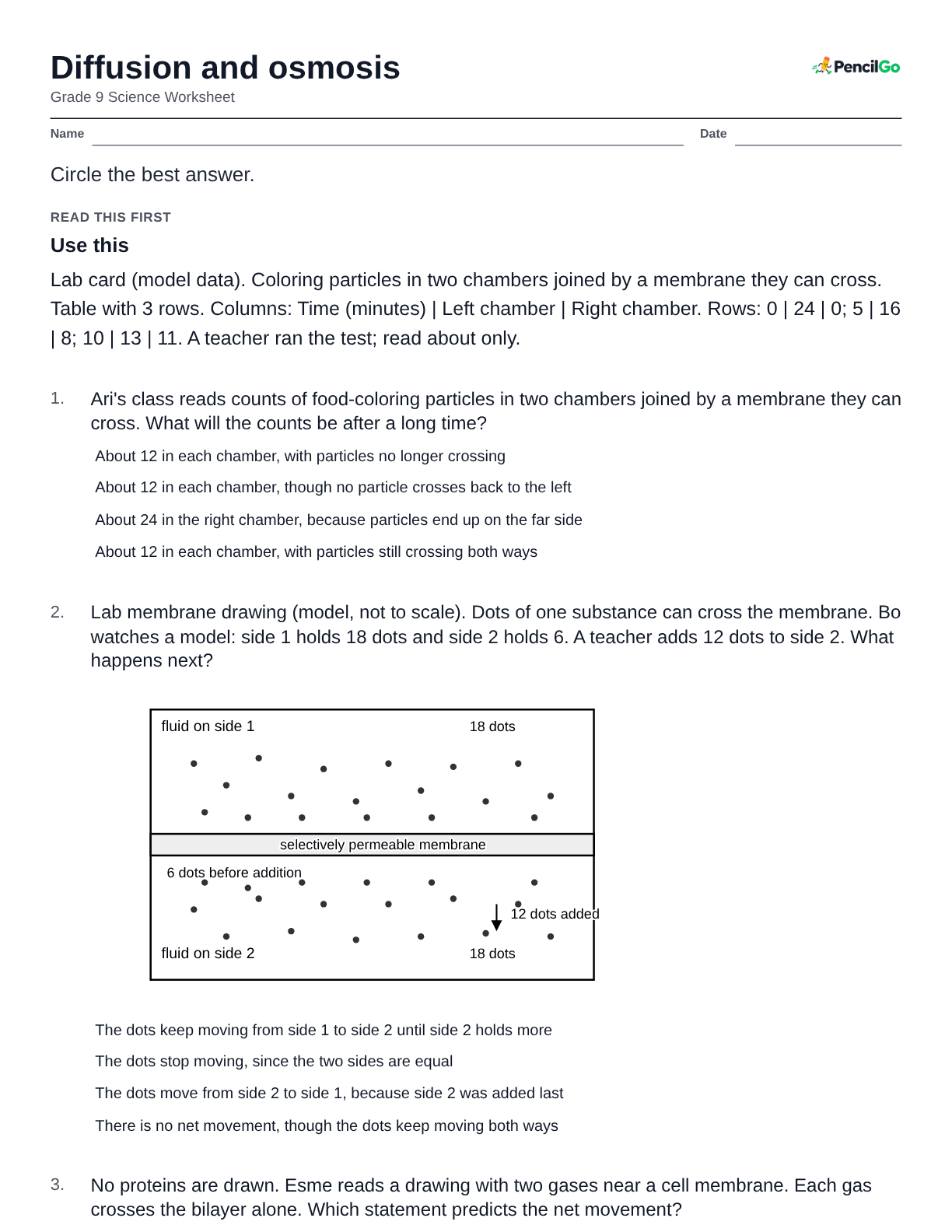
Lab membrane drawing (model, not to scale). Dots of one substance can cross the membrane. Bo watches a model: side 1 holds 18 dots and side 2 holds 6. A teacher adds 12 dots to side 2. What happens next?
- The dots keep moving from side 1 to side 2 until side 2 holds more
- The dots stop moving, since the two sides are equal
- The dots move from side 2 to side 1, because side 2 was added last
- There is no net movement, though the dots keep moving both ways
No proteins are drawn. Esme reads a drawing with two gases near a cell membrane. Each gas crosses the bilayer alone. Which statement predicts the net movement?
- Both gases move in, because the outside holds more molecules in total
- Oxygen moves in, and the cell spends energy to move carbon dioxide out
- Oxygen moves out and carbon dioxide moves in, because gases swap places
- Oxygen moves in and carbon dioxide out, each down its own gradient
Use this
Lab card (model data). Time for food coloring to spread to the far side of a cup. Table with 2 rows. Columns: Water | Time to spread (seconds). Rows: warm water | 30; cold water | 90. The cups were the same size and held the same amount of water. A teacher ran the test; read about only.
Jun's class drops food coloring into two cups of water and times how long the color takes to reach the far side. What does the card show?
- The cups match, because diffusion is passive and needs no energy
- Cold water spreads color faster, because dense water pushes particles along
- Warmer water speeds diffusion, because particles have more thermal energy
- Warmer water slows diffusion, because particles crowd together
Use this
Lab card (model data). Time for each substance to spread across a tank. Table with 2 rows. Columns: Substance | Molecule mass | Time to spread (seconds). Rows: L | lighter | 40; H | heavier | 100. Both tanks held the same warm water and the same starting gradient. A teacher ran the test; read about only.
Luz's class reads a card with two substances in the same warm tank. A third substance, M, has molecules heavier than L's but lighter than H's. Predict M's time.
- Under 40 seconds, since heavier molecules diffuse faster
- Exactly 40 seconds, since the same gradient gives the same time
- Exactly 140 seconds, since the two times add together
- Between 40 and 100 seconds, since heavier molecules diffuse more slowly
model, not to scale. Chloride ions cross a cell membrane through channel protein H, from 14 molecules outside to 5 inside. Milo classifies the transport. Which label fits?
- Simple diffusion: passing between the tails, down the concentration gradient
- Facilitated diffusion: passive, through a protein, down the gradient
- Osmosis: chloride ions crossing toward the side with more water
- Facilitated diffusion: through a protein, using energy from the cell
Noah sorts four transport events shown on a membrane drawing. Which event is simple diffusion?
- Oxygen slips between the tails, down its gradient, with no protein
- Carbon dioxide slips between the tails, powered by cell energy
- Glucose binds carrier M, which spends cell energy to change shape
- Chloride ions pass through channel L, down their gradient
Lab membrane drawing (model, not to scale). Pia reads a drawing of aquaporin channels in a lab membrane. Water crosses, but solute cannot. Which label fits the water movement?
- Facilitated diffusion: the cell spends energy to open the aquaporin
- Osmosis: movement of water that the cell powers with its energy
- Osmosis: passive movement of water toward the side with less solute
- Osmosis: passive water movement toward the side with more solute
Use this
Lab drawing (model, not to scale). A U-tube with a selectively permeable membrane across the bottom. Water crosses it; sugar dots cannot. The left arm holds 2 sugar dots and the right arm holds 7 sugar dots. Both arms hold the same volume of fluid at the start.
Ren's class reads about a U-tube with a membrane at the bottom that passes water but not sugar. The arms start at the same level. Which arm's level rises?
- The left arm, because water moves toward the side with less sugar
- Neither arm, because water stops moving when the arms start level
- The right arm, because water moves toward the side with more sugar
- The right arm, because the sugar dots cross to the right
Zee compares two U-tubes with a membrane that passes water but not sugar. Which tube shows the faster net movement of water, and why?
- Tube 1, because its arms are closer to equal, so water moves faster
- The tubes match, because water moves toward the right arm in both
- Tube 2, because the membrane spends more energy on a bigger difference
- Tube 2, because its arms differ more in sugar, so water moves faster