Diffusion and osmosis
Grade 9 Science Worksheet - Challenge Me

Circle the best answer.
Ari reads a graph of particles on two sides of a membrane they cross. What does the flat part of both lines, after 30 minutes, show?
- Particles stopped crossing once the sides reached 50
- The sides are equal near 50, with particles still crossing both ways
- Particles crossed from side 1 to side 2, and no particle crossed back
- The membrane ran out of energy for moving particles at 30 minutes
Bo reads a graph of one substance crossing a membrane in warm water and in cold water. Which conclusion does the graph support?
- Cold water is slower because the membrane spends less energy there
- Warmth raises the rate but not the end point: both reach 50
- Warm particles stop moving after 30 minutes, when the line goes flat
- Warmth changes the end point: warm water ends higher than cold
Esme reads a graph of one substance moving into a lab chamber. The line climbs steeply, then flattens. Why does the climb slow down?
- Particles cross into the chamber and do not cross back, so the first empties
- The chamber is running low on energy to power diffusion
- Particles slow down and stop moving as the line flattens
- The gradient shrinks as the chambers near equal, so diffusion slows
Read this first
Use this
Lab card (model data). A bag of dialysis tubing, a kind of lab membrane, held starch molecules and sat in a beaker with iodine molecules. The lab membrane lets iodine molecules cross but not starch molecules. Table with 2 rows. Columns: Particle | In the bag at 0 minutes | In the bag at 30 minutes | In the beaker at 30 minutes. Rows: starch | 10 | 10 | 0; iodine | 0 | 7 | 3. The beaker held 10 iodine molecules and no starch at 0 minutes. A teacher ran the test; read about only.
Jun reads a teacher's card about a bag of dialysis tubing, a lab membrane, set in a beaker. Which conclusion does the card support?
- Iodine moved into the bag down its gradient; starch stayed inside
- Iodine moved into the bag, and no iodine molecule moved back out again
- Iodine moved into the bag because the membrane spent energy moving it
- Starch moved out of the bag down its gradient as iodine moved in
Use this
Lab card (model data). A U-tube had a membrane across the bottom that passes water but not sugar. The left arm held 3 sugar dots and the right arm held 9 at the start, and both levels began at 20 mL. Table with 3 rows. Columns: Time (minutes) | Left level (mL) | Right level (mL). Rows: 0 | 20 | 20; 10 | 17 | 23; 20 | 15 | 25. A teacher ran the test; read about only.
Kira reads a card for a U-tube with a membrane that passes water but not sugar. Which conclusion does the card support?
- Water moved left to right, toward more sugar, as the left level fell 5 mL by 20 minutes
- Sugar dots crossed to the right arm and raised its level
- Water moved left to right, toward more sugar, as the left level fell 3 mL by 20 minutes
- Water moved right to left, toward less sugar, as the right level rose
Use this
Lab card (model data). A lab-made bilayer held 10 carrier proteins for glucose. The card gives the glucose outside and the rate of crossing. Table with 4 rows. Columns: Glucose outside (units) | Rate (molecules per second). Rows: 2 | 5; 4 | 9; 8 | 12; 16 | 12. A teacher ran the test; read about only.
Luz reads a card about glucose crossing through carrier proteins. The rate stays at 12 when glucose outside rises from 8 to 16. Why?
- Every carrier was busy, so more glucose could not raise the rate
- Glucose stopped moving at 8 units, because the sides reached equilibrium
- The carriers ran out of cell energy once glucose reached 8 units
- Glucose crossed the bilayer alone at 16 units, so carriers were not needed
Use this
Notes card written by a student. Line 1: Diffusion moves a substance from higher to lower concentration. Line 2: The cell spends ATP to run diffusion. Line 3: Warmer conditions speed diffusion up.
Milo's notes on diffusion have three lines. One line is wrong. Which correction fixes the notes?
- Line 3 is wrong: warmer conditions slow diffusion down
- Line 2 is wrong: diffusion is passive, so the cell spends no ATP
- Line 1 is wrong: substances move from lower to higher concentration
- Line 2 is right: diffusion through proteins also spends ATP
Use this
Notes card written by a student. The left arm holds 2 sugar dots and the right arm holds 8. Line 1: Sugar cannot cross the membrane. Line 2: Water crosses, so water moves toward the left arm, where there is less sugar. Line 3: The left level will rise.
Noah's notes explain a U-tube with a membrane that passes water but not sugar. One line is wrong. Which correction fixes the notes?
- Sugar moves to the left arm, which has less sugar, so its level rises
- Water moves to the right arm, which has more sugar, so its level falls
- Water moves to the right arm, which has more sugar, so its level rises
- Water moves to the left arm, which has less sugar, so its level rises
Use the table
Model data (not to scale)
Cell Width (units) Cell 1 10 Cell 2 40 Both cells start with the same oxygen concentration at the surface and none at the center. Oxygen enters by diffusion at the same temperature.
Tala compares two round model cells at the same temperature. Which claim, with its reason, fits for oxygen reaching the center?
- Cell 1 gets oxygen to its center sooner, because the distance is shorter
- Cell 2 gets oxygen to its center sooner, because a larger cell spends more energy
- Both cells get oxygen to the center together, because diffusion is passive
- Cell 2 gets oxygen to its center sooner, because a larger cell has a steeper gradient
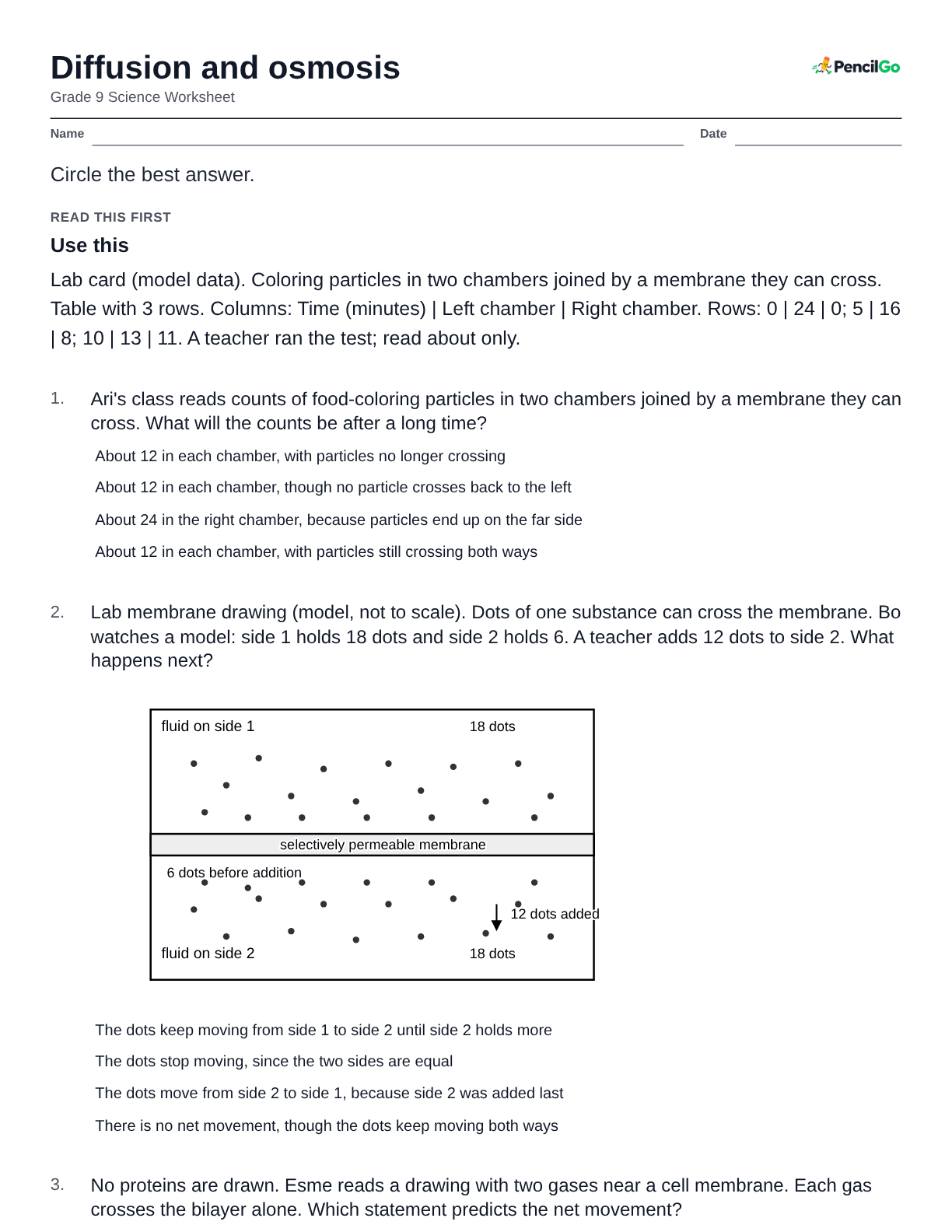
Lab drawing (model, not to scale). Zee reads about a bag of lab membrane that passes water but not starch. Which claim about water, with its reason, fits?
- Water moves into the bag, because the beaker has more free water
- Water moves out of the bag, because it moves toward the side with less starch
- Water moves into the bag, because the membrane spends energy to pull it in
- Water moves into the bag, because water molecules move in one direction