Newton's second law: calculations and data
Grade 11 Science Worksheet

Circle the best answer, or write your answer on the line.
A cart with friction has an acceleration-applied force line through (5 N, 0.5 m/s²) and (9 N, 1.5 m/s²). What is its mass, Bo?
A cart with friction has an acceleration-applied force line through (4.5 N, 0.5 m/s²) and (10.5 N, 1.5 m/s²). What is its mass, Esme?
Read this first
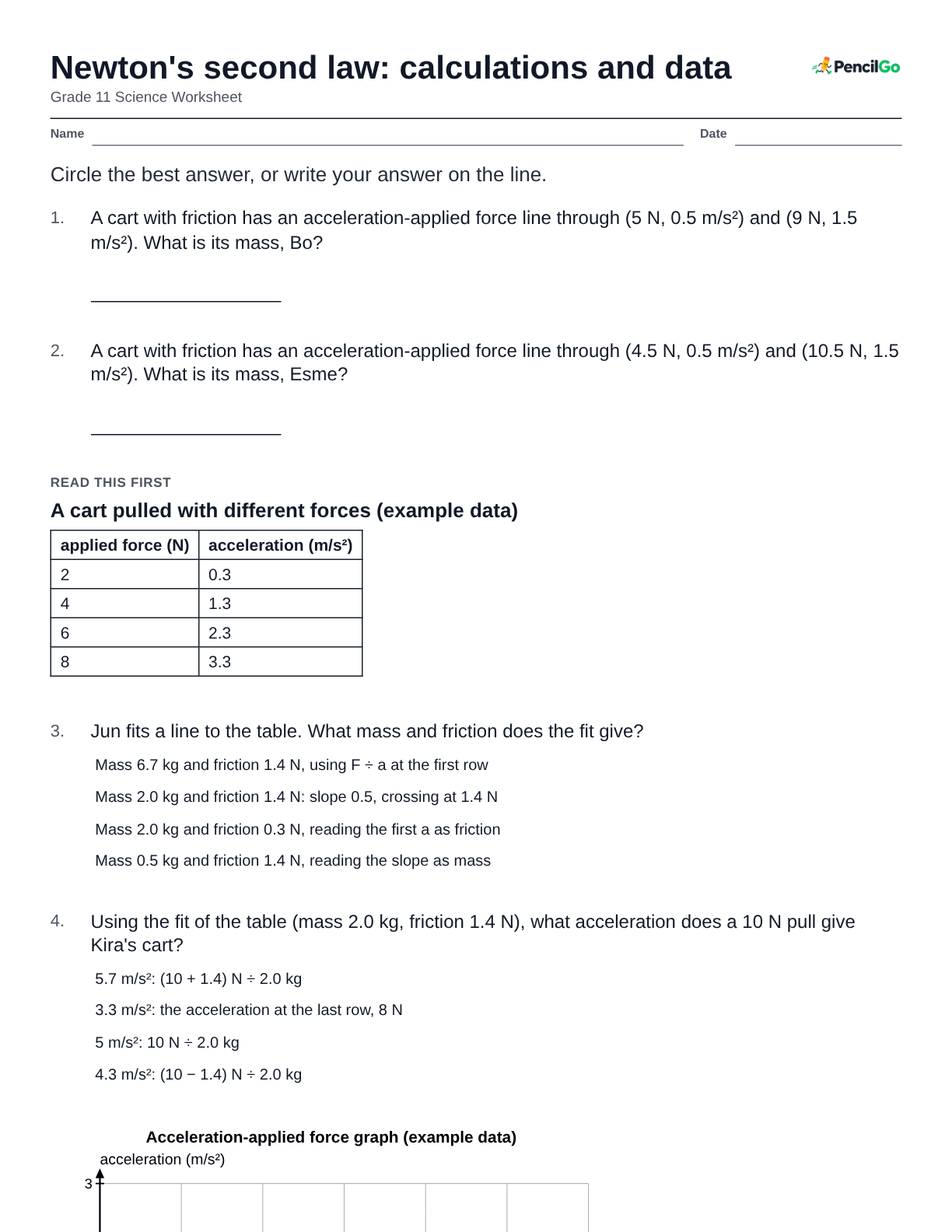
A cart pulled with different forces (example data)
applied force (N) acceleration (m/s²) 2 0.3 4 1.3 6 2.3 8 3.3 Jun fits a line to the table. What mass and friction does the fit give?
- Mass 6.7 kg and friction 1.4 N, using F ÷ a at the first row
- Mass 2.0 kg and friction 1.4 N: slope 0.5, crossing at 1.4 N
- Mass 2.0 kg and friction 0.3 N, reading the first a as friction
- Mass 0.5 kg and friction 1.4 N, reading the slope as mass
Using the fit of the table (mass 2.0 kg, friction 1.4 N), what acceleration does a 10 N pull give Kira's cart?
- 5.7 m/s²: (10 + 1.4) N ÷ 2.0 kg
- 3.3 m/s²: the acceleration at the last row, 8 N
- 5 m/s²: 10 N ÷ 2.0 kg
- 4.3 m/s²: (10 − 1.4) N ÷ 2.0 kg
Milo reads the graph. What does the crossing at 1 N on the force axis show?
- Friction of 1 N: the pull must beat it first
- The cart's mass is 1 kg, read from the crossing
- The cart weighs 1 N, as shown at the crossing
- The cart already speeds up even with no pull applied
Noah reads the graph. What is the cart's mass?
Use the picture in question 5.
- 1 kg: where the line meets the force axis
- 2 kg: 1 ÷ the slope of 0.5
- 2.5 kg: 5 N ÷ 2 m/s², ignoring the friction
- 0.5 kg: the value of the slope itself, read off the graph
Pia reads the graph. What acceleration does a 4 N applied force give?
Use the picture in question 5.
- 1.5 m/s²: (4 − 1) N ÷ 2 kg
- 2.5 m/s²: (4 + 1) N ÷ 2 kg
- 1.2 m/s²: (4 − 1) N ÷ 2.5 kg
- 2 m/s²: 4 N ÷ 2 kg, leaving friction out
A 30 N pull on a 3 kg cart tows a 2 kg cart behind it by a light rope on a smooth floor. What is the rope tension, Ren?
- 30 N, the whole pull
- 15 N, half of the pull
- 18 N: 3 kg × 6 m/s², the front cart's net force
- 12 N: the rope alone accelerates the 2 kg cart at 6 m/s²
A 3 kg mass and a 2 kg mass hang on a light string over a frictionless pulley and are released. What is their acceleration, Tala? Use g = 9.8 m/s².
- 0.98 m/s²: (3 − 2) × 9.8 ÷ 10
- 5.88 m/s²: 3 × 9.8 ÷ 5
- 1.96 m/s²: (3 − 2) × 9.8 ÷ (3 + 2)
- 4.9 m/s²: (3 − 2) × 9.8 ÷ 2
A 3 kg mass and a 2 kg mass hang on a light string over a frictionless pulley and accelerate at 1.96 m/s². What is the string tension, Zee? Use g = 9.8 m/s².
- 23.52 N: 2 × (9.8 + 1.96)
- 29.4 N, the weight of the 3 kg mass
- 24.5 N, halfway between the two weights
- 19.6 N, the weight of the 2 kg mass