
PencilGo

Grade 11 · Science · Physics

11th grade Newton's second law: calculations and data worksheet

6 printable versionsBuilding Confidence10 questions · answer keyFree · no account

Level: Building Confidence · On Level · Challenge Me

When it’s done, scan the sheet with your phone and PencilGo marks it and picks the next one. Create a free account

Version
Print

Newton's second law: calculations and data

Grade 11 Science Worksheet - Building Confidence

NameDate

Circle the best answer, or write your answer on the line.

  1. Ari rolls a 3 kg cart east. A string pulls it 30 N east, a spring pushes it 9 N west, and friction drags it 6 N west. What is its acceleration?

  2. Bo rolls a 4 kg cart east. A string pulls it 38 N east, a spring pushes it 6 N west, and friction drags it 4 N west. What is its acceleration?

  3. Esme rolls a 6 kg cart east. A string pulls it 30 N east, a spring pushes it 12 N west, and friction drags it 6 N west. What is its acceleration?

  4. Jun reads the acceleration-force graph of a cart. What is the cart's mass?

    • 2 kg: the slope is 0.5, and mass = 1 ÷ slope
    • 0.5 kg: the value of the slope itself, read off the graph
    • 3 kg: the largest acceleration on the graph
    • 6 kg: the largest force on the graph
  5. Kira reads the acceleration-force graph. The same cart gets a net force of 10 N. What acceleration does it have?

    • 18 m/s²: 8 plus 10
    • 20 m/s²: the slope of 2 times 10 N
    • 5 m/s²: 10 N divided by the slope of 2
    • 80 m/s²: 8 times 10 N
  6. Luz reads the graph of two carts pulled by the same forces. Which cart has more mass, and by what factor?

    • Cart A, because its line is steeper
    • Cart B, 4 times as massive, as its line is half as steep
    • Cart B, twice as massive: slope 0.5 against 1
    • They match, since both lines start at the origin
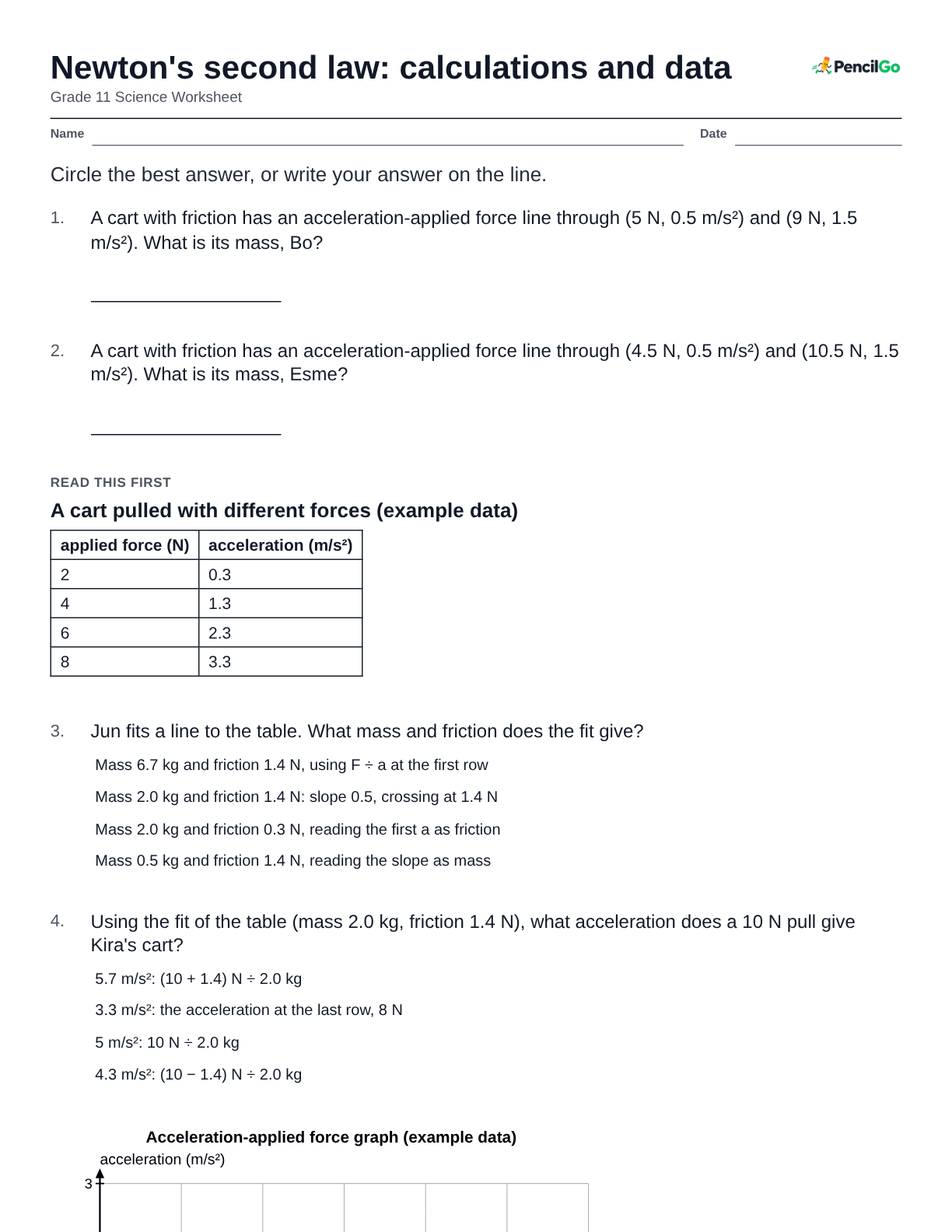
  7. Read this first

    One force on carts of different mass (example data)

    mass (kg)acceleration (m/s²)
    18
    24
    42
    81
  8. Milo reads the table of carts pulled by one force. What is that net force?

    • 15 N: 1 + 2 + 4 + 8, from the mass column
    • 8 N: mass × acceleration in every row
    • 1 N: the last acceleration
    • 3.75 N: the average acceleration
  9. Noah puts a 16 kg cart under the same force as the table. What acceleration does it get?

    • 8 m/s²: the acceleration in the first row
    • 2 m/s²: 16 kg ÷ 8 N
    • 0.25 m/s²: halving the 1 m/s² of the 8 kg row twice
    • 0.5 m/s²: 8 N ÷ 16 kg
  10. A 5 kg box on a floor is pushed 30 N east against 12 N of friction. Its weight and the floor's push are 49 N each. What is its acceleration, Ren?

    • 3.6 m/s² east: (30 − 12) ÷ 5
    • 0 m/s²: the 49 N forces cancel, so it stays still
    • 6 m/s² east: 30 ÷ 5, leaving friction out
    • 8.4 m/s² east: (30 + 12) ÷ 5
  11. A drone's cable pulls a 2 kg box up with 19.6 N. Use g = 9.8 m/s². What is the box's acceleration, Zee?

    • 9.8 m/s² down: gravity acting alone on the box
    • 19.6 m/s² up: the number of newtons of pull, in m/s²
    • 9.8 m/s² up: 19.6 N divided by the 2 kg mass
    • 0 m/s²: 19.6 N up balances 19.6 N of weight
PencilGopencilgo.com

11th grade Newton's second law: calculations and data worksheet – printable
Print: 123456

About this worksheet

Newton's second law: calculations and data. Every version has 10 questions, and the answer key prints on the second page.

What your child will learn

  • I can use F_net = ma with the net force: subtract friction, add every pull with its direction, and include weight and drag.
  • I can read an acceleration-force graph. It is a straight line through zero, and its slope is 1 ÷ m. When friction acts, the line starts at the friction force.
  • I can read a same-force, different-mass table (a ∝ 1/m), and find a mass from two data points (m = ΔF ÷ Δa) or from a table.
  • I can plan a fair cart experiment: hold the mass constant, measure and subtract friction, and use several forces.

Standard: HS-PS2-1

Words to know

net force: All forces added with their directions

F_net = ma: Net force equals mass times acceleration

slope: Rise ÷ run; here acceleration per newton, which is 1 ÷ m

inversely proportional: Double one, the other halves

controlled variable: A quantity kept the same during an experiment

Common mistakes

Your child left friction out of the net force. F = ma uses the sum of every force, with opposing forces subtracted.

Your child added all the forces. Forces that point opposite ways partly cancel, so subtract them.

Your child divided force by acceleration at one point. With friction, the line misses the origin, so the slope between two points gives the mass.

Questions parents ask

What is the most common mistake with newton's second law: calculations and data?

Your child left friction out of the net force. F = ma uses the sum of every force, with opposing forces subtracted.

Are these 11th grade science worksheets free to print?

Yes. All 6 printable versions at each level are free to print, with the answer key, and no account is needed.

More physics

See all Physics

Every sheet you scan goes into your child’s record: dated, marked and ready for the year-end portfolio. Homeschool records